dailynewsnblog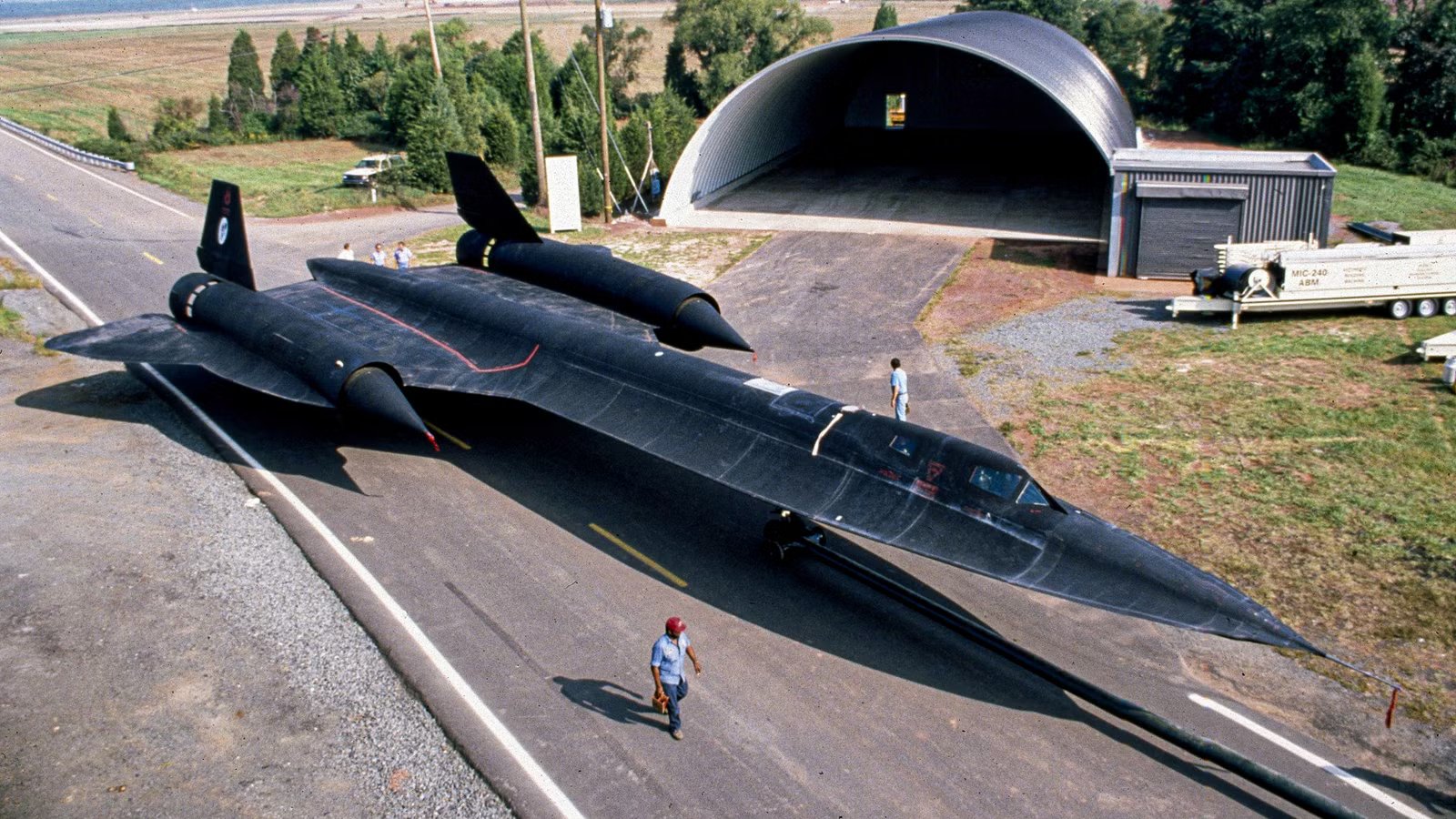
The Lockheed SR-71 Blackbird remains one of the most remarkable aircraft ever produced in limited numbers, with just 32 airframes built, yet its operational legacy hinges not only on titanium airframes and Pratt & Whitney J58 turbojets, but on an unglamorous starter cart packed with Detroit iron. This article unpacks the engineering logic behind that decision, how the AG330 start cart worked in precise mechanical detail, what happened during a successful start, and what went wrong when things didn’t go according to plan.
Using technical documentation, historical accounts, and operational details from former SR-71 support procedures, this article examines how the AG330 start cart worked, why Buick V8 engines were chosen for the role, and what made the Blackbird’s engine-start sequence so demanding. The article also explores the chemistry behind J58 ignition, the operational risks crews faced during launches, and how one of the Cold War’s most advanced aircraft depended on an unexpectedly mechanical solution on the ground.
The Weight-Saving Decision That Made An External Starter Necessary

The SR-71 was conceived by Lockheed’s Skunk Works division under the direction of Clarence “Kelly” Johnson, one of the most consequential aeronautical engineers of the twentieth century. Operating at speeds exceeding Mach 3.2 and altitudes above 85,000 feet (25,900 meters), the Blackbird was pushed to the absolute limits of materials science and thermodynamics. Every pound of unnecessary weight was a pound that demanded more fuel, reduced range, and complicated the aircraft’s already punishing heat management requirements.
According to The Aviation Geek Club, Johnson’s team made a deliberate design decision: the SR-71 would carry no onboard starter system whatsoever. The saving in weight and fuel capacity was considered more valuable than the convenience of self-starting.
That decision had an immediate operational consequence. The Pratt & Whitney J58, a truly unique engine designed for continuous afterburner operation above Mach 3, and one of the few turbojets ever built for sustained high-supersonic cruise, is a physically massive machine. Each unit weighs approximately 6,500 lb (2,948 kg) and contains compressor stages that, at rest, require enormous external torque to be brought up to a speed at which fuel ignition becomes viable. A conventional pneumatic or electric starter small enough to fit inside the airframe simply could not have generated the force required. Something far more powerful and far heavier would be needed. Since that weight couldn’t be carried in the aircraft, it had to wait on the ground.
The solution that emerged from two Lockheed Skunk Works engineers with a background in race car engines was as elegantly unconventional as the aircraft it served. Rather than developing an entirely new purpose-built powerplant for the starting role, the team reached for something already refined by American automotive engineering: the Buick 401-cubic-inch (6.6-liter) “Nailhead” V8. With 325 horsepower and 445 lb-ft (603 N·m) of torque per unit, and with two of them linked together, the math worked. The result was the AG330 start cart.
Inside The AG330: How Two Buick V8s Were Turned Into A Jet Starter

The AG330 was a compact, low-slung yellow cart (later repainted green) that, at first glance, could be mistaken for industrial support equipment found at any busy airport. What it contained, however, was anything but ordinary. According to The SR-71 Blackbird fan website, two Buick Wildcat V8 engines were mounted side by side inside the cart, each paired with a Hydra-Matic automatic transmission with electric shift. The two transmissions were then coupled together using a 12-inch(30.5 cm)-wide toothed Gilmer belt — a reinforced, high-grip power transmission belt typically found in industrial machinery and high-performance automotive applications.
This linked drivetrain fed power into a gearbox that turned the output 90 degrees vertically, driving a probe that extended out the top of the cart. The probe was designed to mate with a splined starter receptacle located on the underside of each J58 nacelle. Positioning was everything: the probe head could gimbal roughly a quarter to half an inch (6–13 mm) in any direction to accommodate minor misalignment, and three microswitches had to close simultaneously before the system was considered armed.
The control panel on the AG330 consisted of a dense bank of gauges, warning lights, toggle switches, and a single Morse throttle controlling both engines simultaneously. The panel monitored water temperature, oil pressure, oil temperature, torque output, jet speed, amperage, and gearbox chip detection, among other parameters. The Hobbs meter on one surviving example shows 408.5 hours of accumulated Buick run time.
Here are the key technical specifications of the AG330 start cart system, as documented by the National Museum of the United States Air Force and The SR-71 Blackbird:
- Engines: Two Buick 401 cubic inches (6.6 L) “Nailhead” V8s, 325 hp (242 kW) each, 650 hp (485 kW) combined
- Transmissions: Two Hydra-Matic automatic units with electric shift, coupled via 12 inches (30.5 cm) Gilmer belt
- Output direction: 90-degree gearbox turning drive vertical to mate with the J58 starter pad
- Target J58 ignition speed: 3,200 RPM
- Required Buick operating RPM: 4,500–4,900 RPM during start sequence
- Required torque output: 700–725 lb-ft (949–983 N·m), sustained throughout the starting procedure
- TEB injection volume: 30 cc per ignition event
- Exhaust configuration: Eight straight-piped exhaust outlets per engine (16 total), producing visible flames up to 3 feet (0.9 meters) in length
One cart was positioned beneath each of the SR-71’s two J58 engines, meaning a complete two-engine start required two AG330 carts operating in sequence. The first engine was started, stabilized at idle, and then the process was repeated for the second. There was no shortcut. Every Blackbird departure, regardless of urgency, required these elaborate pre-flight procedures before a single gallon of JP-7 began burning at altitude.

The SR-71 Blackbird’s Final Flight Set 4 Speed Records In Just 64 Minutes
The final day that the legendary jet streaked through America’s skies.
TEB, Torque, And The Precise Chemistry Of J58 Ignition

Getting the J58’s turbine spinning was only part of the problem. The engine’s primary fuel, JP-7, was specifically formulated to be extraordinarily difficult to ignite — a deliberate safety feature given that the Blackbird’s fuel tanks routinely reached operating temperatures above 350°F (177°C) during Mach 3 cruise. At rest on the ground, JP-7 simply would not light from a conventional spark igniter.
To bridge the ignition gap, the SR-71 program adopted triethylborane, a chemical compound better known by its acronym TEB, as its ignition agent. TEB ignites spontaneously on contact with atmospheric oxygen at room temperature, which chemists call pyrophoric, producing a distinctive green flash visible even in daylight. Pilots and ground crews learned to watch for it as confirmation that the J58 had lit off.
The starting sequence as described by The SR-71 Blackbird unfolded in strict order. With the Buicks running and warm in neutral, the probe engaged and confirmed armed, the pilot radioed the crew chief: “Engage Buicks.” The cart operator advanced the single throttle downward, engaging both transmissions simultaneously. As the Buicks loaded up, the operator’s primary job was to monitor the torque gauge and hold output between 700 and 725 lb-ft (949–983 N·m). Too much torque and the probe would drop out, leaving a partially spinning J58 at risk of over-temperature. Too little and the acceleration to ignition speed would lag, creating the same over-temperature risk from a different direction. Once the J58 reached 3,200 RPM, the pilot confirmed satisfactory oil pressure, fuel pressure, and rising tachometer, set the throttle to idle, and triggered a 30 cc shot of TEB into the engine‘s burner cans. The characteristic green flash followed, the jet lit, and the accelerating J58 began to unload the Buicks.
At exactly 3,200 RPM, or the moment the pilot called “Buicks out”, the crew chief signaled the cart operator to hit “Cart Shutdown.” The probe fell free passively, the throttle returned to idle automatically, and the AG330 was repositioned for the second engine. The entire sequence, from “Engage Buicks” to a stabilized J58 idle at 3,950 RPM, took only a few intense minutes. But those minutes demanded precision from every person involved, and the consequences of a misstep were measured in damaged engines, fire risk, and, in the worst case, an airframe that couldn’t fly.
Redline: What Happened When The Probe Hung Up

Neither the J58, the AG330’s probe, nor the transmission system incorporated an overrunning clutch — the standard safety mechanism that allows a driving component to freewheel when the driven component accelerates past it. The design required the probe to fall free the moment the “Cart Shutdown” command was executed. When it failed to do so, the consequences escalated rapidly. According to Hagerty Media, aircraft engine historian Tom Fey described the scenario precisely: “Overspeeding of the Buicks caused by a probe hang-up contributed to the occasional thrown connecting rod and oily parts dropping out from under the cart.”
The math explains why. Idle speed for the J58 is 3,950 RPM, already beyond the 3,200 RPM ignition target. If the probe remained connected as the jet engine accelerated toward idle, the J58 would begin driving the Buicks through the gearbox rather than the other way around. The Buicks, designed to operate comfortably between 4,500 and 4,900 RPM during the start sequence, would be driven past 6,000 RPM as the J58 sought its own idle. The redline on the AG330 start cart was 4,800–4,900 RPM.
Anything beyond that was borrowed time — and the Buick Nailhead, for all its torque characteristics as a low-revving American V8, was never engineered to sustain those speeds. The result, when the probe hung up, was occasionally spectacular: connecting rods punched through engine blocks, and oily mechanical fragments dropped onto the tarmac beneath the cart.
The procedure when a probe hang-up occurred was urgently physical: crew members had to sprint to the cart and shake the probe handles as hard and fast as possible to free the connection before catastrophic overspeed destroyed the V8. The Buick exhaust stream, shooting three-foot (0.9 meters) flames horizontally from the sides of the cart at high RPM, meant that crew positioning mattered enormously. Ground teams were trained to stand only at the ends of the AG330, never alongside it, precisely to stay clear of the exhaust and debris path. The potential for a Buick failure created a hazard zone around the entire start operation, reinforcing the need for strict crew discipline at every launch.

This Is How Fast The SR-71 Blackbird Could Fly
The incredible power of the fastest jet in the USAF.
Operational Reality: The Sights, Sounds, And Stakes Of A Blackbird Launch

For anyone who witnessed an SR-71 engine start for the first time, the sensory experience was unforgettable. The Buick V8s ran with no mufflers, no exhaust silencers, and no acoustic treatment of any kind. As the single throttle lever advanced and both transmissions engaged, the engine’s RPM climbed steadily from idle toward the 4,500–4,900 RPM range needed to spool the J58 to ignition speed. The AG330’s 16 straight-pipe exhausts, with eight per engine, produced a wall of sound and light that eyewitnesses consistently compared to the start of the Indianapolis 500. According to The SR-71 Blackbird, the spectacle of twin V8s firing at near-peak RPM while three-foot flames erupted from the sides of a low yellow cart, positioned beneath the wing of what was already the most futuristic aircraft on Earth, was “almost indescribable.”
At Cold War deployment sites such as Beale Air Force Base, Kadena Air Base, and RAF Mildenhall, SR-71 launches were anything but routine. Many Cold War-era aircraft programs that pushed engineering to its limits ultimately paid hidden operational costs, and the SR-71 was no exception: each start required a dedicated AG330 cart and a trained crew for every engine, meaning a full two-engine departure tied up substantial ground support resources before the aircraft even reached the runway.
The operational tempo at forward operating locations was further constrained by the carts’ own maintenance demands. The Buick engines needed to be started, warmed up, and checked before each use, and the gearbox chip detector was a constant source of scrutiny.
The proximity of the exhaust flames to the aircraft itself, combined with the possibility of a mechanical failure during a hang-up scenario, meant that while the ground crew worked on the AG330, the pilot was simultaneously monitoring cockpit gauges for any sign of over-temperature or oil pressure anomaly. The intercom link between pilot and crew chief was the nervous system for the entire operation. A single mistimed call, like “Buicks out” a few seconds late, or a “Cut” command that didn’t reach the cart operator in time, could cascade into a damaged J58 that grounded the aircraft for days. Given that the SR-71’s primary mission was time-sensitive strategic reconnaissance, those days mattered.
From Nailheads To 454s: The Evolution And End Of The Start Cart Era

The original Buick 401 cubic inches (6.6 L) Nailhead V8 served the AG330 fleet from the SR-71’s introduction into USAF service in January 1966 through the mid-1970s. By that point, Buick had discontinued the Nailhead engine, and sourcing parts for the growing number of AG330 carts in service was becoming progressively harder. The replacement was another Detroit big-block: the Chevrolet LS7 454 cubic inches (7.4 L) V8, which produced 465 hp (347 kW) per unit, notably more than each Nailhead.
According to The SR-71 Blackbird fan site, the Chevrolet 454s were installed in the mid-1970s and remained in service for roughly a decade. Veterans who worked the AG330s during both eras sometimes remembered the 454s less fondly — one former ground crew member recalled that the transition away from the Nailheads was, for him, effectively the end of an era he didn’t want to leave.
The Chevrolet era ended in the early 1980s, when the AG330 start carts were retired altogether and replaced by a pneumatic air starting system engineered and installed by Garrett AiResearch.
Fixed pneumatic starters were built into dedicated hangars at Beale Air Force Base, and while the system was considerably quieter, considerably easier to maneuver around in confined spaces, and far more practical for forward-deployed recovery operations at unfamiliar bases, it was also, by any honest measure, considerably less dramatic. The AG330 required trained operators, precise maintenance expertise, and a certain dangerous spectacle during the best days. A pneumatic line required none of that. Logistics won, as it almost always does.
The few surviving AG330 start carts, including one on display at the National Museum of the United States Air Force at Wright Patterson Air Force Base, Ohio, stand today as artifacts of a deeply unconventional engineering chain: an American muscle-car engine, designed for road-going sedans, serving as the ignition key for the fastest military aircraft ever flown. The Hobbs meter on that surviving cart, still reading 408.5 hours of accumulated Buick run time, is a quiet record of dozens of missions that began not with the roar of a Pratt & Whitney J58, but with the very American sound of a Wildcat V8 clearing its throat on a cold tarmac, ready to wake up something much faster than itself.