dailynewsnblog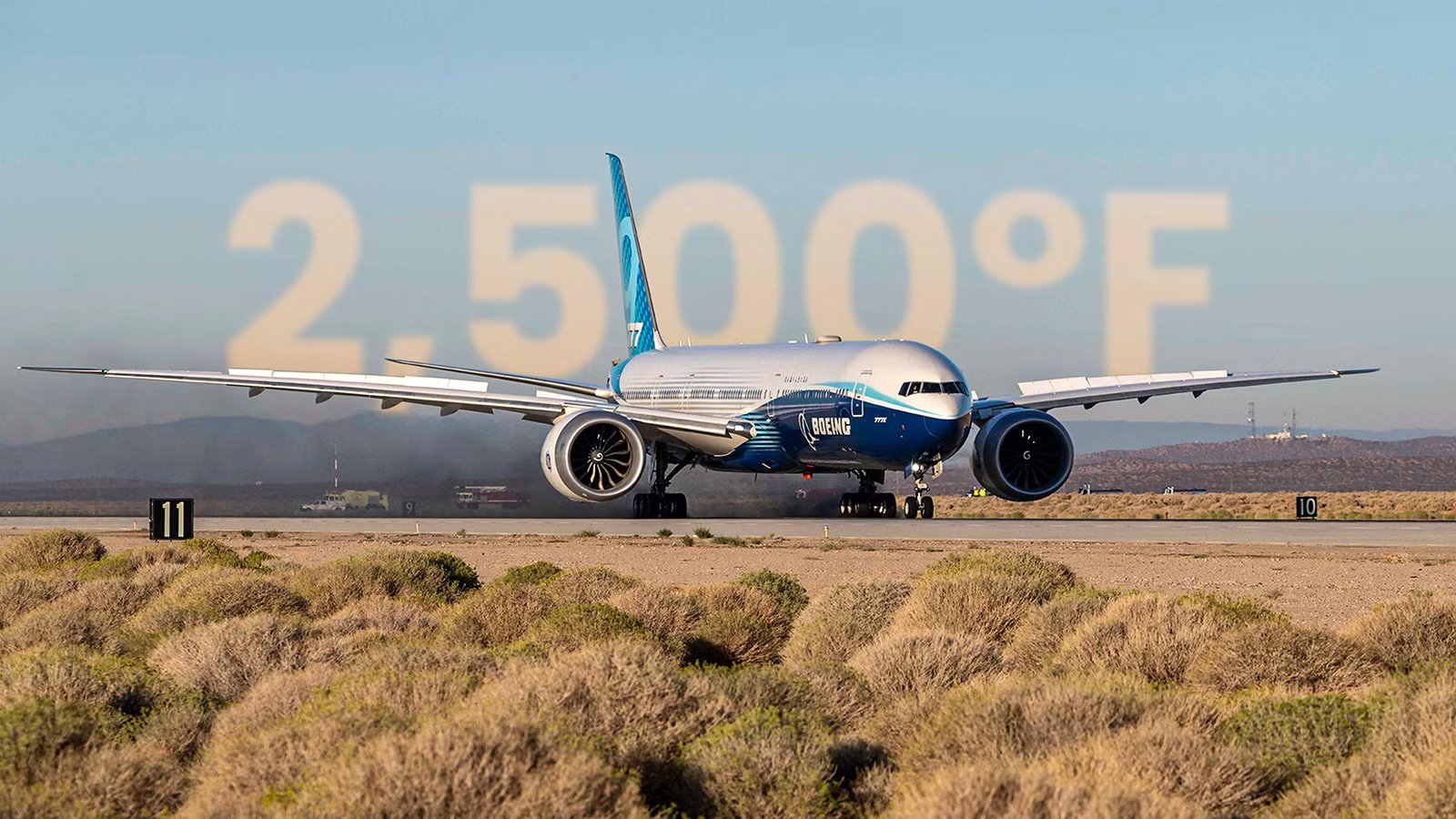
Most coverage of the Boeing 777X program focuses on production delays, certification setbacks, folding wingtips, or premium cabin concepts. Yet one of the most punishing tests in the entire certification campaign happens far from airshow crowds and marketing presentations. It takes place on a desert runway with an aircraft traveling at near takeoff speed, carrying enormous kinetic energy, before the crew deliberately slams the aircraft to a halt using brakes that have already been worn nearly to their operational limit.
That is exactly what  Boeing recently demonstrated with the Boeing 777-9 during maximum brake energy testing at Edwards Air Force Base. The aircraft accelerated to roughly 190 knots at maximum takeoff weight before executing a rejected takeoff with no reverse thrust assistance. The brakes, supplied by Safran, absorbed several hundred megajoules of energy while temperatures climbed beyond 2,500°F, or approximately 1,370°C.
The test illustrated a central reality of commercial aviation certification. A modern widebody airliner is not approved because it performs well under normal conditions. It earns certification because it can survive the most extreme failures and edge-case scenarios regulators can reasonably anticipate. For the 777-9, one of those scenarios involves stopping a fully loaded aircraft at high speed after a rejected takeoff, entirely on brake energy absorption, while using heavily worn brakes that are operating at temperatures hotter than molten lava.
Why Maximum Brake Energy Testing Matters

Large commercial aircraft generate astonishing amounts of kinetic energy during takeoff. A fully loaded 777-9 weighs hundreds of thousands of pounds and accelerates to high speeds before rotation. If a critical malfunction occurs before liftoff, pilots may have to reject the takeoff and stop the aircraft on the runway. That decision creates one of the harshest operating conditions an aircraft braking system will ever encounter. The brakes must absorb virtually all the aircraft’s kinetic energy and convert it into heat within seconds. If the system cannot manage the thermal load, catastrophic consequences can follow, including wheel failures, brake fires, tire explosions, or runway overruns.
The FAA addresses this risk through regulations under 14 CFR § 25.735, which governs brake and antiskid systems for transport-category aircraft. Among the requirements is the Maximum Kinetic-Energy Accelerate-Stop test, often considered one of the defining certification hurdles for heavy jets. Regulators require manufacturers to prove that the aircraft can safely stop under worst-case conditions using only brakes worn to their allowable operational limit. The logic behind the requirement is straightforward: airlines do not operate aircraft only with factory-fresh components. Brakes accumulate wear throughout service life, and certification standards must account for realistic operational conditions. Testing a pristine braking system would provide an incomplete and potentially misleading assessment of safety margins.
For the 777-9, Boeing and Safran conducted the test with fully worn brakes machined down to 100% wear condition. Reverse thrust was intentionally excluded from the stopping procedure to ensure the brakes alone absorbed the full stopping load. This represented a highly conservative scenario designed to validate the aircraft under the most demanding circumstances that regulators could require. Such testing also reflects a broader philosophy within transport aircraft certification where modern airliners are engineered around layered redundancy and worst-case assumptions. Certification authorities expect manufacturers to demonstrate not merely adequate performance, but survivability after failures, degraded systems, and abnormal operating conditions.
The Physics Behind A 190-Knot Rejected Takeoff

Shutterstock | Simple Flying
To understand why brake temperatures climbed so high, it is necessary to examine the immense physical forces involved in stopping a heavy widebody aircraft at near takeoff speed. Kinetic energy increases exponentially with velocity. Specifically, it scales according to the square of speed. That means a relatively small increase in takeoff velocity produces a dramatically larger increase in energy that must be dissipated during braking. In the case of the 777-9, Boeing accelerated the aircraft to approximately 190 knots while operating at maximum takeoff weight. The resulting energy load reached several hundred megajoules, according to reporting on the test campaign. Safran stated the braking event also generated more than a billion foot-pounds of torque.
|
Simple Total Kinetic Energy Estimate at Rejection Point |
||
|---|---|---|
|
Parameter |
Listed Value |
Metric Value |
|
Mass |
775,000 pounds |
351,354 kilograms |
|
Velocity |
190 knots |
97.74 meters per second |
|
Total Kinetic Energy |
1678.41 megajoules |
|
All of that energy had to go somewhere. During a rejected takeoff, aircraft brakes convert kinetic energy into thermal energy through friction. The process happens extremely quickly, creating intense localized heat concentrations within brake discs and surrounding wheel assemblies. Temperatures achieved during the 777-9 test exceeded 2,500°F. For perspective, aluminum melts at approximately 1,220°F (660°C). Even many high-performance industrial alloys begin losing structural integrity well below the temperatures encountered during this certification event. Aircraft brakes, therefore, require highly specialized materials capable of tolerating repeated thermal cycling without deformation, cracking, or catastrophic failure. The thermal challenge becomes even more severe because the braking system must remain structurally intact long enough to allow passenger evacuation if necessary.
An additional complication involves heat transfer into adjacent components. Aircraft tires contain nitrogen under high pressure. Excessive wheel temperatures can raise internal tire pressure to dangerous levels, potentially resulting in explosions. Certification standards, therefore, require not only successful stopping performance, but also controlled thermal behavior after the aircraft comes to rest. The rejected takeoff test is essentially a controlled exercise in thermal management under extreme mechanical stress. Every component involved, from brake discs to wheel structures and hydraulic systems, must continue functioning within acceptable safety margins.
Is It True That The Boeing 777X Doesn’t Need Reverse Thrust To Come To A Full Stop?
Boeing’s 777X can stop without reverse thrust, but proving it is brutally complex.
How Safran Engineered The 777X Brake System

The Safran braking system used on the 777X reflects decades of development in carbon brake technology for large commercial aircraft. Safran’s design incorporates several advanced engineering features intended to improve thermal performance, durability, and weight efficiency. At the center of the system are carbon brake discs rather than traditional steel brakes. Carbon composites offer major advantages for heavy transport aircraft because they tolerate much higher operating temperatures while also reducing overall system weight.
Safran’s 777X brake package includes a titanium torque tube and clipless stators. The company also integrated oxidation-protection technology intended to improve service life and reliability under repeated high-temperature cycles. Titanium plays an important role because it combines high strength with lower weight and strong heat resistance. The torque tube transfers braking forces throughout the assembly, making structural integrity critical during severe braking events. Meanwhile, the clipless stator architecture simplifies portions of the brake assembly while helping manage stresses generated during thermal expansion.
Carbon brakes differ substantially from automotive braking systems familiar to most travelers. In passenger vehicles, repeated hard braking can quickly produce brake fade as temperatures rise. Commercial aircraft systems are designed for far more extreme energy absorption requirements. One reason carbon brakes are preferred on large jets is their ability to maintain friction characteristics at elevated temperatures. In some operating conditions, carbon brakes actually perform more effectively after heating. They also dissipate heat more efficiently and generally last longer than steel alternatives in airline service. The oxidation-protection system is equally important. Carbon materials exposed to oxygen at extreme temperatures can degrade over time. Protective coatings and treatments help preserve structural integrity and extend usable life despite repeated exposure to severe thermal environments.
Reverse Thrust Was Intentionally Excluded

Reverse thrust is an important operational tool for airlines because it reduces brake wear and shortens stopping distances during routine operations. However, regulators cannot assume reverse thrust will always be available during an emergency. An engine failure, deployment malfunction, hydraulic issue, or procedural limitation could prevent reverse thrust from contributing effectively during a rejected takeoff. Certification standards, therefore, require the braking system itself to demonstrate adequate stopping capability independent of thrust reversers.
By excluding reverse thrust entirely, Boeing forced the brakes to absorb the complete kinetic load. That approach produced the most severe thermal scenario possible within the test envelope. Aircraft systems must tolerate failures gracefully without depending excessively on secondary features that may not always function as intended.
This conservative approach also explains why the brakes were tested in fully worn condition rather than in a near-new status. FAA certification does not evaluate ideal operating scenarios. It evaluates combinations of worst-case variables that could plausibly occur in service simultaneously. For airlines, this capability translates directly into operational safety margins. Pilots making a high-speed reject decision must trust that the aircraft can stop reliably even under degraded conditions. Certification testing exists to validate that confidence before passengers ever board the aircraft.
How The GE9X’s 134-Inch Fan Creates Problems No Other Jet Engine Faces
The engine is set to launch on the Boeing 777X in 2027.
Where The Brake Test Fits Into FAA Certification

Certification of a modern widebody jet involves thousands of individual compliance activities covering structures, avionics, propulsion, flight controls, evacuation procedures, systems redundancy, environmental performance, and operational safety. Manufacturers must generate extensive evidence proving compliance with regulatory standards before a type certificate can be issued. According to analysis from Leeham News, the 777X program is currently operating within the implementation phase of FAA Part 25 certification. This phase focuses on generating and substantiating compliance data through testing, analysis, and validation activities.
In practical terms, implementation means engineers are no longer discussing theoretical compliance methods. They are physically demonstrating that the aircraft satisfies regulatory requirements under real-world conditions. Computer models can estimate thermal loads and structural responses, but regulators still require physical demonstration for critical safety systems. The 777X program has faced years of delays caused by certification scrutiny, manufacturing disruptions, and broader industry challenges following the 737 MAX crisis. Regulators have adopted a far more rigorous oversight posture toward aircraft certification programs, increasing the importance of demonstrable compliance milestones.
Successfully completing maximum brake energy testing, therefore, represents both a technical and regulatory achievement. It indicates progress toward resolving one of the remaining supplier-level certification hurdles before the aircraft can enter commercial service. For passengers, these procedures remain largely invisible. Yet such testing forms the foundation of commercial aviation safety.
In Summary

The maximum brake energy test was far more than a dramatic engineering exercise. It represented a critical demonstration of compliance with one of the FAA’s toughest transport-aircraft certification requirements. Boeing and Safran recreated one of the harshest scenarios imaginable in airline operations, as aircraft certification is fundamentally about surviving edge cases, not merely performing efficiently during routine flights.
Completing the brake energy campaign marked an important milestone for the 777-9 as Boeing works toward eventual entry into service. Most importantly, the test demonstrated the depth of engineering hidden beneath everyday airline operations. Thus, ensuring that a massive long-range aircraft can safely halt from near takeoff speed under worst-case conditions requires exhaustive validation. Before the 777-9 can carry travelers across oceans, it first had to prove it could survive one of the most violent stopping events in commercial aviation.