dailynewsnblog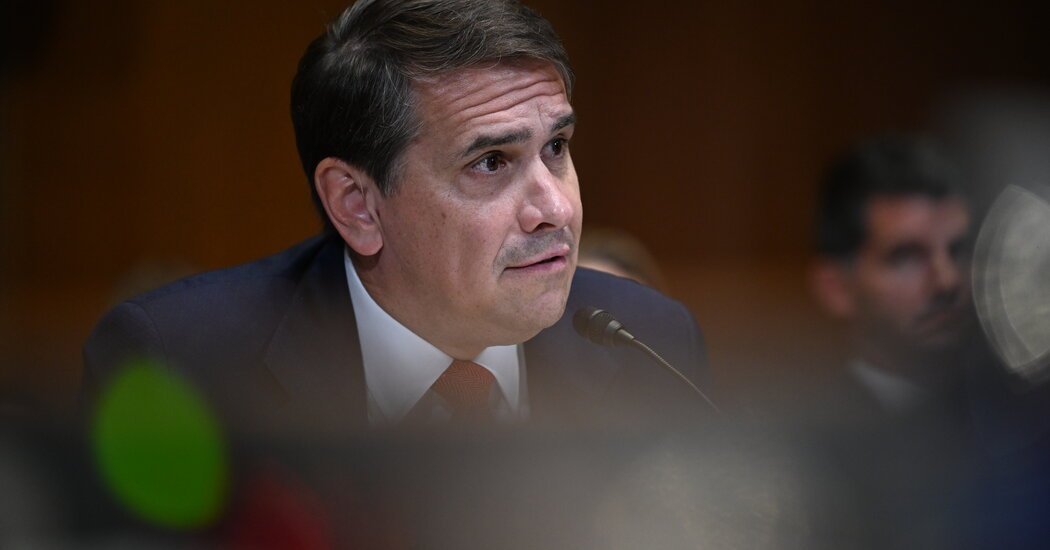
Todd Blanche, the acting attorney general, has tried to tread an ever-narrowing path between his role as a top Justice Department official and the job that got him there in the first place — as President Trump’s doggedly loyal former lead defense lawyer.
Allies of Mr. Blanche thought he could achieve two seemingly irreconcilable goals when he was elevated to temporarily replace Pam Bondi after her ouster in April: restoring stability and competence to the department and taking a handful of actions that were sufficiently drastic to convince the boss he was tough enough to make his title permanent.
So far, however, Mr. Blanche has exhibited few of the modest moderating tendencies he exhibited during more than a year as Ms. Bondi’s top deputy. Under Mr. Blanche, the pace of investigations against Mr. Trump’s perceived enemies has accelerated — most strikingly, the indictment of the former F.B.I. director, James B. Comey, for posting on social media an image of seashells that prosecutors cast as threatening. Mr. Blanche has used his new perch to boost debunked election conspiracy theories promoted by the president.
But the moves that most starkly illustrated Mr. Blanche’s evolving approach came this week. In announcing on Monday a $1.8 billion fund that would benefit those who claim they were targeted by the federal government, he effectively forged a pipeline to funnel taxpayer money to Trump allies, among them supporters who ransacked the Capitol on Jan. 6, 2021. “The machinery of government should never be weaponized against any American, and it is this department’s intention to make right the wrongs that were previously done while ensuring this never happens again,” Mr. Blanche said in a statement.
It was instantly labeled a “slush fund” by Democrats. The head of one prominent good-government group described the plan as “one of the single most corrupt acts in American history.”
Then came a stealthy stunner. The department inserted a supplement to the fund agreement that granted Mr. Trump, his family and their businesses immunity from ongoing inquiries into their taxes, an extraordinary move that could shield the president from significant financial liability — issued under Mr. Blanche’s signature.
But while Mr. Blanche’s name is on the documents, and he has defended the actions as lawful and necessary, his precise role in formulating these policies remains unclear.
During an interview with CNN on Wednesday, he suggested that Mr. Trump’s “outside counsel” and department lawyers, but “not me,” had been involved in drafting the settlement, including the provision shielding the president from I.R.S. scrutiny.
The fund proposal has been under broad consideration for months, although not necessarily linked to the I.R.S. case. Some far-right Trump supporters, including the department’s pardon attorney, Ed Martin, have been pushing the idea of providing compensation for legal bills and other expenses, according to current and former officials, speaking on the condition of anonymity to describe private conversations.
It remains unclear if the fund, which is likely to draw a rush of applications, can withstand legal and political challenges.
Mr. Blanche and his team have provided few details about its operation. Most importantly, it is unclear how they would define weaponization when many of those targeted for investigation were either involved in potential offenses, had evidence needed to pursue legitimate inquiries or were convicted by juries and judges for crimes that were exhaustively documented by witnesses and visual evidence.
During an appearance before a Senate subcommittee on Tuesday, Mr. Blanche would not commit to narrowing the criteria for applicants to exclude people who had violently attacked law enforcement, Mr. Trump’s political donors or even those who had committed crimes after being pardoned.
He said he would appoint five commissioners who would make all the major decisions, that Mr. Trump would have authority to fire them, vowed to appoint one member after consulting Congress — but refused to commit to including even a single Democrat.
On Wednesday, Mr. Blanche tweaked his answer about criteria, telling CNN that the commissioners would take applicants’ conduct into account when evaluating their claims.
The department’s outline of the fund was vague enough to elicit negative comments on Tuesday from some senior Republicans, including Senator John Thune of South Dakota, the majority leader, who said he was “not a big fan of the idea.”
He might have good reason. Republicans, who often hammer Democrats for permissive attitudes toward criminals, will now be tied to a policy that goes beyond lenience to the lining of pockets. Former prosecutors recoiled at the prospect of the government rewarding those it had convicted of crimes, rewriting history and undermining the rule of law.
“Just because we are going to compensate people who believe in the Tooth Fairy doesn’t mean that there is a Tooth Fairy,” said Leo Wise, who secured two criminal convictions against former President Joseph R. Biden Jr.’s son Hunter Biden, who Vice President JD Vance suggested would also be eligible.
“This is all based on a lie,” he added. “This wasn’t weaponization. It is a false premise.”
(Mr. Biden has said he will not apply to the fund.)
Thus far, Mr. Blanche has not found any of Mr. Trump’s directives or requests sufficiently objectionable to offer his public defiance or resignation, as William P. Barr, an attorney general in Mr. Trump’s first term, did to protest the president’s effort to overturn the 2020 election.
But Mr. Blanche has earned a reputation within the department as among the most conventional of Mr. Trump’s political appointees, at times seeking to counter moves, including some pushed by the White House, that he viewed as being unsupported by evidence or the law.
The most notable example came last fall, when Mr. Blanche told White House officials that there was not enough evidence to indict Letitia James, the New York attorney general, on mortgage-related charges in Virginia. He was overruled. He also opposed the hasty appointment of Lindsey Halligan to lead the prosecutions of Ms. James and Mr. Comey. A judge later ruled she had been illegally appointed and threw out both cases.
Mr. Blanche also cautioned senior administration officials against immediately ordering the arrest of Mr. Comey after his seashell post on social media, urging them to allow an investigation of the episode to proceed, according to two people familiar with the situation.
Stylistically, Mr. Blanche projects a more measured and respectful image that belies his increasingly hard-line approach intended to please Mr. Trump.
He did not come to Capitol Hill on Tuesday armed with insults like Ms. Bondi, nor did he employ the shout-downs that Kash Patel, the F.B.I. director, used to overwhelm Democratic lawmakers who questioned his partying habits at a recent hearing.
The acting attorney general, appearing at a subcommittee hearing, calmly parried hostile questions about the $1.776 billion fund. But his brow furrowed when he was asked to confront a core question by Senator Chris Van Hollen, a Democrat from Maryland.
Was he acting in the public interest, or as Mr. Trump’s hired gun?
“The fact that I used to be President Trump’s lawyer, is just a fact, but I’m the acting attorney general!” said an agitated Mr. Blanche, the former head of the president’s criminal defense team. “So don’t say the president’s former personal lawyer will do something — the acting attorney general will do something.”
Mr. Van Hollen cut him off.
“You are acting today like the president’s personal attorney, and that’s the whole problem,” he said.