(Bloomberg) — The emerging-market carry trade has bounced back from its Iran war losses as surging crude oil prices reinforce expectations that interest rates will stay elevated and bolster the currencies of commodity exporters.
Most Read from Bloomberg
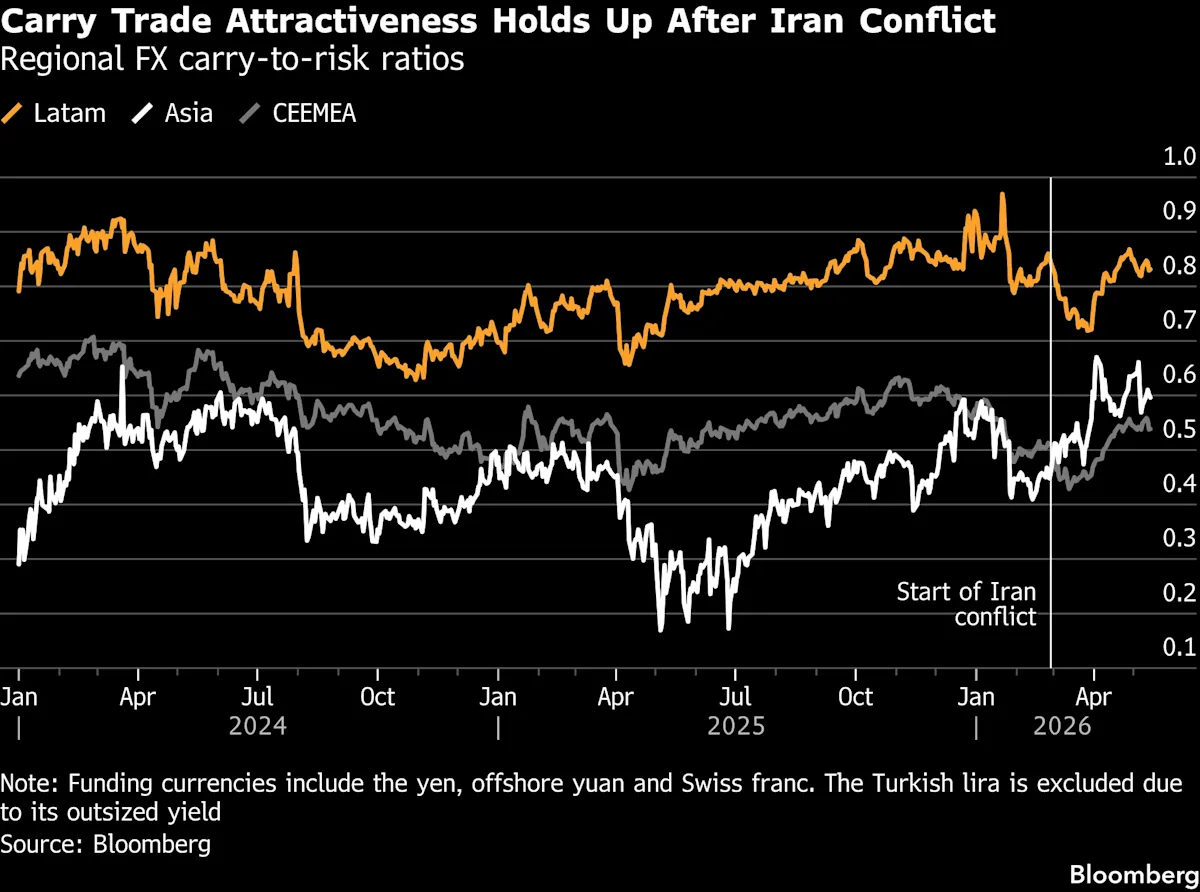
An index tracking this trading strategy has jumped around 2.6% from its March low, and gained about 1.2% since the conflict began in late February. The gauge approximates the carry trade by measuring returns from borrowing in three low-yielding currencies — namely the yen, Swiss franc and Chinese yuan — and investing in eight higher-yielding emerging market ones, including the Brazilian real and South African rand.
The rally in oil due to the Middle East conflict is proving a double-edged sword for emerging markets. While it initially caused a flight to safety away from the sector, the last month has seen investors return to growth-oriented assets. The rise in crude prices has also boosted bets that central banks will tighten monetary policy aggressively to rein in consumer prices, ensuring real rates — nominal rates adjusted for inflation — remain attractive.
“The EM carry trade will be buoyed by higher-for-longer real rates to combat incipient inflationary expectations,” said Jason Devito, a senior portfolio manager for emerging market debt at Federated Hermes Inc. in Pittsburgh. “While there are winners and losers within EM from higher oil prices, the losers are better prepared than ever, while the winners, such as Brazil for example, are supported by central bank credibility amid a backdrop of high real rates.”
Traders have been increasing their bets that elevated oil prices will keep inflation and policy rates high across developing nations. The average of 12-month interest-rate swaps from 14 emerging-market economies has risen to 5.7% from 5% before the Iran conflict began, according to data compiled by Bloomberg.
The rebound in the carry trade has also been helped by relatively subdued currency volatility. A gauge of one-month EM foreign-exchange volatility is currently 7%, down from as high as 9.23% in the middle of March, according to a JPMorgan Chase & Co. index. Lower volatility supports the carry trade by minimizing the risk that exchange-rate fluctuations will erase profits from interest-rate differentials.
Some individual trades have delivered stellar returns. A strategy of borrowing in the Swiss franc and investing in the Brazilian real since the end of February returned 6.65%, while funding in the yen and buying the Turkish lira delivered a gain of 7%, based on data compiled by Bloomberg.
The current market environment remains favorable to the emerging-market carry trade partly as the Federal Reserve will refrain from turning more hawkish under Kevin Warsh, said Homin Lee, a strategist at Lombard Odier in Singapore.
“We are bullish on the Brazilian real first and foremost,” he said. “Brazil is strongly positioned to withstand the ongoing energy market disruption and also benefit from the post-conflict global capex boom.”
While there are opportunities to profit from carry, investors must remain vigilant due to rising political risks, including the elections this year in Colombia and Brazil.
“EM carry remains attractive but increasingly selective,” said Anthony Kettle, a senior portfolio manager at RBC Bluebay Asset Management in London. “We favor high yielders with credible policy frameworks, strong real yields, and solid external balances, such as the real, as well as frontier names which are benefiting from elevated energy prices, for example Nigeria.”
Some previously lucrative carry-trade bets are also coming under strain.
Bank of America Corp. and Barclays Plc are among the banks that recently abandoned their bullish positions on the Turkish lira, signaling concern about the fallout from the Iran conflict given the country’s position as an oil importer.
“While higher-for-longer oil prices will help oil-exporting EMs with strong external balances, it will hurt oil-importing EMs where inflation, current-account deficits and bonds are more vulnerable,” said Charu Chanana, chief investment strategist at Saxo Markets in Singapore.
Traders are generally more positive about the South African rand due to the outlook for monetary policy tightening.
The market is now anticipating three quarter-point rate increases by the South African central bank this year, as the war in Iran fuels inflation concerns, whereas traders had been pricing in rate cuts before the conflict.
“Rate hikes would clearly support the rand’s carry appeal via a wider rate differential,” said Hironori Sannami, a foreign-exchange trader at Mizuho Bank Ltd. in London.
What to Watch
Chile, Peru and Mexico will release GDP numbers this week
Investors will be on the watch for any signs of escalating price pressures as Malaysia, Poland and South Africa publish inflation figures
Central banks in Indonesia and Egypt will announce monetary policy decisions
–With assistance from Mpho Hlakudi.
(Updates prices in second and sixth paragraphs, and ‘What to Watch’ section.)
Most Read from Bloomberg Businessweek
©2026 Bloomberg L.P.


 dailynewsnblog