dailynewsnblog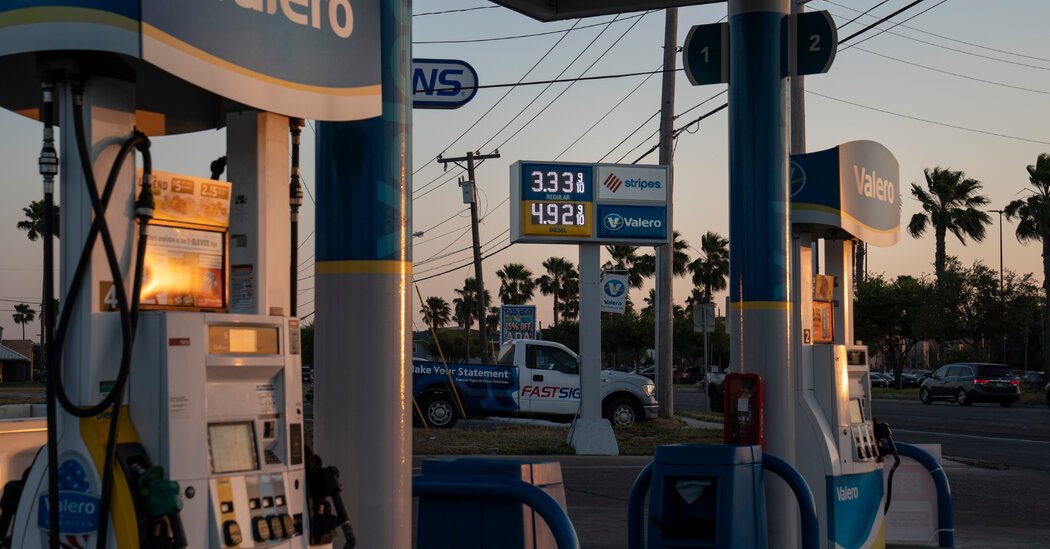
President Trump has for weeks downplayed the economic toll of his war with Iran, citing a bevy of inaccurate statistics.
His remarks to reporters in recent days underscored his approach, as he asserted that the economic hardship Americans might face was not a factor in his negotiations to end the conflict. “I don’t think about Americans’ financial situation,” he said. “I don’t think about anybody. I think about one thing: We cannot let Iran have a nuclear weapon. That’s all.”
Kush Desai, a White House spokesman, said the president had always been clear about the war’s temporary disruptions to the economy as inflation rises.
“The administration remains laser-focused on cutting costs and accelerating growth on the home front,” Mr. Desai said. “As these policies continue taking effect, and as traffic in the Strait of Hormuz normalizes after the Iranian nuclear threat is neutralized, both energy prices and inflation will drop again.”
Here’s a fact check.
What Was Said
“Now with all of this, inflation is much lower than it was under Biden. Biden had the highest inflation in the history of our country. Inflation is nothing by comparison, but our inflation is just short term. Because if you go from before, just before the war, we were for the last three months, 1.7 percent.”
— Mr. Trump in remarks to reporters on Tuesday
False. Mr. Trump is exaggerating the rate of inflation under the Biden administration and understating the rate of inflation under his own administration.
Inflation did reach the highest point in four decades — not in the “history of the country”— in the summer of 2022, at about 9 percent that June. But inflation reached higher points in the 1910s, 1970s and 1980s. Inflation had fallen to 3 percent in January 2025, when Mr. Trump took office.
In the three months before the United States attacked Iran on Feb. 28, inflation reached 2.7 percent in December, 2.4 percent in January and 2.4 percent in February — not 1.7 percent, as Mr. Trump said.
After the war began, inflation increased to 3.3 percent in March and again to 3.8 percent in April. Those figures are all higher than inflation at the end of the Biden administration.
What Was Said
“Oil is down 25% or $30 per barrel since Sleepy Joe”
— Mr. Trump in a social media post on May 8
This is misleading. Mr. Trump shared a chart that showed the price of oil at $120 a barrel under Mr. Biden and $90 under Mr. Trump, comparing the highest point of gas prices under the Biden administration with a recent low under his administration.
The price of Brent crude, the global benchmark for oil, rose to $120 per barrel in June 2022, but had fallen to about $80 a barrel by January 2025, when Mr. Trump took office. The price continued to fall in Mr. Trump’s first year back in office, before surging at the onset of the war in Iran.
On Friday, when Mr. Trump posted his chart, Brent crude had risen to $101 a barrel.
What Was Said
“Well, no, gas prices have come down today. Have you looked? They’ve come down very substantially today.”
— Mr. Trump in remarks to reporters on May 7
False. Government and independent data sources show that the opposite is true. Gas prices have continued to climb.
Gas prices rose to $4.56 a gallon on May 7, according to the AAA motor club, from $4.54 a day earlier. That was about 53 percent higher since the start of the war on Feb. 28, when the national average price of gas was $2.98.
Gas prices averaged $4.45 per gallon in the week ending on May 4, according to the Energy Information Administration, a government statistical agency. That was about 52 percent than the $2.94 in the week ending on Feb. 23.
What Was Said
“We don’t use the strait. We don’t need it. In fact, boats are coming up to Texas, Louisiana and Alaska and filling up with oil. We don’t need the strait.”
— Mr. Trump in a May 5 interview on the syndicated news show “Full Measure”
This is exaggerated. Mr. Trump has a point that a tiny amount of oil imported to the United States travels through the Strait of Hormuz. But he is wrong that the United States does not use the waterway at all.
The Energy Information Administration estimated that in 2024, the year with the latest available data, the United States imported about 500,000 barrels of crude oil per day through the Strait of Hormuz, equal to about 7 percent of total crude oil and condensate imports and 2 percent of consumption.
The United States also relies on the strait to import and export other goods.
The United States imports about 12 to 17 percent of several commonly used materials for fertilizer (monoammonium phosphate, diammonium phosphate and urea). About 22 percent of aluminum imports and about 25 percent of helium imports also travel through the Strait of Hormuz.
The Persian Gulf accounts for nearly 20 percent of all American exports of sauces and condiments, 20 percent of waterborne passenger cars and 15 percent of trucks, according to the Congressional Research Service.