dailynewsnblog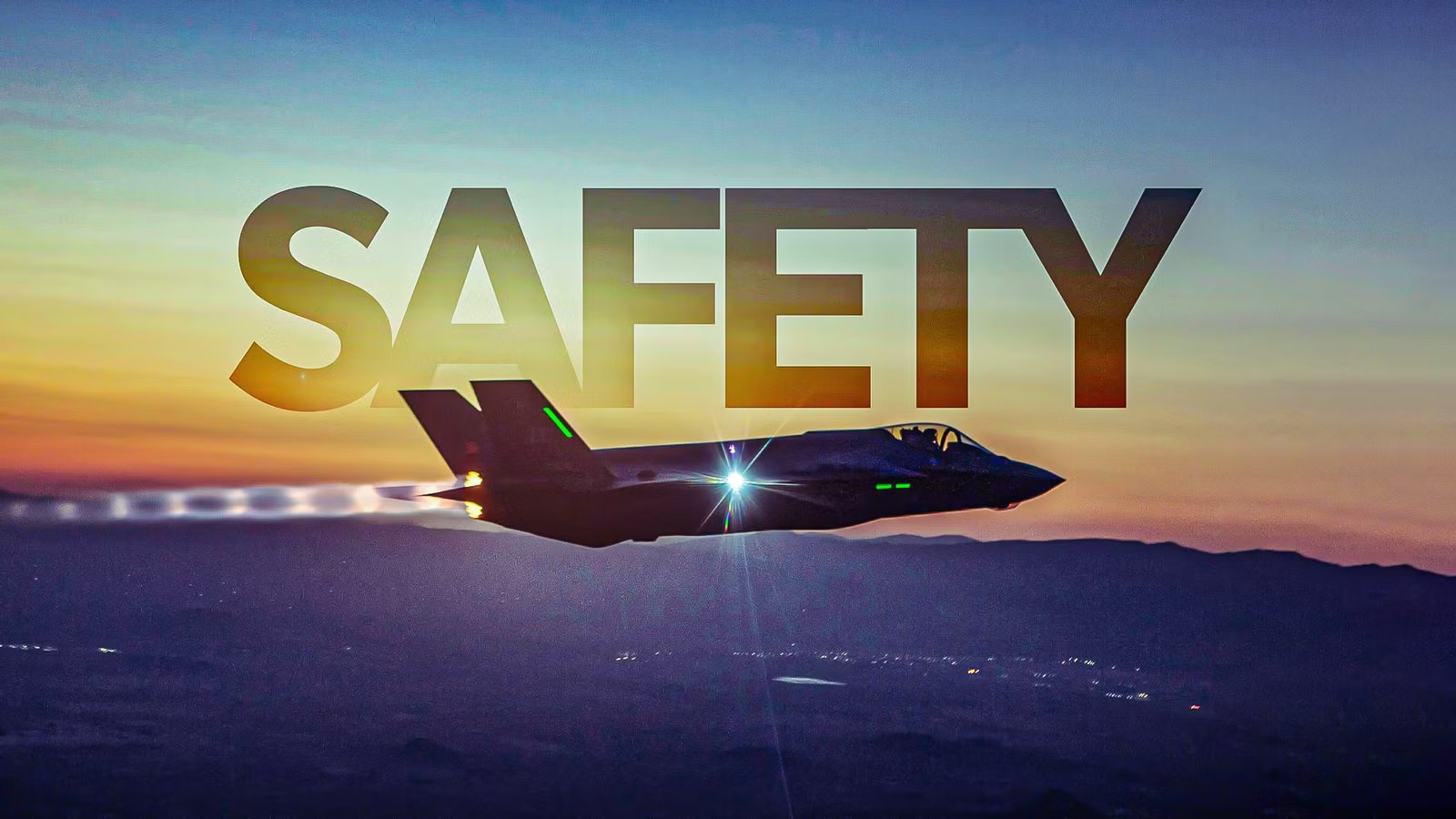
America’s latest and greatest stealth fighter, the 5th-generation F-35 Lightning II, is one of the most widely publicized and criticized aircraft ever built. Everyone knows the headlines about the extremely high cost of a $2 trillion defense project, as well as its shortcomings entering service with missing radars on new deliveries and other readiness issues. The part that often gets overlooked is the fact that the jet is proving to be one of the safest tactical jets ever constructed.
And in the first years of its military service, the Joint Strike Fighter has proven to have far fewer mishaps than its predecessors, like the Boeing F-15 Eagle or General Dynamics F-16 Fighting Falcon. Even including accidents from the flight testing phases that began in 2006, only about 15 or 17 airframes are believed to have been written off in total. More importantly, there is only one recorded fatal crash so far of the F-35.
To put that in context, the history of the F-16 is far more checkered, with over 150 hull losses and more than 50 fatal accidents, as AeroTime writes. Similarly, although no F-15 Eagle has ever been lost to enemy fire on the battlefield, more than 80 of the Jets have been destroyed in accidents, and around two dozen aircrew have been killed. It’s true that the young age of the F-35 gives us an advantage, but the current trend is already showing a far more positive trajectory of flight safety.

The F-35 Lightning II family has established a notably high safety standard compared to previous generations of fighter aircraft, according to the Lexington Institute. While problems in its developmental years were high-profile, the actual data reveals a jet that is safer than its predecessors during their respective early operational phases. As the global fleet of 1,300 jets and counting surpassed one million flight hours in early 2025, the accident rate stabilized at about 1.5 Class A mishaps per 100,000 flight hours.
This is nearly half the lifetime average of the F-16, at 3.55, per Sandboxx. It is also significantly better than the F-15’s early rate of 5.1 mishaps per 1000,000 hours. Historically, the introduction of a new fighter jet is marked by a spike in accidents as pilots and maintainers adjust to new technology. The F-16, for instance, suffered from frequent engine stalls and control issues in its first decade. In contrast, the F-35 has benefited from advanced digital flight controls and predictive maintenance systems that have kept its mishap rate remarkably low.
While accidents have occurred, notably the 2019 Japanese F-35A loss and several F-35B landing mishaps, the majority were attributed to human factors or specific mechanical failures rather than systemic design flaws. Features like Automatic Ground Collision Avoidance System have already been credited with saving lives by automatically pulling the jet out of a dive without pilot input.
The Fighting Falcon’s Legacy Lives On

Consideration for the technological gulf between the two fighter jets must be given to make an honest comparison between the Viper, as the F-16 is known, and the F-35. It is, in fact, only because of pioneering technological development that was completed by the F-16 fleet that the F-35 is as safe as it is. The Viper was the first fighter jet to be mass-produced with fly-by-wire control input from day one, and because of the frequency of controlled flight into terrain mishaps during its early days, it also helped create Auto GCAS.
The F-35 incorporates more mature FBW in the Viper, which allowed the F-16 to use relaxed static stability that made the jet inherently unstable but highly agile. Fat Amy, as the F-35 moniker goes, not only benefits from design improvements but also from refined maintenance procedures that leveraged lessons learned by the F-16 Fleet. Predictive maintenance systems in the F-35 analyze real-time data to anticipate failures before they occur, preventing mechanical-related mishaps.
The F-35 cockpit also has a more pilot-friendly layout with glass displays and an ergonomic control stick derived from the F-16. To help pilots handle high G-forces, the F-16 pioneered the side-mounted control stick. This ergonomic placement was adopted by the F-35 to provide pilots with better control and comfort during high-G maneuvers.
The JSF even takes the heads-up display to a new level by incorporating it fully into the pilot’s helmet so they can look through the jet’s floor with augmented reality. This helmet displays critical flight and combat data in an intuitive interface that can also switch to night vision. The system can even be activated by voice commands. All of which greatly improves the safety of flight by diminishing the workload burden on the pilot in critical flights of phase like take-off and landing, or dogfighting and close air support runs.
Here’s Why The Royal Navy May Never Fill Its Aircraft Carriers With F-35s
Will the UK’s Fleet Air Arm be cut down to size?
F-35A: The Most Mass-Produced Stealth Fighter

The current accident rate of approximately 0.8 to 1.1 Class A mishaps per 100,000 flight hours for the F-35A variant stands out especially as it is nearly four times better than the F-16’s early accident rate. Investigations into recent incidents, such as the 2025 Eielson AFB crash, have reinforced the plane’s reputation for safety. The Eielson mishap found that specific environmental factors, like extreme cold, were to blame rather than technical or design flaws.
As the most produced, Baseline model of the Joint Strike Fighter family, the A-variant is the most important to consider. The jet was initially criticized because the program implemented a design-build process. In the early years, there were issues with engine fires in 2014 and a series of problems with the automated maintenance program that produced false alerts, which forced the fleet to implement a restricted flight envelope. However, as the fleet matured, these issues have been resolved, and both the airframe and its software are fully validated with no restrictions against aggressive maneuvers in recent years.
Below is a table of Class A mishaps that have involved the F-35A so far:
|
Mishap Date |
Operator |
Description |
|---|---|---|
|
Apr 9, 2019 |
JASDF |
Crashed into the Pacific Ocean during training. Attributed to pilot spatial disorientation. |
|
May 19, 2020 |
USAF |
Crashed upon landing at Eglin AFB, Florida. Technical and human factors cited. |
|
Jan 4, 2022 |
ROKAF |
Destroyed following a bird strike near Seosan Air Base. |
|
Oct 19, 2022 |
USAF |
Crashed at Hill AFB, Utah. Attributed to a technical error in the air-data system. |
|
Jan 28, 2025 |
USAF |
Crashed near Eielson AFB, Alaska. |
With thousands of pilots now trained, the human factor errors that plagued early flights have been smoothed out through sophisticated, high-fidelity simulators that prepare pilots for the jet’s unique sensor-fusion environment. In 2020, the accident rate for the F-35A dropped below 1.0 per 100,000 hours, making it statistically safer than the F-16 was at the same stage of its lifecycle.

Here’s Why The Marines Corps Is Scattering F-35Bs Across Tiny Pacific Islands In 2026
Going back to Raider ops for the pivot to the Pacific.
F-35B: The Only Stealth Jump Jet In The World

The F-35B Lightning II, specifically designed for Short Takeoff and Vertical Landing, does have a higher mishap rate than the A-variant but has also achieved a safety record that is statistically far superior to its predecessors. The F-35B’s current mishap rate is roughly 1.5 to 1.6 per 100,000 flight hours, whereas the AV-8B Harrier II suffered a rate of over 31.0 in its early years, according to Slashgear. That is nearly twenty times higher.
The table below outlines the reported mishaps involving F-35Bs to date:
|
Mishap Date |
Operator |
Description |
|---|---|---|
|
Sep 28, 2018 |
USMC |
First-ever crash near MCAS Beaufort, SC. Caused by a faulty fuel tube. |
|
Sep 29, 2020 |
USMC |
Mid-air collision with a KC-130J tanker over California. |
|
Nov 17, 2021 |
Royal Navy |
Crashed into the Mediterranean during takeoff from HMS Queen Elizabeth. Caused by an engine intake cover left on. |
|
Dec 15, 2022 |
Lockheed Martin |
Crashed during a hover-landing attempt at NAS Fort Worth, Texas. |
|
Sep 17, 2023 |
USMC |
Crashed in North Charleston, SC, after the pilot ejected. Electrical malfunction. |
|
May 28, 2024 |
Lockheed Martin |
Crashed during takeoff at Albuquerque, New Mexico. |
Based on historical data, vertical flight is one of the most dangerous regimes in the business of aviation. The AV-8B of the US Marines earned the nickname ‘The Widowmaker’ due to a high accident rate because of the challenges of operating its mechanically complex Rolls-Royce Pegasus engine. The legacy jump jet required pilots to manually manage four thrust nozzles simultaneously.
Here’s Why Landing An F-35 On An Aircraft Carrier Is So Difficult
What it takes to be in the tailhook club.
F-35C: The First Stealth Carrierborne Fighter Jet

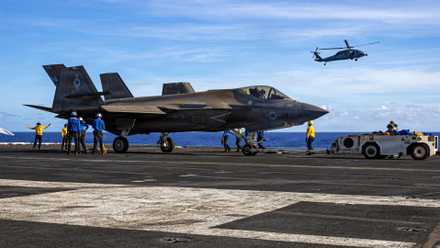
The F-35C carrier variant is the world’s first and only long-range stealth strike fighter designed specifically for aircraft carrier operations. It made history when it entered US Navy service in 2019. The jet is also flown by some USMC squadrons, and unlike the F-35A and F-35B, the F-35C is built to endure the violence of Catapult-Assisted Take-Off But Arrested Recovery operations, or CATOBAR.
The F-35C benefits from Precision Landing Mode, also called Magic Carpet software, which automates much of the glide slope management during carrier landings. This significantly reduces the pilot’s workload compared to the current Boeing F/A-18 Super Hornet or legacy F-14 Tomcat. Although the Super Hornet has a comparable accident rate to the F-35C, which is around 1.6 to 1.8 per 100,000 flight hours, the Tomcat had a much higher mishap frequency, with the average being 7.0 to 10.0 over its lifetime.
This table lists F-35C mishaps that resulted in an airframe write-off:
|
Mishap Date |
Operator |
Description |
|---|---|---|
|
Jan 24, 2022 |
US Navy |
Ramp strike and lost overboard from USS Carl Vinson in the South China Sea. |
|
Jul 30, 2025 |
US Navy |
Crashed near NAS Lemoore, California. |
|
Mar 31, 2026 |
US Navy |
Lost in the Nevada Test and Training Range during a training mission. |
To handle the unique stresses on the flight deck, the carrier variant of the JSF features several unique structural modifications. At 43 feet (13.1 meters) wide, the C-variant’s folding wings are 11 feet (3.35 meters) wider than the A and B models, providing the extra lift needed for low-speed carrier approaches. And of course, it has the most robust landing gear and a dual-wheel nose gear to absorb ‘controlled crash’ landings of the tailhook flying.
The primary reason for the F-35C’s superior safety relative to the F-18 and F-14 is automation. The same can be said when comparing it to the F-16, despite the fact that Naval Aviation is typically higher risk during routine operations. The F-35C was built on the legacy of the jets that came before it to improve safety on the ‘boat,’ and it has ushered in a new era for the US Navy’s tailhook community.