dailynewsnblog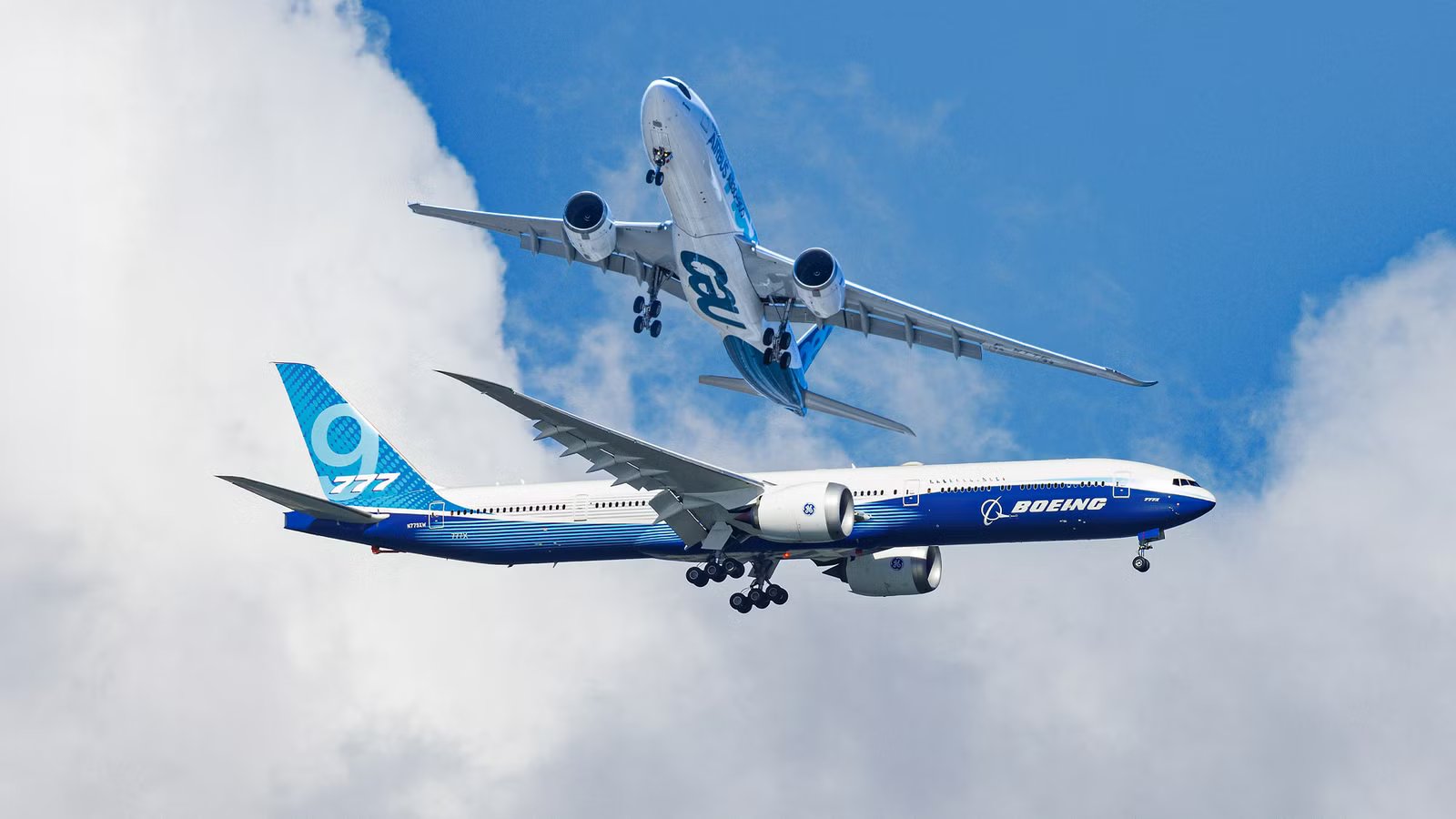
The Airbus A330 and Boeing 777 are two of the world’s most successful widebody programs ever, with both having been developed at largely the same time. Although only three variants in these families ever directly competed against one another (A330-300 versus 777-200/200ER), they are technological peers that have begun to face stiff competition from new, clean-sheet widebodies in recent years. Strikingly, Airbus and Boeing took two extremely different approaches towards refreshing their cash cow widebodies.
Airbus created the refreshed A330neo to compete more effectively against the Boeing 787, while  Boeing revised its star widebody as the 777X, competitor to the Airbus A350. As a whole, Airbus’ approach was to create an aircraft that is cheap to buy, cheap to operate, cheap to integrate, and cheap to develop. Boeing invested in a more thorough overhaul of the 777, including new engines, additional technological updates, and a new carbon fiber reinforced polymer (CFRP) wing, which cost roughly $2 billion, or roughly the same amount that Airbus spent on the entire A330neo program.
The Changes Made For The 777X Program

The 777X is the third generation of the 777, directly succeeding the 777-200LR, 777F, and 777-300ER. Its new composite wing is perhaps the most notable change, and it features a wingspan of 235 feet five inches (71.75 meters), wider than any Boeing airliner. Its wings are only slightly smaller than those on the Boeing 747-8 in terms of total area, and they’re so wide that the 777X technically falls into ICAO Code F, requiring specialized gates. To solve this issue, the 777X features folding wingtips, which bring the aircraft’s wingspan to 212 feet nine inches (64.85 meters).
In addition, the 777X will be equipped with the General Electric GE9X, the largest commercial turbofan engine ever built, and features an evolved version of the Boeing Sky Interior currently found on the 787 as well as on the 737. The cockpit has also been revised to mimic the flight deck on the 787. Furthermore, the two fuselage lengths have been stretched, with the 777-8/8F now boasting a length of 232 feet six inches (70.86 meters), while the 777-9 is 251 feet nine inches (76.7 meters), making it the longest commercial airliner ever built.
The 777X, particularly the 777-9 variant, has proven popular so far, with the family having received over 600 orders. However, the program is several years behind schedule, with Boeing now targeting first deliveries for 2027, seven years behind schedule. For Boeing, this means that the company has yet to earn meaningful revenue from the program, while costs continue to rise as a result of the delays. It’s now estimated that development costs have risen to over $15 billion in accumulated charges.
The Issue With The 777X When Compared To The A330neo

The A330 was Airbus’ cash cow widebody airliner, much like the 777 was for Boeing. At the request of certain customers, Airbus announced the A330neo in 2014, offering a much lighter refresh of the 1990s-era widebody compared to the 777X. The fuselage lengths would be kept the same as the A330-200/300. The wing would be tweaked to accommodate new Rolls-Royce Trent 7000 engines, and Airbus also added composite sharklets that extended the plane’s wingspan. Apart from these changes and subsequent gross weight boosts, the A330neo was largely the same as before.
The approaches of the two manufacturers each come with pros and cons, but one undeniable advantage of Airbus’ decision to only make minimal changes was that it began delivering A330-900s in 2018, just over four years after the program was originally announced. This means that Airbus is earning money from delivering these planes, and the A330neo has also quietly been receiving an increasingly steady number of orders. While it’s sold fewer units than the 777X, the program’s relatively low development costs mean that Airbus doesn’t need to sell as many units to make a profit.
|
Boeing 777X |
Airbus A330neo |
|
|---|---|---|
|
Program Launch |
2013 |
2014 |
|
Variants |
777-8, 777-8F, 777-9 |
A330-800, A330-900 |
|
Development Costs |
$15 billion+ |
$2 billion |
|
Entry Into Service |
2027 (projected) |
2018 |
|
Number Ordered |
619 |
489 |
|
Number Delivered |
Zero |
189 |
Boeing, on the other hand, will need to sell more 777Xs due to the ballooning development costs, and although the company has sold more units overall, it has sold them to fewer customers than the A330neo. With the 777-9 being the most popular variant while also being the largest airliner on sale, this has raised doubts about the 777X’s long-term market viability. Meanwhile, Airbus is selling the A330neo as a pure substitute for existing A330s, anticipating that demand will rise as more A330s age out in the late 2020s and 2030s.

The Striking Differences Between The Boeing 777X & Airbus A350-1000
Find out how the Boeing 777X and Airbus A350-1000 Compete
Why Boeing Chose To Develop The 777X In This Manner

The A330neo and 777X are in two distinct markets with different positions, which is why the manufacturers took these approaches. For Boeing, the older 777-200ER was already having difficulty competing against the A330-300 once Airbus began boosting the plane’s gross weight, and the 777-200LR was a niche aircraft for ultra-long-haul flights. Instead, it was the 777-300ER that was a massive hit with airlines, selling over 800 examples, but the Airbus A350 rendered the 777 uncompetitive.
The A350 is a clean-sheet CFRP airliner that’s lighter than the 777, significantly more fuel efficient, and more capable than the 777-300ER. Installing the GE9X on the 777-300ER wouldn’t be enough to make the aircraft competitive against the A350-1000, and although the new wing was expensive to develop, it was necessary to keep fuel burn down. The 777-300ER’s wing was undersized for the 13 to 14-hour journeys that it regularly performed, and CFRP was selected to keep weight down for a new, larger wing.
|
Variants |
Entry Into Service |
Engine Options |
|
|---|---|---|---|
|
First-generation 777 |
777-200, 777-200ER, 777-300 |
1995 (777-200) |
General Electric GE90 Pratt & Whitney PW4000 Rolls-Royce Trent 800 |
|
Second-generation 777 |
777-200LR, 777F, 777-300ER |
2004 (777-300ER) |
General Electric GE90 |
|
777X |
777-8, 777-8F, 777-9 |
2027 projected (777-9) |
General Electric GE9X |
However, the GE9X and the new wing would still result in a heavy aircraft with a metal fuselage that wouldn’t be competitive against the A350. As such, Boeing stretched the 777 to lower per-seat costs, and this also gave the 777-9 the added benefit of having more floor space than any in-production aircraft. This has made the type appealing to large flag carriers that operate a first class cabin, although there are a limited number of such airlines in the world. At the end of the day, this was what was needed to compete against the Airbus A350.
The Strengths Of The Boeing 777X

The Boeing 777X was designed with heavy feedback from  Emirates and
  Qatar Airways, and the program has been rewarded with hundreds of orders from these two carriers. These airlines desired a plane capable of operating nonstop flights from their hubs to the US West Coast, with excellent performance in hot conditions. As such, it has excellent field performance and should prove valuable when operating out of hot & high airports, where other aircraft may be pushed to their limits.
The 777X should be an extremely fuel-efficient aircraft, in large part due to its promising GE9X engines. The GE9X is rated for less power in service than the preceding GE90-115B, yet it’s proven capable of producing even more during testing. This means that the engine will be far from stressed in regular operations, which will boost long-term durability. This is an especially strong advantage considering that the A350-1000’s Rolls-Royce Trent XWB-97 engines have received some criticism regarding durability in challenging climates.
The 777-9 is projected to enter service at a time when premium international demand is generally on the rise, and the aircraft’s floor space is ideal for installing large premium cabins while still maintaining a reasonably-sized economy cabin. In addition, the 777-9 is also a worthy option to replace 777-300ERs for airlines that are looking to upgauge, since the A350-1000 seats around the same number of passengers 777-300ER.

Here’s How Much More Range The Boeing 777X Has Compared To The 777-300ER
While the 777-300ER has more range than the larger 777-9, the similarly sized 777-8 can fly 1,375 NM further, while carrying a few more passengers.
Why Airbus Only Mildly Upgraded The A330

Airbus originally planned a smaller A350-800 intended to slot between the Boeing 787-8 and 787-9. This plane, however, would have been small, heavy, and inefficient, while some customers requested an improved A330. As such, the A330neo was launched to directly compete with the 787, while the A350-800 was later canceled. From an order standpoint, the A330neo has not been as effective in competing with the 787, as Boeing has sold more than double as many 787s since the A330neo’s launch, while Airbus has only sold 22% more A350s than the competing 777X since the program’s launch.
The A330neo was positioned as being a more cost-effective alternative to the 787, but Boeing aggressively priced the 787 in the A330neo’s early days, made possible in part because of high production rates. However, Boeing is no longer able to easily sell 787s at such low prices. The A330neo is generally considered to have a small fuel burn advantage over the 787 on shorter routes, making it an ideal fit for airlines operating transatlantic routes and flights within Asia, and there’s little integration cost associated with the A330neo for existing A330 operators.
The A330 shares most of its structure with the Airbus A340, which was designed as a true long-haul airliner, and this meant that the A330’s wing was already ideal for such purposes. Meanwhile, the weight difference between the A330 and 787 is much smaller than that of the A350 and 777, meaning that Airbus didn’t need to stretch the aircraft to keep per-seat costs competitive. With increasing popularity in recent years, the A330neo is proving to be an incredibly effective tool for airlines operating medium-haul routes that can also operate longer flights if necessary.