dailynewsnblog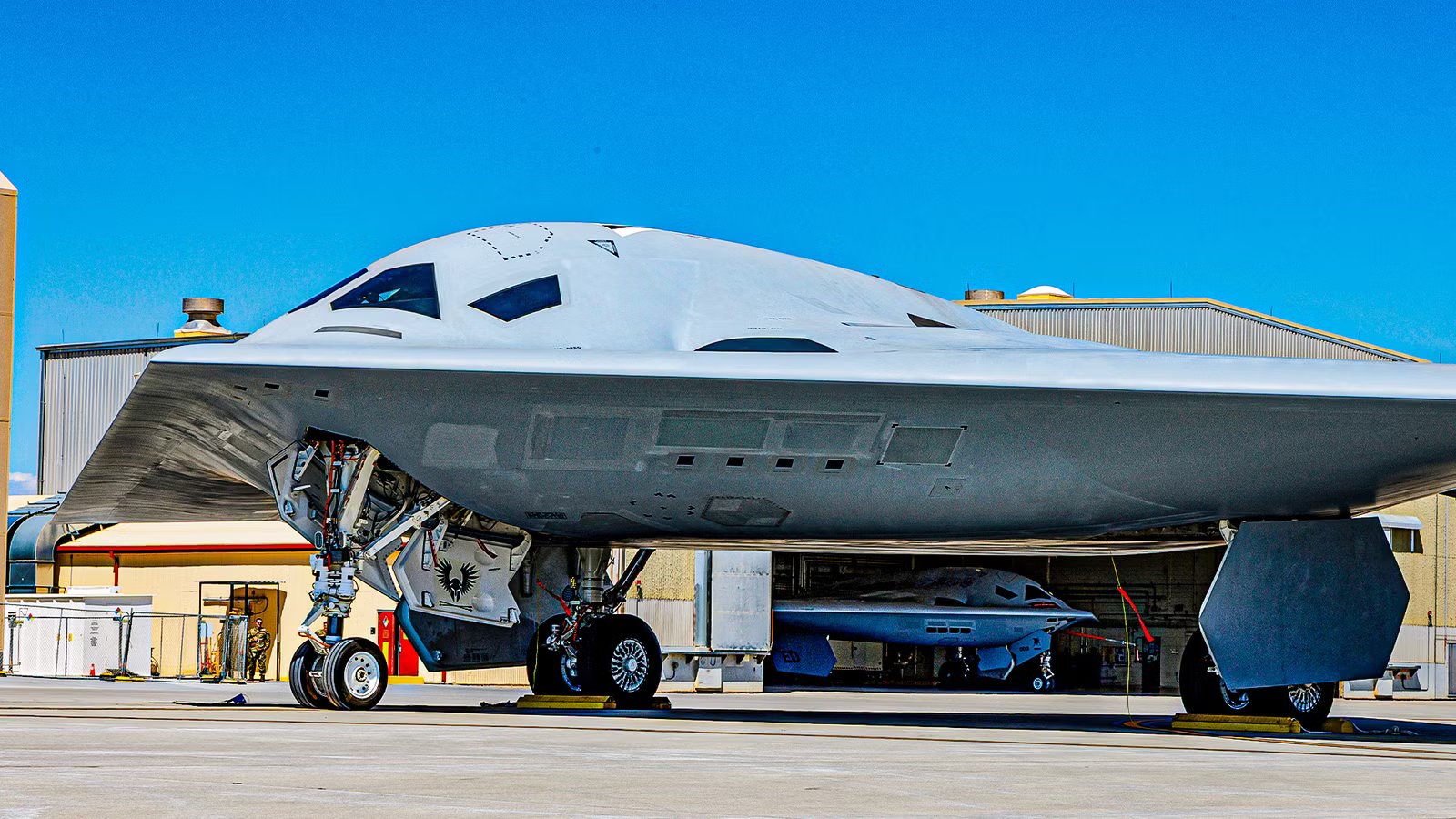
More and more photos of the Northrop Grumman B-21 Raider strategic bomber are being released. Online, some commentators have noticed small, darker panels standing out against the mostly white bomber. In images, four dark square panels can be seen under the nose and four under each side/wing of the aircraft. A bunch of other larger panels are also visible on the underside of the aircraft, making a section of the underbelly resemble a house wall that has only received the primer coat of paint.
The B-21 is set to replace the worn-out B-1B airframes and then the B-2s, once the B-21s are mature enough and are available in large enough numbers. They are intended to be a generational upgrade over the B-21 to allow the US to strike deep into the most contested airspace of the most advanced adversaries well into the future.
Test B-21 Bombers

The United States Air Force received its second pre-production test Northrop Grumman B-21 Raider in 2025, and in 2026, Northrop revealed the Air Force is purchasing another test aircraft that the contractor had built for itself. What these aircraft have in common is that they are not serial production combat aircraft: rather, they are test aircraft, although it’s unclear if any will be upgraded to be combat aircraft later on. With that being said, serial production examples are coming, and the program remains on track to enter service in 2027.
Test aircraft may not be representative of the final production aircraft in their coatings and details. For example, some have ridiculed the Russian Su-57 Felon for being a “stealth” fighter for having exposed, non-flush screws and significant panel gaps. These would significantly undermine the aircraft’s stealth and generate a higher radar return. However, those aircraft in question are actually early T-50 development aircraft (T-50-2, T-50-3).
They are built for aerodynamic testing and are not coated with radar-absorbent coatings. While much of the criticism about whether the Su-57 truly is a fifth-gen fighter has merit, the discussion about exposed screws does not. Similarly, videos and images of testbed B-21s may or may not be representative of the final appearance.
Darker Air Data Probe Arrays

Some observers have asked what small, darker panels on the B-21’s underside are. They are likely dielectric (radar-transparent) panels that cover antennas, sensors, or electronic warfare equipment. As a next-generation bomber, the B-21 needs to bristle with antennas and sensors, and yet it can’t have them protruding and returning radar signatures.
The panels are likely made of special materials that are transparent to infrared, radar, or electronic sensors. Most aspects of the B-21 are, and will remain, classified. As such, it is hard to say exactly what their function is, although plausible factors include terrain-following sensors, defense electronic warfare systems, and communication antennas. With that being said, The Aviationist identifies them as ‘Air Data Probe Arrays.’
The publication also notes that “due to the aircraft’s low observable nature, its pitot tubes and static probes are also of a non-conventional shape. Nearly identical to the setup found on the B-2, the B-21 also utilises three sets of four air data probes located on the nose and cheek of the aircraft.” The article later explains that “one of the red panels marked above is taken up by an air data probe at the moment, but this is for sensor calibration and will only be present on the prototype aircraft,” and says a low probability of intercept radar will later be installed.

In Pictures: A Look Back At The Historic 1st B-21 Raider Test Flight At Edwards Air Force Base
In 2024, the B-21 Raider soared over Edwards AFB in a historic achievement to unconventional aircraft designs and stealth technology.
A Lighter Color For Daytime Operations

For the casual observer, the most striking difference between the B-2 and the B-21 is the color. The B-2 is famous for its dark charcoal coloring, which it gets from its radar-absorbent coatings. The Aviationist notes the B-21’s light gray coloring appears similar to the highly secretive and officially unconfirmed RQ-180 spy drone.
The switch in colors is partly due to changes in doctrine and technology. Air and Space Forces Magazine notes that “while the B-2 wears wrap-around FS 36118 ‘Gunship Gray’ paint with variations around taped areas, effective for night operations, the B-21 wears an overall light gray, possibly FS36375 ‘Light Compass Ghost Gray,’ which may aid in reducing its visual and infrared signature in the daytime.“
|
Northrop Grumman B-21 Raider (per Northrop Grumman) |
|
|---|---|
|
First flight |
2023 |
|
Number in USAF inventory |
Two or more (test aircraft) |
|
Planned in-service date |
2027 |
|
Number planned |
Over 100 |
|
Payload |
30,000 lbs (unclassified, actually likely higher) |
As such, whereas the B-2 Spirit bomber was designed to fly at night, the B-2 will also fly during the day. So much of stealth talk focuses on radar cross-section, but even making it harder for the naked eye to see the aircraft against the haze of the sky is an aspect of stealth. With that being said, it should be emphasized that the aircraft that have so far been unveiled are not the final combat examples, and coloring could change if they haven’t yet received the final coatings.
Why Only Stealth Works

Stealth is not an invisibility cloak, and it does not make an aircraft undetectable: even the stealthiest of aircraft can be detected, tracked, and shot down. After the Second World War, the US developed the B-52 to brute-force its way through enemy air defense in large numbers. It was understood these would be shot down in large numbers and would have to sustain attrition, similar to bombers in the Second World War. Next, the USAF looked to the B-58 for the speed and altitude to fly faster and higher than the flak fire and jet fighters attacking it.
The Air Force doubled down on the B-58 Hustler by developing the Mach 3.1 XB-70 Valkyrie, designed to fly at 77,350 feet and be invulnerable to enemy air defense. However, the development of surface-to-air missiles made them obsolete. Additionally, the emergence of intercontinental ballistic missiles made them less necessary for the nuclear doctrine. Next, the Air Force developed the B-1A Lancer to fly Mach 2 while flying the map of the earth, but look-down radars also diminished its effectiveness.
The Air Force finally turned to stealth and set out on the program that would lead to the B-2 Spirit. However, in the interim, it needed another bridge bomber and so revived the B-1 as the redesigned B-1B with a dramatically reduced radar cross section and a reduced top speed of Mach 1.2. The Air Force purchased 100 Lancers, and these have been invaluable for hauling large amounts of ordinance. However, years of low-level flying have worn their airframes out, and they are in desperate need of replacement.

This Is How Powerful The B-2 Spirit Bomber Is
The B-2 is famous for its stealth, but how much punch does it pack? Let’s find out.
The Need For A Bomber Able To Penetrate

While the B-58 and XB-70 bombers were doctrinally similar, the other bombers all represented a very different doctrinal approach on how to penetrating enemy air defense, take out the target, and survive. Rather than departing from the B-2 Spirit, the B-21 Raider doubles down on many aspects. These are designed to penetrate enemy air defense and carry out precision strikes, and get out.
Currently, the B-2 Spirit is considered the only bomber able to do this. The development of air defense has rendered all other bombers veritable stand-off missile trucks. This includes the B-52, B-1B, Tu-22M3, Tu-95, Tu-160, H-6, and even the Russian Su-34 fighter-bomber. In Ukraine, Russia’s bombers have been reduced to launching stand-off attacks using long-range glide bombs and missiles from outside of contested airspace.
The exception is when a country can gain air dominance and comprehensively degrade the enemy’s air defense. This was seen in the 2026 Iran campaign, where the B-1B and B-52 reprised their roles as bombers carrying Joint Direct Attack Munition bombs, instead of just long-range stand-off munitions. However, in the future, this will become increasingly difficult. The Air Force will keep the B-52s in service as a stand-off missile truck and to carry JDAMs when the opportunity arises, but it needs a large fleet of penetration bombers.
A Comprehensive Upgrade From The B-2

It is both fair and misleading to say the B-21 is an upgrade to the B-2. It looks like a smaller, whiter version of the B-2, with Trump even terming them “updated B-2s.” Still, with modern aircraft, it’s what is on the inside that counts. Northrop is terming the B-21 the world’s first ‘sixth-generation’ combat aircraft (a label typically reserved for fighters). The B-2 functioned as something of a stand-alone bomber, but the B-21 will be a hyper-sensing, networked node as a part of a much larger package that will eventually include loyal combat drones.
While the B-2 can be thought of as the last of the classic bombers, the B-21 can be thought of partially as a command center flying deep into enemy airspace. In the two decades the B-2 has been in service, its advantages have eroded slowly but surely. The B-21 aims to restore that advantage with all-aspect stealth.
The B-21 comes with a cleaner and more refined planform geometry to reduce radar returns on multiple angles and against more multi-band air defenses. The B-2 was optimized for frontal penetration, whereas the B-21 is designed to reduce its signatures from all aspects. Its future reduces its infrared signature, while managing electronic emissions is a priority. Stealth is not just passive: the B-21 is designed to fight back by generating interference, using e;ectronic warfare, creating virtual decoys, and more.