dailynewsnblog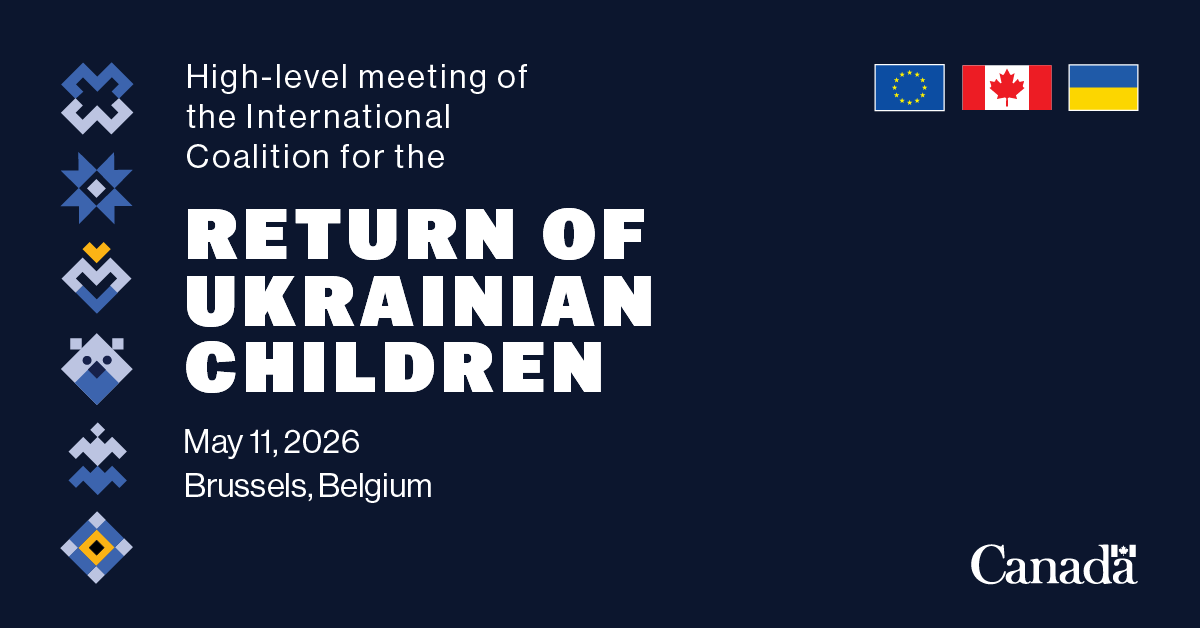
May 12, 2026 – Brussels, Belgium – Global Affairs Canada
High-Level Meeting of the International Coalition for the Return of Ukrainian Children, Brussels, 11 May 2026
Kaja Kallas, High Representative and Vice President of the European Commission; Marta Kos, Commissioner for Enlargement; Anita Anand, Minister of Foreign Affairs of Canada; and Andrii Sybiha, Minister of Foreign Affairs of Ukraine, co-chaired a high-level meeting on the return of Ukrainian children unlawfully deported or forcibly transferred by the Russian Federation in its war of aggression against Ukraine. The high-level meeting was opened by the President of the European Commission Ursula von der Leyen and the President of Ukraine Volodymyr Zelenskyy.
Foreign Ministers and senior representatives from the International Coalition for the Return of Ukrainian Children, non-Coalition member guest countries and international organisations met to ensure that Ukrainian children unlawfully deported or forcibly transferred by the Russian Federation are at the centre of international attention, as well as to strengthen collective efforts to secure their safe return and their reintegration and rehabilitation.
The meeting took place against a backdrop of continued Russian obstruction and growing international pressure. Despite difficult circumstances, an operational framework under the Bring Kids Back UA initiative has enabled the return and reintegration of over 2,100 children to date.
Building on ongoing efforts, the meeting raised awareness of the need for protecting these children, upholding their fundamental rights and ensuring that Russia’s legal obligation to return them remains a priority in any peace negotiations, in line with international humanitarian law and international human rights law. The high-level meeting served to keep the topic high on the political agenda and inform participants of respective progress along six key strands:
- Expanding tracing and data verification
- Scaling up organised returns
- Strengthening the diplomatic track
- Reinforcing reintegration and rehabilitation upon return
- Advancing accountability
- Coordinating sanctions
During the meeting:
Participants welcomed new members of the Coalition. Since the last high-level meeting of the Coalition in New York in September 2025, Cyprus, Monaco, Panama, Switzerland and the Organization for Security and Co-operation in Europe (OSCE) Parliamentary Assembly have joined as members.
Participants reiterated their unwavering commitment to the protection of children affected by Russia’s war of aggression against Ukraine, in line with international humanitarian law and the UN Convention on the Rights of the Child.
Participants emphasised that the unlawful deportation and forced transfer of children constitutes a grave breach of international humanitarian law and a profound violation of human rights. They underlined that this practice is part of a broader pattern of systematic abuses by Russia in the temporarily occupied territories of Ukraine, including the erasure of Ukrainian identity, denial of Ukrainian-language education, indoctrination, including militarisation of children, and separation from families. These unjustifiable acts can result in war crimes.
Participants noted with concern that thousands of Ukrainian children remain in Russia and in the temporarily occupied territories, forcibly separated from their loved ones and communities.
Participants reaffirmed that the return of these children is both a humanitarian imperative and a central element to achieving a just and sustainable peace in Ukraine.
Participants discussed the need to hold Russia accountable for the heinous crimes committed in deporting, forcibly transferring as well as indoctrinating and militarising Ukrainian children, with particular emphasis on taking a holistic approach to accountability.
Participants underlined that all available tools and mechanisms must be used to put pressure on Russia, including the continued use of sanctions focused on persons and entities responsible for these crimes, to ensure the immediate, safe and unconditional return of all Ukrainian children who have been unlawfully deported and forcibly transferred by the Russian Federation.
Participants reaffirmed their commitment to continue working together with all global partners, both in international fora as well as in bilateral exchanges.
At the meeting, the co-chairs announced various strands of support. The European Union (EU) announced nearly EUR 50 million to reinforce Ukraine’s child protection system to ensure that every returned child has access to timely, child-centred and community-based support services. This support will also contribute to strengthening early childhood education initiatives and supporting access to child-centred justice for affected children and families. In addition, the funding will help strengthen Ukraine’s digital capacities, including systems enabling citizens to submit claims for compensation, including on behalf of unlawfully deported and forcibly transferred children.
Canada announced new support for Ukraine, including CAD 3.4 million for the United Nations Human Rights Monitoring Mission in Ukraine. Minister Anand also signed the Convention establishing an International Claims Commission for Ukraine, making Canada the first country outside of Europe to join. Finally, Minister Anand announced the upcoming conference in Toronto on September 28–29, 2026, to be hosted by Canada, Ukraine and Norway, which will focus on the return and reintegration of Ukrainian children, unlawfully detained civilians, and prisoners of war.
A coordinated effort on sanctions also took place. The EU announced restrictive measures against an additional 23 individuals and entities targeted for their responsibilities in the systematic deportation, forced transfer, forced assimilation, including indoctrination, militarised education and unlawful adoption of Ukrainian minors by the Russian Federation.
Canada announced the adoption of new sanctions targeting 23 persons and 5 entities involved in the violations against Ukrainian children. These measures build on the sanctions Canada has already imposed on individuals and entities responsible for, or involved in, the unlawful deportation, forcible transfer, indoctrination, and militarisation of Ukrainian children.
Participants highlighted the adoption, on 3 December 2025, of the UN General Assembly resolution ‘Return of Ukrainian Children’ (ES-11/9), which, inter alia, requests the Secretary-General to exercise his good offices to facilitate the return of Ukrainian children and recognises the role of the International Coalition for the Return of Ukrainian Children in advancing these efforts.
Participants discussed the importance of making further progress and to address the reintegration of children, verification and tracing mechanisms, accountability, sanctions and diplomatic outreach.
Finally, participants welcomed the meeting as a valuable opportunity to exchange perspectives and to introduce new forms of support tailored to Ukraine’s evolving needs. They underscored the continued importance of sustaining international attention and translating commitments into tangible assistance. Participants also highlighted the value for interested states and organisations of considering engagement as members or observers of the Coalition, or of providing support through other means aligned with their respective mandates and capacities.
Background
The International Coalition for the Return of Ukrainian Children was launched in Kyiv in February 2024 by Ukraine and Canada. The EU became a member in September 2025.
In the 2025 State of the European Union speech, President von der Leyen announced that the EU would host a dedicated event of the International Coalition for the Return of Ukrainian Children. In her statement on 23 November 2025, she confirmed the event would be co-hosted with Ukraine and Canada.
The high-level meeting was preceded by an Ambassador Study Tour and a Civil Society and Experts Day held in Kyiv on 29 and 30 April, respectively.
During the Study Tour, Ambassadors had the chance to visit several relevant sites (such as a rehabilitation centre for children) and meet with foster parents, to learn about the progress, challenges and prospects in the implementation of the Better Care reform and the linkages with the return and reintegration agenda in Ukraine.
The Civil Society and Experts Day brought together civil society and the expert community to develop practical recommendations ahead of the high-level meeting. The list of recommendations, which was also presented to the organizers of the high-level meeting in a statement, can be found here.