dailynewsnblog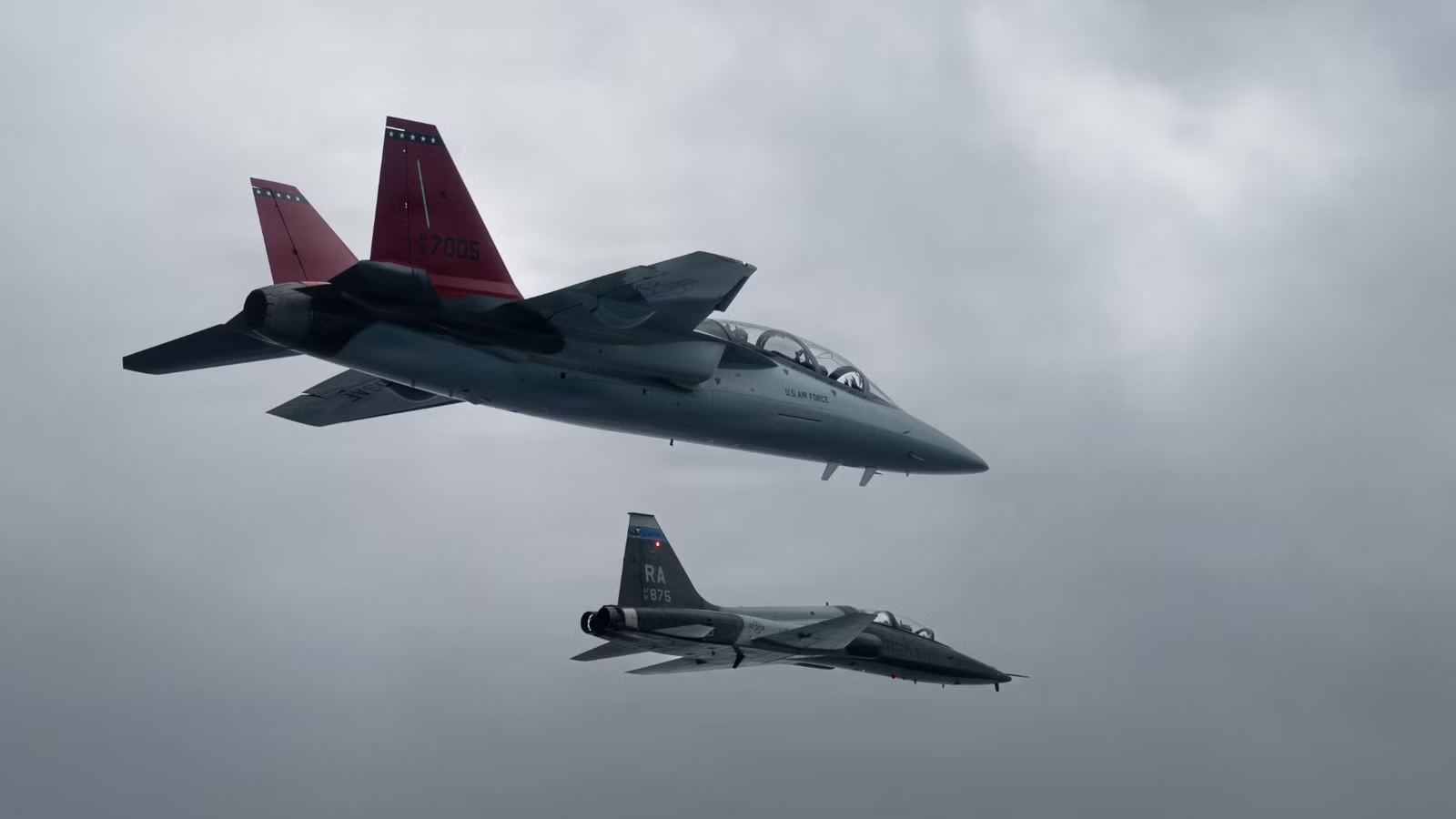
The United States Air Force has relied on the Northrop T-38 Talon for more than six decades. In that time, the fighter jets and bombers that the small supersonic training jet is meant to emulate have radically evolved. In the face of technology advancing at an exponentially more rapid pace, the USAF is now shifting to the  Boeing T-7A Red Hawk, with the advanced trainer receiving the green light for production this month.
The advanced age of the Talon fleet is leading to progressively worse mechanical difficulties for both the discontinued airframe and engines. Not only does this increase the cost and decrease the readiness of the jets, but it also slows down the production of pilots in the Air Force training pipeline. Although the new T-7A will have lower performance, it’s introducing a host of technology that promises to increase readiness and cut operating costs, as well as significantly increase training value on every sortie.
Training for Tomorrow’s Fight, Today

The Talon was developed in the 1950s, entering service in 1961. Since then, more than 1,100 of the lightweight supersonic jets have been built. It’s estimated that over 75,000 USAF pilots have been trained in the T-38, as well as over 50,000 pilots from international partners around the world. However, today, many of the 5th and 6th generation platforms now flowing or in development do not emphasize supersonic performance or dogfighting maneuverability.
Ironically, the urgency driving the transition is also spurred by the T-7A’s own developmental delays. Issues with the emergency escape system and flight control software pushed the timeline of the joint Boeing-Saab program back by years. In a press release, the Air Force recounted this quote from Brigadier General Matthew Leard, Director of Plans, Programs, Requirements, and International Affairs at AETC:
“Replacing our 60-plus-year-old T-38s is a top priority. The T-7A’s advanced systems will give our students a far more realistic training environment, ensuring they are prepared for the cockpits of the future.”
21st Century Tech for America’s Aviators

The T-38 is an analog aircraft in a digital age. It lacks the advanced sensors, radar, and cockpit displays found in the Lockheed Martin F-22 Raptor or F-35 Lightning II. This creates a training gap where pilots graduate from the T-38 and must spend significant time learning basic cockpit management in their follow-on fighter rather than focusing on combat tactics.
The new Red Hawk leverages digital engineering and open software architecture to not only make it much more future-proof than its predecessor but also significantly reduce the complexity and cost of maintenance. Over the lifetime of the jet, this will allow the plane to be easily and quickly upgraded with new systems that keep training current with combat standards.
Meanwhile, enhancements to the maintainability have gone so far as to make the General Electric F404 engine, from the Saab Gripen, replaceable in 90 minutes with basic tools. The Air Force also claims that ejection seats can be switched out in just 15 minutes. This will significantly reduce its downtime between flights and mitigate the impact of breakdowns or accidents on training schedules.
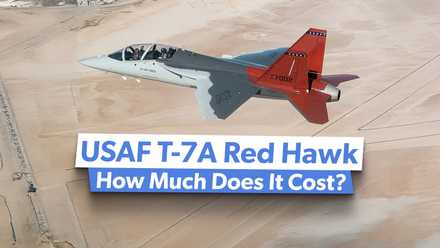
How Much Does The USAF T-7A Red Hawk Trainer Cost?
Get the rundown on the procurement of the T-7A Red Hawk, a new jet trainer designed to build the USAF’s future fighter pilots.
Refining The 5th-Generation Of Air Power

The T-7A shifts the focus from how to fly the plane to how to manage the mission. The aircraft can simulate radar, targeting pods, and adversary threats directly on the cockpit displays without needing expensive external pods. The large area display and Hands-On Throttle-and-Stick setup mirror the stealth, 5th-gen F-35 and F-22. With the Red Hawk, pilots learn sensor fusion and data management from day one.
There is a ‘stadium seating’ backseat that gives trainer pilots far greater ability to observe and instruct students in any phase of flight, unlike the T-38. The Red Hawk is also designed as a digital ecosystem rather than just a replacement jet to maximize its new design and features.
The live virtual constructive integration allows a pilot in the air to engage with virtual wingmen or enemies generated by ground-based simulators, creating complex combat scenarios that were impossible in the T-38. There is even software planned to integrate live feed with students and simulators on the ground for the most realistic experience possible before they step into the cockpit.