dailynewsnblog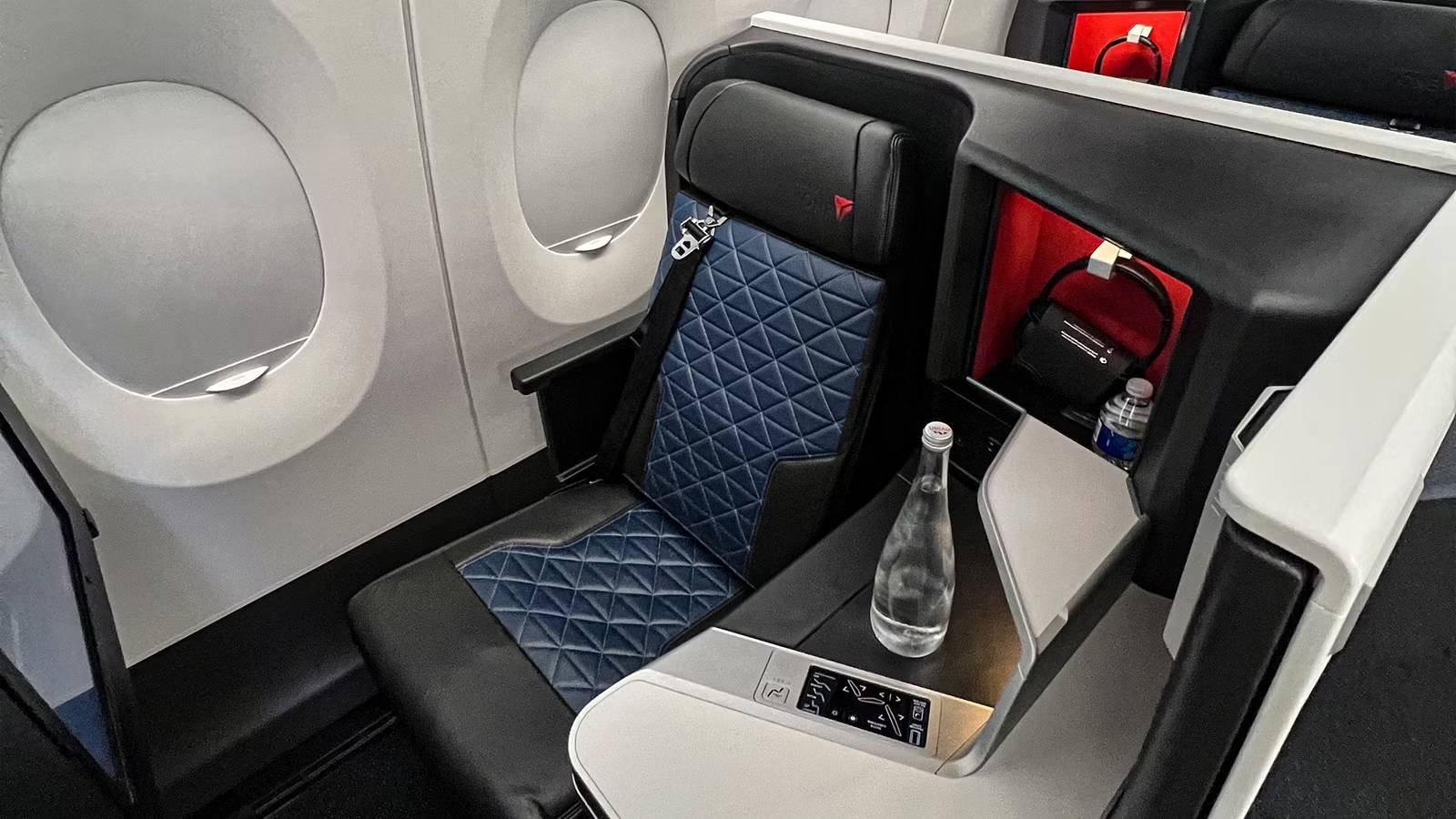
 Delta Air Lines has spent the past decade carefully refining its premium cabin strategy, creating a clear step between its Premium Economy product, Premium Select, and its long-haul business class experience, Delta One. At first glance, both cabins promise more comfort than standard economy, but the real distinction becomes immediately obvious when you examine how much physical space each cabin offers.
While Premium Select introduces noticeably wider seats, greater recline, and more legroom than the main cabin, Delta One takes a far more dramatic leap, transforming the passenger’s personal footprint into something closer to a private suite than a traditional airline seat. The difference is not simply incremental; it is structural, affecting everything from seat pitch and width to how passengers use the space during a long-haul flight.

The most straightforward way to understand the spatial difference between Delta One and Premium Select is by looking at seat pitch, which measures the distance between one seat and the one in front of it. Premium Select typically offers around 38 inches of pitch on aircraft such as the Airbus A350-900, which is already a significant improvement over standard economy seating.
However, Delta One operates in an entirely different category. Rather than being constrained by a fixed upright seat layout, the seats convert into fully flat beds, effectively eliminating the concept of pitch as it exists in economy class or premium economy. Instead of working within a limited forward space, passengers are given a longitudinal sleeping surface that stretches roughly the length of a human body.
This shift fundamentally changes how space is experienced. In Premium Select, passengers remain seated even when reclining, meaning their usable space is still defined by the seat in front of them. In Delta One, the seat transforms into a bed that extends forward without the same physical limitations, allowing passengers to fully stretch out rather than simply recline. The result is that while Premium Select increases comfort within a traditional seating framework, Delta One redefines the framework entirely, giving passengers a much larger usable footprint over the duration of the flight.
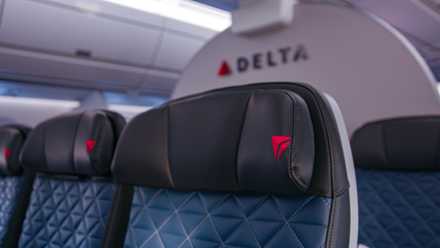
What Are The Benefits Of Flying Delta Air Lines’ Premium Select?
The SkyTeam carrier’s premium economy product offers many perks for passengers.
Seat Width & Shoulder Room

Delta Air Lines | Simple Flying
Beyond pitch, seat width is another key metric that highlights the spatial gap between the  SkyTeam carrier’s two cabins. Premium Select seats generally measure 18.5 to 19 inches wide, offering a noticeable yet modest increase over economy-class seating.
Delta One seats, by contrast, are significantly wider, often exceeding 20 inches and sometimes approaching 22 inches depending on the aircraft configuration. While this may not sound like a dramatic difference numerically, the added inches translate into a much more comfortable shoulder and arm experience, especially on long-haul flights where passengers remain seated or lying down for extended periods. More importantly, Delta One seats are designed with additional surface areas beyond the seat itself. Armrests, side consoles, and storage compartments expand the perceived width of the space, allowing passengers to spread out personal items without encroaching on their seating area.
In Premium Select, passengers still share armrests and have limited lateral space, meaning the experience, while improved, still resembles a traditional row-based layout. Delta One eliminates much of this constraint by providing individual seating pods that isolate each passenger’s space, making the cabin feel far less crowded.
Cabin Layout, Density & Privacy

Perhaps the most significant contributor to the sense of space is the overall cabin layout, which directly influences both density and privacy. Premium Select is typically arranged in a 2-4-2 configuration on widebody aircraft, meaning up to eight passengers share each row. This layout, while more spacious than economy, still reflects a high-density seating approach that maximizes capacity.
Delta One, on the other hand, usually adopts a 1-2-1 configuration, ensuring that every passenger has direct aisle access. This dramatically reduces the number of seats per row and increases the amount of space allocated to each passenger. The reduced density not only creates a more open physical environment but also enhances the sense of exclusivity within the cabin.
In addition to spacing, privacy is crucial. Delta One suites feature high walls and, in many cases, sliding doors that create a semi-enclosed personal area. This design gives passengers a sense of separation from the rest of the cabin, significantly enhancing the perception of space. Meanwhile, Premium Select does not offer this level of privacy. Seats are open and arranged in rows, with only minimal dividers between passengers, meaning that while there is more room than economy, the environment remains shared and visually connected.
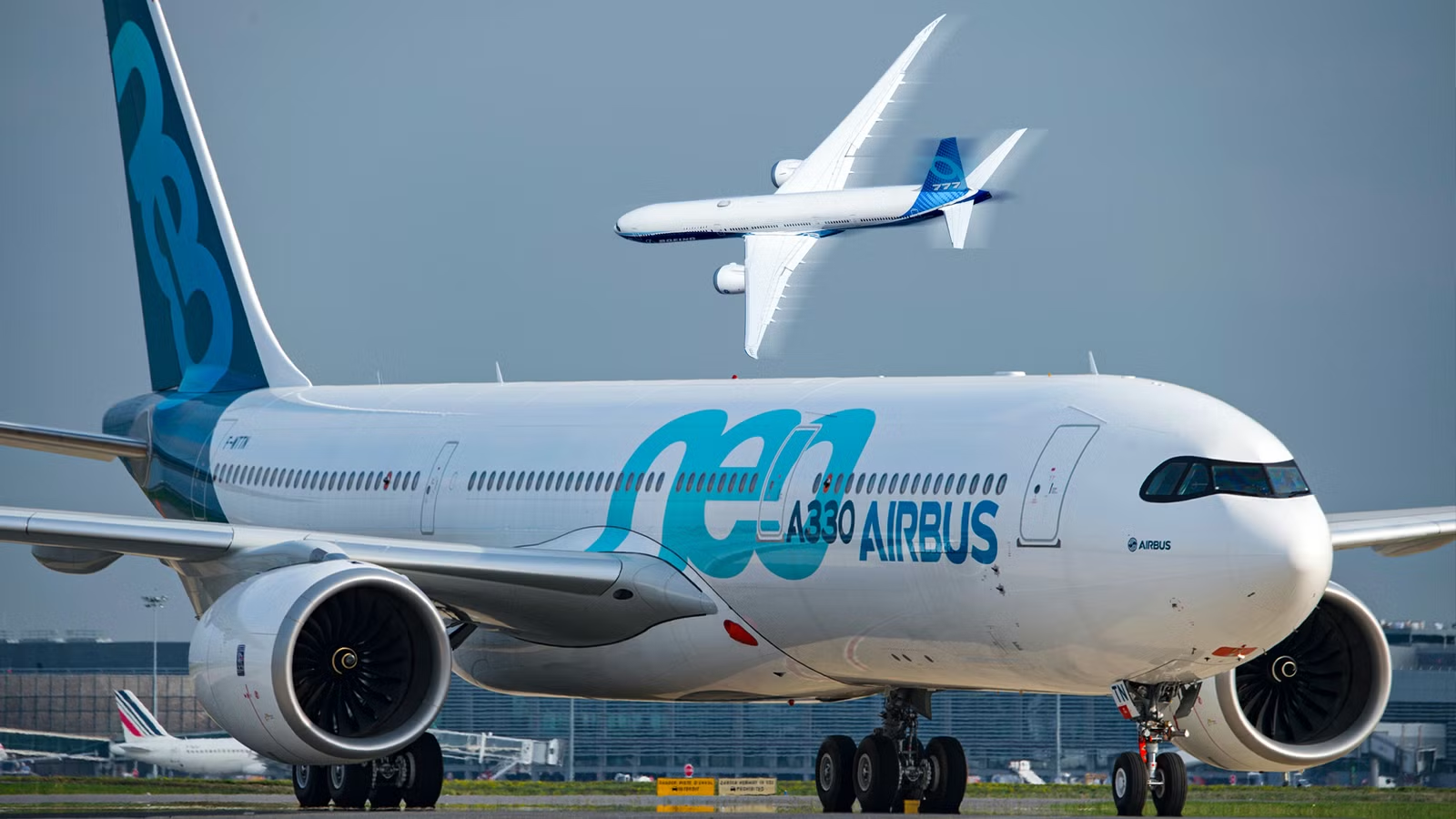
The latest data from ch-aviation shows that Delta currently operates several different aircraft types that feature the Delta One product, including the A330-900neo, A350-900, and the Boeing 767-300ER:
|
Aircraft |
Number In Fleet |
|---|---|
|
Airbus A321neo |
87 |
|
Airbus A330-200 |
11 |
|
Airbus A330-300 |
31 |
|
Airbus A330-900neo |
39 |
|
Airbus A350-900 |
40 |
|
Boeing 757-200 |
75 |
|
Boeing 767-300ER |
37 |
|
Boeing 767-400ER |
21 |
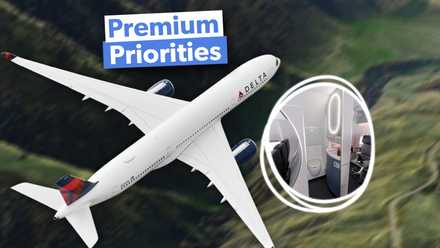
What You’ll Find On Delta Air Lines’ Luxuriously Retrofitted Airbus A350s
Delta Air Lines is home to 29 A30s in its fleet, with another 15 to arrive in the next few years.
Recline Versus Lie-Flat Functionality

Another critical factor in understanding spatial differences is how each seat functions when adjusted. Premium Select seats offer a deeper recline than economy seats, along with features like leg rests and footrests that help passengers relax during the flight. Despite these enhancements, the seat remains fundamentally a reclining chair, the passenger’s body remains angled, and available space is limited by the seat structure and the row in front.
Delta One’s lie-flat functionality, however, transforms the seat into a completely horizontal bed. This change allows passengers to occupy the full length of their seating area, distributing their weight evenly and eliminating pressure points. The spatial implications here are profound: in Premium Select, comfort improvements are achieved within a seated posture, whereas in Delta One, the entire concept of posture changes. Passengers are no longer confined to a seated position, which makes the space feel significantly larger and more versatile, particularly on long-haul and overnight routes.
When it comes to Delta Air Lines’ Premium Select product, this is found onboard the following aircraft:
|
Aircraft |
Number In Fleet |
|---|---|
|
Airbus A330-200 |
11 |
|
Airbus A330-300 |
31 |
|
Airbus A330-900neo |
39 |
|
Airbus A350-900 |
40 |
|
Boeing 767-300ER |
37 |
|
Boeing 767-400ER |
21 |
Both Delta One and Premium Select are planned to be available on the A350-1000, the largest variant of the popular aircraft family, which will begin to join Delta’s fleet in 2027.
Storage, Surfaces & Usable Space

Channing Reid
The difference in space between Delta One and Premium Select extends beyond the seat itself to include storage and surface areas. Premium Select offers limited storage, typically including a seatback pocket, a tray table, and a few additional compartments.
Delta One significantly expands on this by incorporating multiple storage areas, including side compartments, dedicated shelves, and larger tray tables for dining or work. These features allow passengers to keep personal items organized and within reach without cluttering their immediate seating area.
The presence of additional surfaces also enhances usability. In Delta One, passengers can comfortably use a laptop, enjoy a full meal service, or manage personal belongings simultaneously without feeling restricted. In Premium Select, the more limited surface area often requires passengers to prioritize how they use the available space. This increase in usable space contributes to the overall perception of spaciousness, as passengers can interact with their environment more freely.
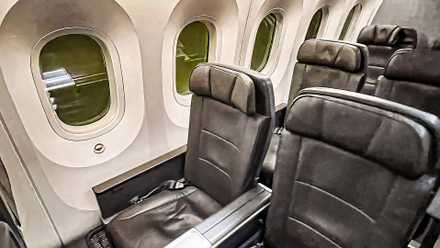
The US Airlines With The Most Spacious Premium Economy Seats In 2026
Across major US air carriers, premium economy is delivering on comfort. Let’s look at some of the best seats available with top American carriers.
Overall Spatial Experience

When comparing Delta One and Premium Select, it becomes clear that the difference in space is not defined by a single measurement but by a combination of factors that work together to create entirely different experiences. Premium Select enhances the traditional airline seat by adding more room and comfort, while remaining within the boundaries of a conventional cabin layout.
Delta One, by contrast, reimagines the use of space in the aircraft cabin through lie-flat beds, suite-style seating, reduced density, and expanded storage. The result is an environment that supports a wider range of activities, from sleeping and dining to working and relaxing, without the constraints typically associated with air travel.
Passengers moving from Premium Select to Delta One are not simply gaining a few extra inches; they are transitioning into a different category of travel, where space is designed to provide a significantly higher level of comfort and flexibility throughout the journey.
Delta One is primarily found on long-haul international routes, such as  Hartsfield-Jackson Atlanta International Airport (ATL) to Cape Town International Airport (CPT), or
  John F. Kennedy International Airport (JFK) to
  London Heathrow Airport (LHR), as well as on select transcontinental and long-haul domestic services. In the US, it is most consistently offered on premium transcontinental routes such as JFK to both
  Los Angeles International Airport (LAX) and San Francisco International Airport (SFO).