dailynewsnblog
The US aviation system is entering a period of transformation unlike anything seen in decades, as airports across the country embark on massive expansion and modernization programs designed to meet surging demand while redefining the passenger experience. From  John F. Kennedy International Airport (JFK) to
  Los Angeles International Airport (LAX), aging terminals built in the mid-20th century are being replaced or reimagined, with billions of dollars flowing into projects that emphasize space, efficiency, sustainability, and global competitiveness.
These developments are not isolated upgrades but part of a coordinated shift in how airports function, driven by record-breaking passenger volumes, the need to compete with modern international hubs, and the growing expectation that airports serve as destinations in their own right. The result is a new generation of terminals and infrastructure projects that promise to reshape air travel in the US over the next decade.
Airport Investment Boom Across The US

What sets the current wave of airport construction apart is its sheer scale and ambition, with tens of billions of dollars committed to projects that go far beyond routine renovations and instead fundamentally reconfigure how major hubs operate. For decades, many of the country’s largest airports relied on infrastructure built during the Cold War era, facilities that were designed for a very different kind of travel environment, one with fewer passengers, simpler security requirements, and limited international connectivity.
Today’s projects reflect a recognition that those older systems can no longer keep pace with modern aviation demands, as airports are now expected to handle larger aircraft, higher passenger throughput, and increasingly complex logistical operations while maintaining comfort and efficiency. This has led to a focus on building larger terminals with more gates, wider concourses, improved passenger flow, and integrated technology systems that reduce congestion and streamline the travel process.
At the same time, airports are competing more directly with one another on a global stage, particularly for long-haul international traffic, which has raised expectations around amenities such as lounges, dining, and retail. In many cases, new terminals are being designed with floor-to-ceiling windows, expansive public spaces, and architectural elements that reflect local identity, turning airports into showcases for their regions rather than simply transit points.

Here’s How The World’s Busiest Airport Is Expanding Even More
Huge development projects are ensuring ATL has the infrastructure to stay at the front of the pack.
New York-JFK’s $19 Billion Transformation

Port Authority Of New York & New Jersey | Simple Flying
Nowhere is this transformation more visible than at JFK, where a staggering $19 billion redevelopment program is reshaping one of the country’s most important international gateways. At the center of this effort is the New Terminal 1, a $9.5 billion project that represents the largest public-private partnership in US aviation history and will ultimately become the airport’s largest terminal.
Built on the sites of the current Terminal 1 and the former Terminals 2 and 3, the new facility will span 2.6 million square feet and include 23 gates, with construction scheduled for 2026-2030. The design places a heavy emphasis on passenger experience, incorporating more than 300,000 square feet of dining, retail, and lounge space, all situated behind expansive glass walls that bring in natural light and create a sense of openness rarely associated with older terminals at the major hub for both  American Airlines and
  Delta Air Lines.
On the airport’s north side, the development of Terminal 6 is proceeding in parallel, adding another 1.2 million square feet of space and linking directly with the existing Terminal 5, currently used by JetBlue Airways, to create a seamless passenger experience across multiple facilities. With ten gates planned, the first phase of Terminal 6 is expected to open in 2026, with full completion by 2028.
These terminal projects are complemented by broader infrastructure upgrades, including a $1.2 billion overhaul of roadways and the construction of a new ground transportation center, which together aim to address long-standing congestion issues and improve access to the airport. The result will be a dramatically reconfigured JFK designed not only to handle more passengers but to position itself as a leading global hub.
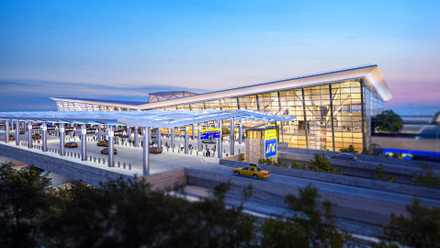
Insanely Modern: Inside New York-JFK’s New Terminal 1 & Its 22 Widebody Gates
A closer look at the wonderful new terminal coming to JFK Airport.
Dallas/Fort Worth’s Strategy

In Texas,  Dallas/Fort Worth International Airport (DFW) is undertaking one of the largest single-airport capital programs in US history through its $12 billion DFW Forward plan, an initiative that reflects the airport’s growing importance as a central hub for domestic and international travel. The program includes a comprehensive transformation of Terminal C, one of the airport’s oldest facilities, as well as the construction of an entirely new Terminal F.
Terminal F represents a particularly innovative approach to airport construction, as it uses modular construction techniques that allow key components, such as mechanical and electrical systems, to be assembled off-site before being transported into place. These modules are moved across closed runways using self-propelled vehicles, a method that reduces construction time and minimizes disruption to ongoing airport operations.
The new terminal will add nine gates by 2026, with additional expansion planned in later phases, while the renovation of Terminal C will bring it in line with the standards set by newer facilities at the airport. Together, these projects are designed to increase capacity, improve efficiency, and enhance the overall passenger experience, ensuring that DFW remains competitive as one of the nation’s busiest and most strategically located airports.
Beyond the physical expansion, the DFW Forward plan also reflects a broader shift toward flexibility and scalability in airport design, with infrastructure that can adapt to changing airline needs and evolving travel patterns. This approach is increasingly important in an industry where demand can shift rapidly, requiring airports to remain agile while continuing to deliver high service levels.
Chicago O’Hare’s Long-Term Expansion Vision

 Chicago O’Hare International Airport (ORD), long known for its complex layout and heavy traffic, is also undergoing a significant transformation through the ORDNext program, which aims to modernize and expand the airport over the coming decade. Central to this effort is the construction of new concourses and a major terminal redevelopment that will fundamentally change the airport’s footprint.
The addition of Concourse D, a satellite facility with 19 gates, marks the first new concourse built at O’Hare in more than 30 years and is expected to open in the late 2028 timeframe. This will be followed by the construction of a new Global Terminal, which will replace Terminal 2 and feature a facility more than twice its current size, designed to accommodate both domestic and international operations in a more integrated layout.
Further expansion will come in the form of Concourse E, another satellite facility that will add 24 gates, significantly increasing the airport’s overall capacity. Together, these projects aim to reduce delays, improve passenger flow, and create a more intuitive travel experience, addressing many of the challenges historically associated with O’Hare.
The scale of the ORDNext program reflects the airport’s critical role in the national aviation network, serving as a major hub for connecting traffic and a key gateway for international travel. By investing in new infrastructure and rethinking its layout, ORD is positioning itself to handle future growth while maintaining its status as one of the country’s most important aviation centers.
Los Angeles’s Ground Transportation Revolution

While many airport projects focus primarily on terminals and gates, Los Angeles International Airport (LAX) is taking a different approach by placing a significant emphasis on ground transportation as part of its broader $30 billion modernization effort. The airport’s landside access modernization program is one of the most ambitious infrastructure initiatives in US aviation, aiming to fundamentally change how passengers move to and from the airport.
Already completed elements include a consolidated car rental facility and a new transit station that connects to the city’s expanding metro system, specifically the C and K lines. These developments are designed to reduce congestion, improve connectivity, and provide travelers with more options for reaching the airport without relying solely on private vehicles.
The centerpiece of the program, however, is an automated people mover that will link all terminals, parking facilities, and the new transit station, creating a seamless transportation network that integrates air travel with the broader urban environment. Once completed, this system is expected to significantly reduce travel times within the airport and alleviate some of the traffic challenges that have long plagued the airport.
This focus on ground transportation reflects a broader recognition that the airport experience begins long before passengers reach the terminal and continues after they leave, making connectivity a critical component of overall efficiency. By investing heavily in this area, LAX is setting a new standard for how airports can integrate with their surrounding cities.

The European Airports Undergoing Major Improvement Projects
From London Heathrow to Florence, airport expansion projects are well underway throughout Europe.
Transformations Beyond The Largest Hubs

Not all transformative airport projects are concentrated at the very largest hubs, as a number of mid-sized and fast-growing airports are also undertaking significant expansions that reflect changing travel patterns and regional growth.  Pittsburgh International Airport (PIT), for example, opened its new $1.57 billion landside terminal in November 2025, a 700,000-square-foot facility designed to consolidate operations and dramatically improve efficiency.
The new terminal replaces an older system that required passengers to take a train to reach the gates, instead offering a more direct journey that roughly halves the time from entrance to gate. This improvement is achieved through a streamlined layout, upgraded security screening, and better integration of airline functions, all of which contribute to a smoother overall experience.
At the same time, Nashville International Airport (BNA) continues to expand through its $1.5 billion New Horizons plan, which includes adding new gates, reconstructing concourses, and a complete overhaul of baggage handling systems. The recent extension of Concourse D added five gates, while future phases will introduce outdoor terraces and enhanced passenger amenities, reflecting the city’s rapid growth and increasing importance as an aviation market.
On the West Coast,  San Francisco International Airport (SFO) has begun a $2.6 billion modernization of Terminal 3, adding 200,000 square feet of space while continuing a broader sustainability initiative aimed at achieving zero carbon emissions, zero waste, and zero net energy usage. This project highlights the growing importance of environmental considerations in airport design, as operators seek to reduce their environmental impact while maintaining high service levels. Together, these developments demonstrate that the transformation of US airports is not limited to a handful of major cities but is instead a nationwide phenomenon, with facilities of all sizes investing in the infrastructure needed to support the future of air travel.