dailynewsnblog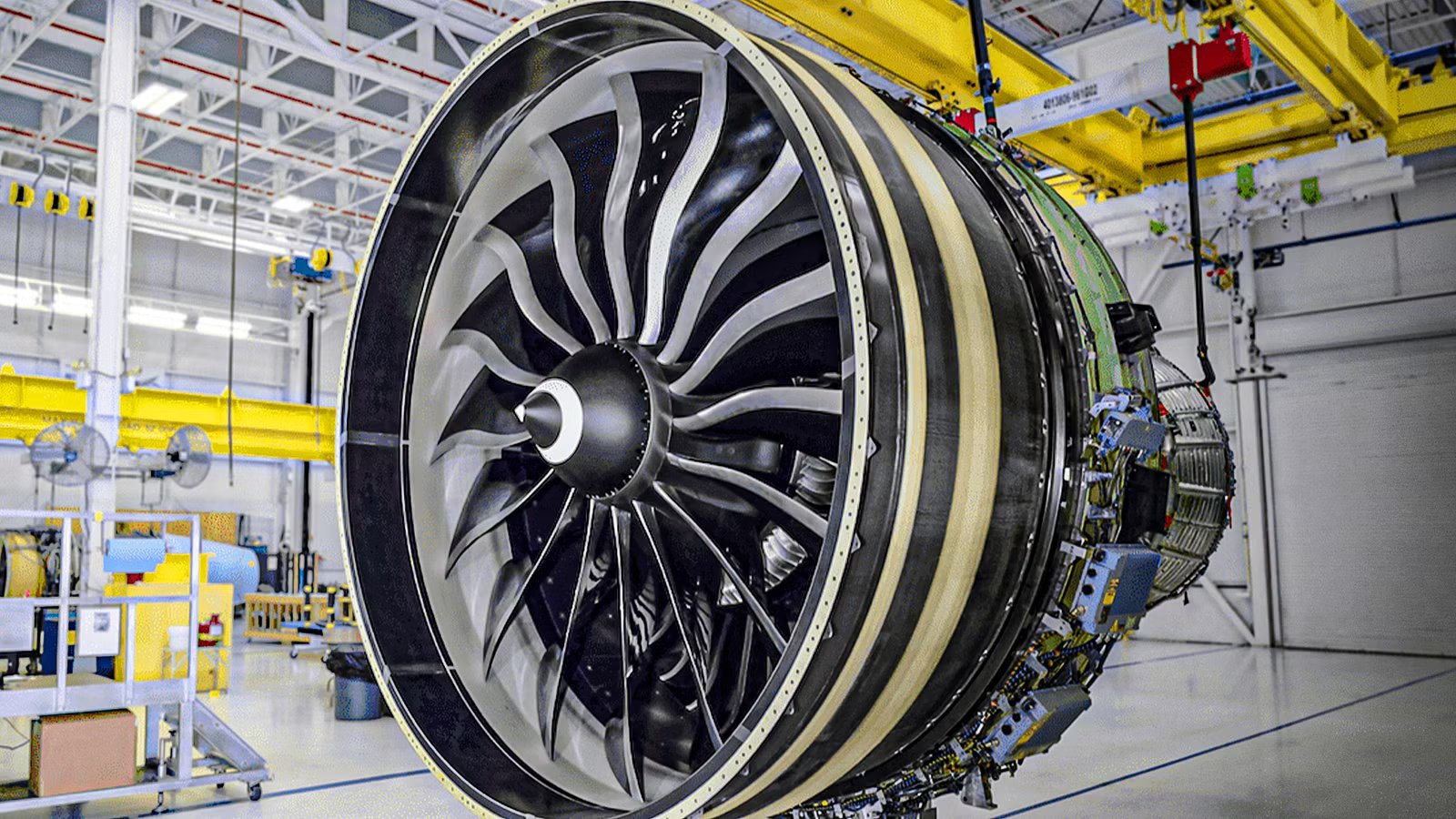
The short answer is yes! With an average list price ranging between $40 to $45 million per engine, and each Boeing 777X aircraft requiring two engines to fly, the cost of the engine package per aircraft an airline orders will exceed the cost of most of the latest generation private jet aircraft in production today.
The reason for the high prices can be attributed to the fact that the General Electric GE9X engines are the largest and most powerful jet engines produced in commercial aviation. While they were due to enter commercial service six years ago, it has not yet happened because the aircraft these engines exclusively power is still awaiting certification and is not expected to enter service until next year.
Around $80-90 Million For A Pair Of GE9X Engines

Developed by General Electric (GE) to power the next-generation widebody jet produced by Boeing, the 777X, the list price for a single GE9X engine can cost within the range of $40-45 million. Of course, since the 777X is a twin-engine aircraft, an operator would have to purchase a minimum of two of these engines for every airframe they order, increasing the engine costs to $80-90 million per aircraft.
Additionally, some airlines also purchase additional engines to ensure easy access to spare powerplants and minimize disruptions in the event of unforeseen maintenance requirements. However, considering the premise of an operator ordering just two engines per 777X airframe, the costs still exceed those of most next-generation private jet aircraft available on the market today.
Brand-new, latest-generation private jet aircraft, such as the Gulfstream G800, have a list price of around $72 million, while the Bombardier Global 8000, according to data published by Reuters, has a list price of $78 million. That being said, it is quite common for operators (especially those making large orders) to get significant discounts from the manufacturer, and these discounted prices are rarely disclosed to the public.
There Are Several Exceptions

While the above-listed aircraft, such as the G800 or the Global 8000, have a list price of around $75 million, it does not mean they cannot be more expensive. Quite often, operators or even individuals who purchase these jets, fit the aircraft with additional features, modifications, and configurations that are made available by the manufacturers, which can drive up the price significantly.
For example, while the list price for a standard Gulfstream G650ER jet is around $70 million, according to a report by L’Officiel, celebrity Kim Kardashian owns a Gulfstream G650ER, which was built from scratch for $95 million, onto which further customization worth $45 million was added, increasing the cost of the jet to $140 million, with some other sources also claiming the jet to cost as high as $150 million, which far exceeds the cost of a pair of GE9X engines.
Beyond these modified jets, there are also other, larger jets, manufactured by the likes of Boeing and Airbus. These jets are known as Boeing Business Jets (BBJs) or Airbus Corporate Jets (ACJs), which are regular passenger jets such as the 737, 787, or the Airbus A320, which have been configured with ultra-luxurious interiors, designed for maximum comfort, and to be used in charter aviation space, rather than the typical commercial aviation operations. These jets will also be a lot more expensive than the GE9X engines used to power the 777X.

5 Celebrities With The Most Expensive Private Jets In 2026, Worth Over $500 Million Combined
These celebrities are big fans of private aviation.
Technical Specifications Of The GE9X

Considering this engine is marketed as the world’s largest and most powerful engine, what does the GE9X powerplant bring to the table? In terms of size, the engine is the largest on the market, with data published by GE indicating a front fan diameter of 134 inches (11.2 ft / 3.4 meters), which means the engine cowling (the housing of the engine components) is even larger at the front. In fact, the front of the GE9X engine is larger than the fuselage of the Boeing 737 aircraft.
The increased size allows the engine a higher bypass ratio, enabling the powerplant to deliver more power and operate with better fuel efficiency. The following are the engine’s technical specifications, as published by GE:
|
Specification |
Details |
|---|---|
|
Fan diameter |
134 inches (11.2 ft / 3.4 meters) |
|
Number of fan blades |
16 fan blades made of advanced composite materials. Six fewer blades than engines on previous 777 variants. |
|
Thrust |
Up to 134,000 lbs |
|
Bypass ratio |
10:1 |
|
Efficiency (marketed) |
5% lower fuel consumption than any twin-aisle engine. 10% lower fuel consumption than the previous 777 variants. |
Compared to the GE9X, engines that are currently used by modern widebody aircraft that are currently in production, offer lower thrust/power. On the Boeing 787 Dreamliner jets, the Rolls-Royce Trent 1000 engine produces thrust in the range of 53,000 – 78,000 lbs, while the alternative GEnx-1B produces between 69,800 – 76,100 lbs, depending on the Dreamliner variant. On the other hand, the maximum thrust produced by the Rolls-Royce Trent XWB-97 on the larger Airbus A350-1000 is 97,000 lbs. This conclusively proves that the GE9X is more powerful than the engine currently being used by modern commercial jets.
Emirates Will Have The Most Number Of GE9X Engines

As established above, each of the 777X aircraft will need two GE9X engines for operations. Therefore, it can be considered that the largest operator of the 777X will also have the most number of engines. In this case, the honor would go to the Middle Eastern giant,  Emirates.
According to the latest orders and delivery data from Boeing, the manufacturer has received orders for a total of 624 777X airframes. Of these, the Dubai-based carrier accounts for 270 jets, which account for 43.3% of the total orders for the type. This includes the airline’s latest order of 65 777-9 aircraft, along with 130 GE9X engines, worth $38 billion, that was announced last November, at the  Dubai Airshow 2025.
Overall, with 270 jets on order, the airline will also be receiving 540 engines to power these aircraft in the years to come. Considering the airline has its own maintenance facilities and does a lot of maintenance work in-house with Emirates Engineering, along with the fact that it stocks a comprehensive number of spare parts and equipment, it is possible that the carrier also has spare engines on order.

Spare Planes: How Many Do Airlines Have On Tap?
Airlines don’t keep many spare aircraft lying around idle, but there are other ways airlines can ensure some flexibility.
The GE9X Will Power Three 777X Variants

While several aircraft types have multiple engines an operator can choose from, the 777X only has the GE9X as the engine option. So what do these engines allow the upcoming aircraft to do? The first of the variants in the series to enter commercial service will be the Boeing 777-9, which is a passenger aircraft and the largest variant of the series. This variant will be followed by the 777-8F and the 777-8 aircraft.
Built based on the popular 777 platform, the 777X is not only the next generation 777s, but the jet (especially the larger -9 variant) offers itself as a suitable twin-engine replacement for the Boeing 747 and, under broader considerations, even the Airbus A380. As per Boeing’s specification, these are the aircraft’s capabilities:
|
Boeing 777X Variants |
777-9 |
777-8 |
777-8F |
|---|---|---|---|
|
Passenger/Revenue Payload Capacity |
426 (two-class configuration) |
395 (two-class configuration) |
224,000 lbs (112 tons) |
|
Operational Range |
7,285 NM (13,500 km) |
8,745 NM (16,190 km) |
4,410 NM (8,167 km) |
|
Engine Used |
GE9X |
||
While the 777-9 is in its advanced stages of testing, with the aircraft expected to enter commercial service sometime next year with Lufthansa, the second variant to enter commercial service will most likely be the freighter variant, 777-8F. Reports indicate that the first of the 777-8F airframes has already been assembled at its facility in Everett and will soon go through the pre-flight testing process, where the aircraft will have its engines installed, and rigorous ground testing will be conducted.
Can The Engine Handle A Stretch Version?

Speaking of the 777X and its variants, in recent times, discussions have arisen regarding Boeing potentially developing a stretched version of the 777-9 (there are similar talks about potentially stretching the A350-1000 as well). A case study looking into this was first hinted at the aforementioned 2025 Dubai Airshow conference when Emirates ordered an additional 65 examples of the type. If this were to happen, the question then arises, will the existing GE9X engine be capable of supporting a stretched 777-9 variant?
Ultimately, it would be for the manufacturers, such as Boeing and GE, to decide if and when they decide to develop a stretched version. Looking at past aircraft developments, examples can be found of airlines utilizing existing engines for different variants. This is evident from both the Boeing 777-200LR and the 777-300ER variants, utilizing the GE90-115BL powerplants, despite the latter being a larger airframe capable of accommodating more passengers and cargo. The same can be said for the Dreamliner jets, as all three variants have either the GEnx-1B or the Trent 1000 engines as their options, and the two variants of the Airbus A330neo are being powered by the Rolls-Royce Trent 7000.
That being said, this is not always the case, as seen with the Airbus A350 family. Although all three variants are allocated the Rolls-Royce XWB engines, the larger A350-1000, along with the upcoming A350F freight jet, use the XWB-97 variant; the smaller passenger variant, the A350-900, is allocated the XWB-84 engine.
The bottom line is, several factors such as power requirements, existing wing capabilities, and advancements of technology, along with the certification process, will determine if a new engine (or engine variant) is required for a potential stretched 777X. That being said, a pair of these engines is guaranteed to be more expensive than most private jets available on the market!