dailynewsnblog
The F-35 Lightning II is the most expensive weapons program in human history, but surprisingly, it is slower than several of the aircraft it was designed to replace. With a top speed of Mach 1.6 (~1,200 mph), the fifth-generation stealth fighter cannot keep pace with the 1970s-era F-15 Eagle (Mach 2.5), the F-16 Fighting Falcon (Mach 2.0), or even the retired F-4 Phantom II (Mach 2.2) — aircraft that first flew decades before the Lightning II was conceived. Most remarkably of all, the F-35 flies at less than half the top speed of the SR-71 Blackbird, a reconnaissance platform that entered service in 1966 and still holds the absolute speed record for an air-breathing jet aircraft. Our article explains why the world’s costliest fighter is also one of its slowest, and why that is a feature rather than a flaw.
Understanding this paradox means following two parallel threads: the engineering choices embedded in the F-35’s design, and the combat data that caused the US military to fundamentally rethink what a fighter jet is actually for. The story begins over the skies of Vietnam, runs through the Cold War’s most audacious reconnaissance missions, and arrives at a present in which the fastest object in an air battle is almost never the aircraft but the missile. Speed, it turns out, is the wrong question. The right question is survivability, and the two answers look very different depending on which era of air warfare you are designing for.
A $2 Trillion Program That Can’t Top Mach 1.6

The scale of the Lockheed Martin F-35 program is difficult to overstate. Total acquisition costs have already exceeded $428 billion , 84% more than the original $233 billion estimate, and a 2024 Government Accountability Office report placed the full lifecycle cost of operating and sustaining the fleet through 2088 at over $2 trillion.
The Air Force currently spends $6.6 million per aircraft per year just to keep an F-35A flying, well above the original $4.1 million affordability target. In exchange for this investment, the US military receives an aircraft that tops out at Mach 1.6 — a figure that would have been considered disappointing for a frontline fighter at any point after the mid-1950s.
The speed deficit becomes concrete when placed alongside the legacy aircraft the F-35 is replacing or operating alongside. According to Simple Flying, the McDonnell Douglas F-15 Eagle, which entered service in 1976, has a top speed of Mach 2.5. The Lockheed F-16 Fighting Falcon, designed in the same era, reaches Mach 2.0. The McDonnell Douglas F-4 Phantom II, which flew combat missions in Vietnam before the F-35’s design requirements even existed, was rated at Mach 2.2. Against all three of these aircraft, the F-35 is slower by a substantial margin, because speed was deliberately not the priority.
What the F-35 does offer in exchange for its modest top speed is a sensor suite, stealth profile, and networked capability that no Cold War-era aircraft approaches. As reported by National Security Magazine, its AN/APG-81 active electronically scanned array (AESA) radar, Distributed Aperture System (DAS), and Electro-Optical Targeting System (EOTS) collectively allow the aircraft to detect, track, and engage threats far beyond visual range — engagements in which absolute top speed is largely irrelevant. The F-35 was designed not to outrun threats, but to remain entirely invisible to them.
Vietnam And The Gulf War: How Combat Data Grounded The Speed Race

The shift away from speed as the defining metric of fighter performance began before the F-35 program, with data collected over the skies of Vietnam in the 1960s, and was decisively reinforced in the Persian Gulf a quarter-century later. After analysts reviewed more than 100,000 combat sorties flown during the Vietnam War, they found that no American pilot had ever flown above Mach 1.6 in actual combat, and that only a handful of minutes across the entire conflict were spent above Mach 1.2. Aircraft capable of Mach 2.0 and beyond were routinely flying subsonic speeds during engagements because the geometry of close-in air combat, including rapid turns, reaction time, and energy management, penalized the straight-line velocity that maximum speed figures represent.
The Persian Gulf War of 1991 reinforced this lesson at scale. According to SlashGear, it was the largest air campaign since Vietnam, with multiple US aircraft types capable of Mach 2 operating simultaneously — yet in no engagement did any American aircraft exceed Mach 1.03, even when enemy combatants flew faster. The consistent pattern across two major air campaigns pointed to the uncomfortable truth that the operational environment of real air combat rarely requires or rewards a fighter’s maximum rated speed.
Sustained high-speed flight burns fuel at a dramatic rate, reduces maneuverability by increasing the turn radius, and generates significant thermal signatures detectable by infrared systems.
These findings shaped the entire philosophy behind fifth-generation fighter design. Rather than optimizing airframes to sustain exceptionally high speeds, US military planners instead turned their attention to thrust-to-weight ratio for maneuverability, low-observable stealth coatings, and networked situational awareness — capabilities that translate directly into combat effectiveness in ways that an extra 400 mph of top speed does not. The speed race that defined the 1950s and early 1960s, when jet designers chased Mach 2 and then Mach 3 as primary engineering goals, was effectively over by the time the first F-15s rolled off the production line.
Speed Comparison Table: F-35 vs. Contemporaries and Legacy Aircraft
|
Aircraft |
Service Entry |
Top Speed |
Generation |
|
SR-71 Blackbird |
1966 |
Mach 3.3+ (2,193 mph) |
Reconnaissance |
|
F-4 Phantom II |
1960 |
Mach 2.2 (1,473 mph) |
3rd Gen Fighter |
|
F-15 Eagle |
1976 |
Mach 2.5 (1,875 mph) |
4th Gen Fighter |
|
F-16 Fighting Falcon |
1978 |
Mach 2.0 (1,500 mph) |
4th Gen Fighter |
|
F-22 Raptor |
2005 |
Mach 2.25 (1,500 mph+) |
5th Gen Fighter |
|
F-35 Lightning II |
2015 |
Mach 1.6 (1,200 mph) |
5th Gen Fighter |
The table above makes clear why raw speed figures alone do not make a plane the best in everything. The F-35, as the most recently designed aircraft in the group, sits at the bottom of the speed ranking because the requirements driving its design placed speed well below stealth, sensor integration, and electronic warfare capability in the priority order.
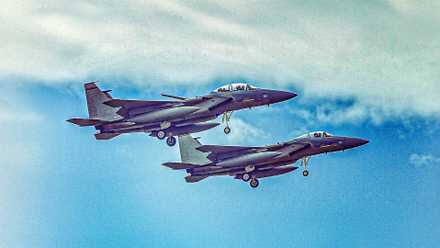
F-15 Vs. F-35: Which Fighter Jet Is Faster?
Each aircraft offers exceptional combat capabilities.
The SR-71 Blackbird: When Mach 3.3 Was The Only Armor You Needed

If the F-35 represents a deliberate sacrifice of speed, the SR-71 Blackbird represents speed taken to its logical extreme as a defense system. The aircraft’s official top speed stands at Mach 3.3, equivalent to approximately 2,193 mph (3,529 km/h) — though pilots who flew it have long suggested the classified operational ceiling was higher still, with credible accounts pointing to Mach 3.5 or beyond during certain missions, as per 19fortyfive. To put this in context: at Mach 3.3, the Blackbird covered a mile every 1.6 seconds.
The Blackbird’s Pratt & Whitney J58 engines were hybrid turbojet-ramjets that became more efficient as speed increased, a counterintuitive characteristic that turned velocity into a fuel advantage rather than a penalty.
As reported by Boltflight, air friction at these velocities generated surface temperatures exceeding 500°F (260°C), causing the titanium fuselage to physically expand by several inches during flight, which is why the Blackbird famously leaked fuel on the ground, its panels designed to seal only after thermal expansion at operating speed. The aircraft was built from titanium precisely because aluminum, the standard aerospace material of the era, would have softened and failed under the aerodynamic heating of sustained Mach 3+ flight.
The Blackbird’s legacy is a proof of concept that speed, taken far enough, becomes a kind of invulnerability. But that concept required a purpose-built airframe, purpose-built engines, and purpose-built fuel (the exotic JP-7, with an ignition point so high a match dropped into it would be extinguished), operating at altitudes where the atmosphere is barely thick enough to support flight at all. The question whether this approach remained viable for a frontline combat aircraft, which is very distinct from a reconnaissance platform, was decisively answered by the Vietnam War and the Gulf War long before the F-35’s design was finalized.
Why The F-35 Was Deliberately Slowed Down

The F-35’s Mach 1.6 ceiling is a design decision with a specific engineering rationale. During development, the F-35’s maximum sustained speed was reduced from the originally specified Mach 1.8 to Mach 1.6, reportedly to preserve stealthiness. Sustained high-speed flight at Mach 1.8 generated sufficient aerodynamic heating to begin degrading the low-observable coatings on the aircraft’s airframe — coatings that are among the most expensive and maintenance-intensive components of the entire platform. Reducing the top speed limit protected the stealth materials on which the aircraft’s entire strategic concept depends.
The afterburner problem runs deeper still. Using the afterburner to push the F-35 to its maximum speed makes the aircraft significantly more visible to enemy infrared sensors, because the intense heat signature of the afterburner flame plume is detectable at long range by modern passive IR search and track (IRST) systems. An F-35 at full military power with afterburner engaged is no longer a stealthy aircraft — it is a large, hot object moving quickly, which is precisely what modern long-range air defense systems are designed to detect and engage.
The aircraft’s stealth advantage, worth billions of dollars in design, production, and maintenance costs, is substantially negated the moment the throttle goes fully forward. The contrast with the SR-71 is stark: the Blackbird generated enormous heat signatures at speed, but those signatures were irrelevant because no interceptor missile of the era had the performance to reach its altitude and velocity, as noted by National Interest.
The F-35’s Pratt & Whitney F135 engine, the most powerful fighter engine ever built for a US aircraft, producing approximately 43,000 lbf of thrust in afterburner, is more than capable of pushing the airframe to higher speeds.
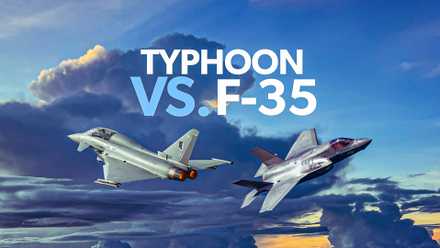
Is The Eurofighter Typhoon Faster Than The F-35?
A riveting race between two titans of the sky: does the Eurofighter Typhoon outrun the F-35?
The Threat That Made Speed Irrelevant: Adversary Missiles The F-35 Must Survive

To understand why the F-35’s Mach 1.6 ceiling is not a liability, it helps to look at the missiles it is actually designed to survive — and they are not American ones. The F-35’s adversaries in any realistic high-end conflict scenario would be equipped with Chinese and Russian-made air-to-air missiles that have fundamentally redrawn the engagement geometry of modern air combat. The central reality is that no current fighter aircraft can outrun a modern beyond-visual-range missile, and the weapons carried by peer and near-peer adversaries make this more true than ever. Against these threats, the difference between Mach 1.6 and Mach 2.5 is strategically meaningless; the only meaningful variable is whether the missile’s seeker can find you in the first place.
China’s primary BVR air-to-air missile, the PL-15, is the most directly relevant benchmark. It uses a dual-pulse solid-fuel rocket motor capable of reaching speeds greater than Mach 5, with a range of 120–190 nm (200–300 km) for the domestic PLAAF version, a figure that substantially outranges the AIM-120C/D AMRAAM variants that previously defined US air-to-air doctrine.
During the terminal phase of its flight, the PL-15’s second motor pulse re-ignites to restore velocity, meaning it arrives at the target at high speed even after a long flight. Its AESA radar seeker is specifically designed with improved resistance to electronic countermeasures and enhanced performance against low-observable targets. According to Defense Security, a Royal United Services Institute assessment concluded that the PL-15 outranges the AIM-120C/D AMRAAM series, a finding that drove the urgent development of the AIM-260 JATM as a US response.
Modern Adversary Air-to-Air Missile Performance
|
Missile |
Country |
Est. Speed |
Est. Range |
|
PL-15 |
China |
Mach 5+ |
108–162 nm (200–300 km) |
|
PL-17 / PL-XX |
China |
Mach 4+ |
162+ nm (300+ km) |
|
R-37M (RVV-BD) |
Russia |
Mach 5–6 |
108–216 nm (200–400 km) |
|
R-77M (K-77M) |
Russia |
Mach 4+ |
70–81 nm (130–150 km) |
|
Fakour-90 |
Iran |
Mach 3.5+ |
54 nm (~100 km) |
Russia’s contribution to the adversary missile threat is perhaps even more extreme in raw kinematic terms. The R-37M, currently deployed operationally on MiG-31BM interceptors, Su-35S fighters, and Su-57s, has an estimated speed approaching Mach 6 and a range of up to 400 km in its most capable configuration. In Ukraine, the R-37M has been fired at ranges that sometimes exceed 200 km, with Ukrainian pilots acknowledging that the missile’s extreme speed leaves little reaction time.
Iran, while a less sophisticated peer, fields the Fakour-90, a long-range AAM derived from the AIM-54 Phoenix, as its primary BVR weapon. Against all of these threats, a Mach 2.5 airframe offers no more kinematic escape than a Mach 1.6 one: the only viable defense is to avoid detection entirely, which is precisely what the F-35’s low-observable design is engineered to achieve.
The New Air Combat Calculus: Stealth, Sensors, And Networked Lethality

What has replaced speed as the primary measure of fighter effectiveness is a combination of attributes: low-observable stealth shaping, active electronically scanned array radars with real-time electronic beam steering, passive infrared search-and-track systems, datalink fusion, and the ability to operate as a node in a networked kill chain.
The F-35’s AN/APG-81 AESA radar can detect, track, and simultaneously engage multiple targets at ranges that exceed the visual horizon by an order of magnitude. The aircraft’s Multifunction Advanced Data Link (MADL) allows it to share targeting data in near-real time with other F-35s and compatible platforms without emitting a detectable signal. None of this requires Mach 2.5.
The US military’s reorientation away from speed toward stealth, sensors, and networked capabilities reflects lessons accumulated across every major air campaign since Vietnam — and the core lesson is that the aircraft that sees the enemy first and fires first from beyond the enemy’s detection range wins. An F-35 pilot who detects a hostile aircraft at 80 nautical miles and launches an AMRAAM before being detected has won an engagement that his opponent never knew was happening.
The SR-71’s extraordinary speed record will almost certainly never be beaten by a crewed aircraft. But the air combat environment it was designed for — where speed and altitude alone could defeat a threat — no longer exists. The F-35’s deliberate restraint at Mach 1.6 is, paradoxically, evidence that fighter aircraft design has grown more sophisticated, not less. The world’s most expensive fighter cannot outrun a 50-year-old aircraft. But in the threat environment of the 21st century, it doesn’t need to — and understanding why is the key to understanding modern air power.