dailynewsnblog
The US Air Force is the largest branch dedicated to air warfare in any military in the world. The colossal fleet of nearly 13,000 aircraft is dispersed around the globe to support US and allied operations wherever they are needed on short notice for anything from humanitarian aid to air policing and close air support.
In order to provide rapid response times and the best airframe for the job, whenever duty calls, the USAF maintains a large network of bases overseas. These facilities range from tiny posts at civil airfields or allied air bases to enormous dedicated airfields that support both long-term deployments and force surges when a crisis breaks out.
Two of the largest bases that support expeditionary operations in the USAF are located in the Pacific region, where there is a high concentration of American air assets from the Air Force, Navy, Marines, and even the Army. The Middle East is also home to a massive permanent site, and the long-standing Ramstein Air Base in Germany remains one of the largest in the network to this day.
6
Yokota Air Base
1,700 Acres

Some refer to Yokota as the Pentagon of the Pacific because it is not quite the largest in the chain of bases operated by the US in the region, but it is widely considered to be the most critical command and control center in Asia. The airfield serves as the headquarters of US Forces Japan as well as the Fifth Air Force. The unique aspect of its location is the close proximity to the metropolitan area of western Tokyo.
Yokota serves as the primary logistical hub for troops and supplies ferried throughout the Asia Pacific region and back to the United States. The 374th Airlift Wing operates C-130J Super Hercules and other transport planes in support of this fundamentally vital mission. The 11,000-foot runway on site can accommodate even the largest aircraft in the USAF.
The base population can be as high as 14,000, depending on the number of troops on deployment, as well as their dependents, defense contractors, and associated Japanese employees. The base also hosts the Japan Air Self-Defense Force Air Defense Command, facilitating daily coordination between US and Japanese air forces.
5
Incirlik Air Base
3,300 Acres

This strategic joint-use air base is shared by the US and Turkish Air Forces in Adana, Turkey. Many squadrons are deployed here to support operations in the Middle East, with permanent troops sustaining operations year-round in support of both American and Allied Air Forces. Unlike the Pacific bases, it is a Turkish-owned and commanded facility where the USAF operates as a guest tenant under NATO and bilateral agreements.
The sprawling industrial complex and airfield are located in Southeastern Turkey with a massive footprint that supports combat air operations. The primary runway is 10,000 feet long, and the alternate is 9,000 feet, giving the base the capacity to accommodate virtually any platform in the USAF. The airfield is also fortified with 57 hardened aircraft shelters designed to protect aircraft from conventional and nuclear attacks.
The 39th Air Base Wing is the permanent host unit station alongside the Turkish forces. Together, these units make Incirlik a key air combat support facility for regional deterrence on NATO’s southern flank. The US Air Force keeps a very large stockpile of conventional munitions and fuel on site with as many as 50 B61 nuclear bombs as part of NATO’s nuclear sharing agreement, though official US policy is to neither confirm nor deny their presence.
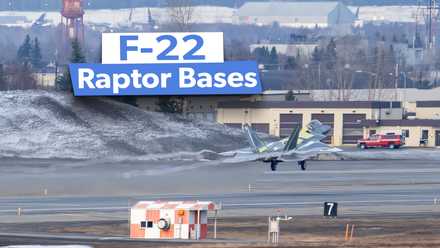
The US Air Force Bases Assigned F-22 Raptors
From the heartland to global deployments, the F-22 Raptor provides air superiority, supporting US troops and allies worldwide.
4
Ramstein Air Base
3,500 Acres

In Southwestern Germany, Ramstein is the headquarters of US Air Forces in Europe and a critical airfield across the pond that facilitates US operations around the globe. The base has one of the largest populations of Americans outside the US. The Kaiserslautern Military Community has grown with enormous troop concentrations, as well as families and contractors living on and around the facility for extended tours.
While Ramstein has a smaller land area than the Pacific giants like Andersen or Kadena, its operational density and role as the headquarters for two major commands make it one of the most critical installations in the world. There are over 1,300 structures alongside two primary runways, with one being just over 10,000 feet and the other slightly under. The wider supporting apparatus includes 30 other sites in the area, with a local population of around 54,000 Americans.
The base is essential for rapid mobility, hosting exercises like Agile Bison and the tactical live-fly exercise Ramstein Flag, which integrates air power from across 15+ NATO nations. It is home to both the USAFE and the NATO Allied Air Command. This makes Ramstein the key center for air defense and missile defense across the European alliance.
The base is a crucial global gateway for operations around the world conducted by both the US and its partners. The host unit is the 86th Airlift Wing, which operates the C-130J and other airlift platforms to support tactical deployment, airdrop, and air medical evacuation operations. Ramstein serves as the primary medical evacuation hub for three unified commands, administering more than 97% of patient movements from theaters of operation in Africa and the Middle East.
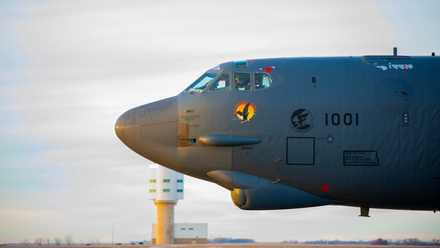
The 4 Largest Air Force Bases By Bomber Fleet Presence
A closer look at the homes of the USAF’s heaviest-hitters.
3
Al Udeid Air Base
11,000 Acres

Situated near the capital city of Qatar, this is the largest US base in the Middle East. Al Udeid is a joint facility outside of Doha that hosts a massive forward headquarters for the US Central Command. The base has the longest runway in the Gulf region, measuring 12,300 feet (3,750 meters). As a joint facility, Qatar recently invested over $8 billion to upgrade the base from a limited expeditionary site to a permanent facility with hardened structures and underground hangars.
As the forward headquarters for CENTCOM, it is home to the combined air operations center that coordinates all traffic for US and Coalition aircraft in the area. A large number of sorties have been launched to Egypt, Kazakhstan, and Iran since the beginning of the year. The base drew attention during Operation Epic Fury when three Boeing F-15E Strike Eagle aircraft were shot down by friendly fire nearby.
The base is home to the 379th Air Expeditionary Wing, which has nearly 100 aircraft in a fleet composed of tankers, reconnaissance platforms, and airlift transports. This is one of the largest wings in the Air Force, and there are over 10,000 troops stationed here. That includes the USAF, combined with international forces from Qatar’s Emirati Air Force, the Royal Air Force of the United Kingdom, and the recently added US Space Forces.
The 7 Largest Canadian Air Bases By Land Area
Air power of the Great North.
2
Kadena Air Base
11,000 Acres

As the largest and most important Air Force facility in Japan, this base occupies a massive central area in Okinawa that covers roughly 5,000 acres for the main airfield complex. There’s an additional munitions storage area with more than 6,000 acres of supporting facilities. Kadena is home to the Air Force’s largest operational combat wing in the world. The base contains over 4,800 facilities and nearly 400 miles of roadway. Meanwhile, the airfield features two parallel 12,100-foot (4,000-meter) runways capable of launching heavy bombers, tankers, and fighter jets simultaneously.
Kadena is just 400 miles from the coastline of mainland China, which makes it the most strategically vital point in deterrence operations for the US and its allies in the region against Chinese aggression. It houses one of the Air Force’s largest conventional munitions storage areas, valued at nearly $1 billion, providing critical stockpiles for the entire Pacific theater.
The 18th Wing, based at Kadena, is both the largest and most diverse combat wing in the USAF. It operates a fleet of approximately 81 combat-ready aircraft, including F-15 Eagles, KC-135 Stratotankers, E-3 Sentry command and control planes, as well as helicopters like HH-60 Pave Hawks. Beyond the Air Force, Kadena provides infrastructure for Navy P-8 Poseidon reconnaissance aircraft, Army Patriot missile batteries, and Special Operations units.
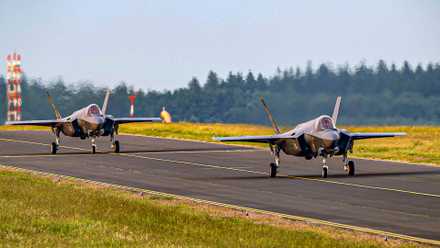
The US Air Force’s 5 Major Bases In Europe & Their Strategic Roles
Discover five of the bases that ensure US air dominance over two continents.
1
Andersen Air Force Base
18,000 Acres

Located in the US territory of Guam, Andersen AB is famous for being one of the few locations where a Northrop Grumman B-2 stealth bomber can land outside the continental United States. This airfield is the most important strategic hub in the Second Island Chain. It features two primary runways, both approximately 11,200 feet long, capable of supporting every aircraft in the Department of Defense inventory, including heavy bombers like the Boeing B-52 Stratofortress and massive cargo jets like the Lockheed C-5 Galaxy.
Andersen serves as a forward edge for US military operations, strategically located 1,500 miles from Tokyo and 1,800 miles from the South China Sea. It is home to the 36th Wing, which manages the base’s operations and hosts over 20 tenant units. The base also has one of the largest conventional munitions and fuel storage facilities in the entire US Air Force, with around 66 million gallons. This capacity allows it to serve as a massive gas station and armory for theater-wide operations.
Andersen is also historically significant for being where the one and only B-2 accident occurred that resulted in a total loss mishap when it crashed after takeoff. While it has no permanently assigned combat aircraft, it serves as the primary hub for rotating Bomber Task Force deployments. These missions provide a continuous, yet unpredictable, strategic presence to deter regional adversaries.