dailynewsnblog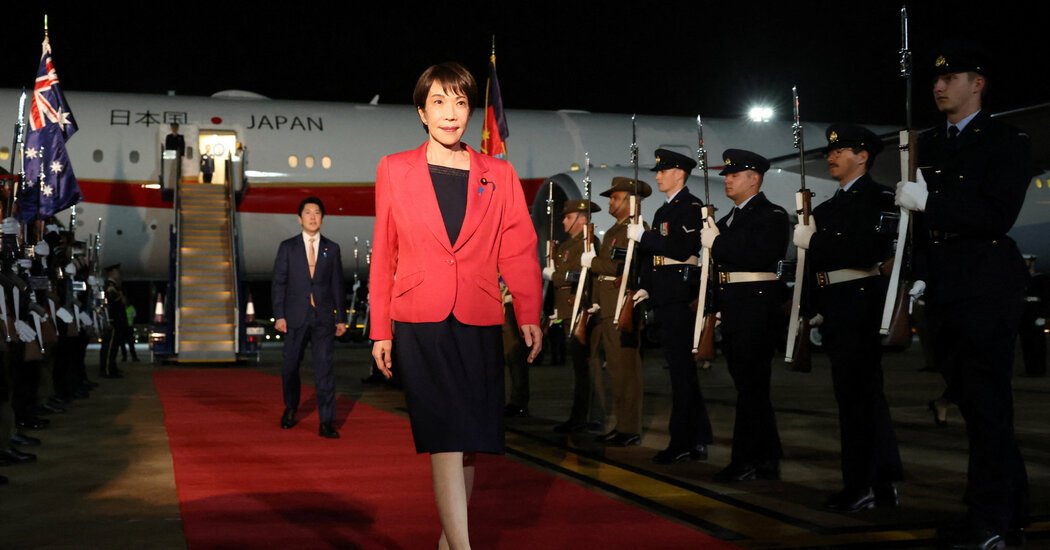
Prime Minister Sanae Takaichi’s visit to Vietnam and Australia over the past few days had all the trappings of a standard diplomatic tour. She showered her hosts with praise and gifts, including prized Japanese melons. She snapped selfies with students in Canberra and tried her hand at playing traditional drums in Hanoi.
But by the time Ms. Takaichi departed the Australian capital on Tuesday, it was clear that the trip had been far from routine. It was the opening pitch for Japan as a force for stability and strength in a region increasingly rattled by China’s aggressive posturing and President Trump’s volatile foreign policy.
Under Ms. Takaichi, Japan has pledged $10 billion to help Southeast Asian nations cope with soaring oil prices because of the Iran war. She has reversed longstanding limits on the sale of Japan-made weapons overseas and doubled down on shuttle diplomacy, dispatching 10 top officials abroad this week to make the case for Japan as the partner of choice in Asia.
“Japan will play an even more proactive role than ever before in building an international order based on freedom, openness, diversity, inclusiveness and the rule of law,” Ms. Takaichi told students and staff at Vietnam National University in Hanoi on Saturday.
Ms. Takaichi, a conservative lawmaker who last fall became the first woman to serve as Japan’s prime minister, is attempting to elevate her country’s profile at a time when China’s economic and military clout is rapidly rising.
She is also navigating the unpredictability of Mr. Trump, whose handling of the war in Iran has sown fears about American commitments in Asia. Japan depends on the United States, its main ally, for security. Unlike the leaders of Canada and some European countries, who have sought distance from Mr. Trump, Ms. Takaichi has made a point of cultivating warm ties with Mr. Trump.
To many Asian countries, Japan now represents “the stability and continuity that we used to expect from the United States,” said Huong Le Thu, deputy director for Asia at the International Crisis Group.
“Japan is stepping up to fill the leadership vacuum,” Ms. Le Thu said. “It wants to be relevant in soft power but also increasingly in hard power.”
While Ms. Takaichi rarely mentioned China by name, she seemed eager to tap into growing anxiety in Asia and Australia over Beijing’s increasingly aggressive military and economic policies. The Chinese government has put economic pressure on Japan since November, in retaliation for a comment Ms. Takaichi made before Parliament. She said that Japan could intervene militarily if China were to attack Taiwan.
Throughout the tour, Ms. Takaichi invoked her mentor, Shinzo Abe, Japan’s longest-serving prime minister. Mr. Abe, who was assassinated in 2022, shared her view that Japan should play a more assertive role in the world.
She was greeted warmly by Vietnam’s leader, To Lam, who described Mr. Abe and other Japanese politicians as “great friends of Vietnam.”
In Hanoi, she said her aim was to build on Mr. Abe’s notion of “a free and open Indo-Pacific,” a concept that is considered a way of countering China. She said like-minded countries needed to work more closely in areas like artificial intelligence, rare earths and building infrastructure, to avoid “excessive dependence on a single country for critical goods.”
Ms. Takaichi laid a wreath for Mr. Abe on Monday at Canberra Nara Peace Park, a monument to Japan-Australian ties.
Ms. Takaichi, like Mr. Abe, has made shedding Japan’s pacifist constraints a priority. Tokyo hopes that easing export rules can help strengthen deterrence in the region by showing China, North Korea and Russia that democratic countries around the Pacific are building a global arms supply chain.
Japan’s defense minister, Shinjiro Koizumi, during a visit to the Philippines on Tuesday, announced one of the first deals under the new rules: He said that Tokyo is working to provide used warships to Manila.
Japan recently sealed a $6.5 billion deal to supply warships to Australia. In Canberra, Ms. Takaichi and her counterpart, Prime Minister Anthony Albanese, announced that Japan would test more weapons in Australia, and that the two countries would work to strengthen supply chains for energy and critical minerals.
“Our friendship has never been closer,” Mr. Albanese said on Monday. “In these uncertain times, friendships matter more than ever.”
Ms. Takaichi made clear that she wanted to maintain close ties with the United States as well, saying during a news conference with Mr. Albanese that, “amid the severe international environment, strengthening cooperation with our common ally, the United States, is indispensable.”
Ms. Takaichi has several advantages in her campaign to strengthen Japan’s global standing, experts said. Japan is consistently ranked as one of the most trusted countries in the region, and Ms. Takaichi has high approval ratings at home and a supermajority in Parliament.
“She has the most powerful mandate of any Japanese prime minister since Abe,” said Michael J. Green, chief executive of the United States Study Centre at the University of Sydney in Australia. “She’s now using it to go out and build relationships with her counterparts that will last for years.”
But some analysts say that Japan’s rapidly aging population and tepid economic growth could hinder its ability to maintain robust levels of defense and economic support over the long term.
China could tap into those fears to undermine Japan, pointing to its own size and agility to make the case that it is a more reliable source of future investment.
“The big problem for Japan is that they are becoming more muscular in a military sense but in an economic sense, they are losing ground,” said Richard McGregor, a senior fellow at the Lowy Institute in Sydney. “The Chinese are so fast. The Japanese are slow and deliberate.”
Damien Cave contributed reporting from Ho Chi Minh City and Tung Ngo from Hanoi, Vietnam.