dailynewsnblog
Upon very first glance, Trump’s luxury  Boeing 747-8 and the newly upgraded Boeing 777 purchased by the National Aeronautics and Space Administration (NASA) appear to belong to entirely different operational worlds. One is a politically charged presidential transport project, while the other is a scientific flying laboratory. Nonetheless, the deeper story is that both aircraft show how the United States government is increasingly repurposing commercial widebody jets to solve urgent fleet-modernization problems. NASA’s former Japan Airlines Boeing 777-200ER has just returned to Langley after heavy structural work was completed in Waco, Texas, where L3Harris helped transform it into the agency’s next-generation airborne science platform. The aircraft is set to replace NASA’s retired DC-8 and support long-duration Earth science missions with major gains in payload, endurance, and onboard operator capacity.
Trump’s Qatar-linked Boeing 747-8 conversion follows a similar logic, though with far greater political controversy. Rather than waiting solely on Boeing’s delayed VC-25B Air Force One replacement program, the administration has pursued a pre-owned 747-8 that must be stripped, secured, rewired, and rebuilt for presidential communications, defense, and survivability requirements. Air Force officials have estimated the retrofit at around $400 million. Together, the two aircraft illustrate a very common theme. They are old airliners that can become powerful government tools, but only after they have undergone complex, expensive, mission-specific reinvention.
A Brief Overview Of Trump’s New Boeing 747-8

This particular Qatar-linked Boeing 747-8 is a former luxury widebody being converted into a presidential transport aircraft, a plane that effectively serves as a potential interim Air Force One platform while the official VC-25B replacement program remains extremely delayed. The plane’s basic role is executive airlift, but presidential airlift is far more demanding than simply carrying a VIP cabin. In order to serve the president, the aircraft must be transformed into a secure airborne command center, with hardened communications, classified connectivity, defensive systems, counter-surveillance protection, and an interior rebuilt around both comfort and national security requirements.
That is ultimately why the conversion is expected to be expensive, even though the aircraft itself already exists and is extremely operationally capable. The jet is designed to serve an extremely unique purpose and will thus need the appropriate modifications. From an operational perspective, the aircraft began life as a privately configured Boeing 747-8 associated with Qatar’s royal fleet rather than a US government aircraft.
The Boeing 747-8 is attractive because it is newer, larger, and much more capable than the aging VC-25A aircraft currently used for presidential transport, which are based on older 747-200 airframes from the early 1990s. However, the Qatar aircraft was not designed from the start around American presidential security standards, meaning much of its luxury interior and installed systems would likely need to be inspected, stripped, replaced, or heavily modified. Its value is therefore not that it is prepared to be Air Force One, but rather that it offers a modern 747 airframe that can be adapted faster than waiting for an entirely new aircraft program to conclude. It is a financially responsible stopgap solution.
A Look Into NASA’s Boeing 777-200ER

The NASA-operated Boeing 777-200ER that we are discussing today is being reborn as a large airborne science laboratory, replacing the agency’s long-serving DC-8 research aircraft. Its unique role is not transportation in the ordinary commercial sense, but rather flying complex science missions with researchers, engineers, instruments, and specialized sensors onboard.
The aircraft in question will support Earth science campaigns, atmospheric research, remote sensing, climate studies, and other missions that require scientists to bring laboratory-grade equipment directly into the sky, according to NASA. When compared with the DC-8, the 777 offers a major leap in payload, endurance, range, available electrical power, cabin volume, and onboard work capacity. The jet itself has a relatively conventional commercial history. It previously flew for Japan Airlines before being retired and eventually acquired by NASA as a comparatively low-cost platform for conversion.
Rather than buying a purpose-built research aircraft from scratch, NASA took advantage of a proven long-haul airliner with years of operational life remaining. Its modifications include research workstations, specialized wiring, sensor ports, windows, and structural changes that allow scientific payloads to communicate with external instruments like imaging systems. Once fully operational, the 777 will be able to carry a large team of mission operators and large amounts of equipment on flights lasting many hours. In practical terms, it turns a retired passenger jet into a flexible flying laboratory, extending NASA’s ability to study the planet directly from above.
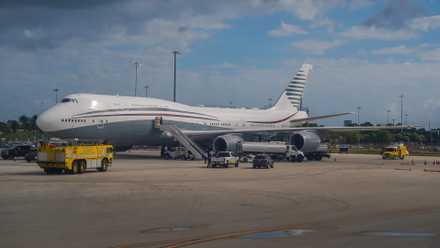
US Air Force Begins Modifying Qatar-Gifted Boeing 747-8 For “Executive Airlift” Use
Trump’s personally styled Air Force One has started its makeover.
How Much Did Each Of These Two Programs Cost?

The two programs sit in very different cost categories. The Trump/Qatar Boeing 747-8 is the more expensive of the two. The aircraft itself was accepted as a gift, but the conversion process is quite expensive. Secretary of the Air Force Troy Meink told lawmakers that the retrofit would likely cost less than $400 million, primarily because the aircraft must be rebuilt for presidential communications, security, defensive systems, and counterintelligence requirements.
Some lawmakers and outside critics have suggested that the final bill could run higher, even above $1 billion, but the official public estimate remains under $400 million, primarily because that figure reflects a new-aircraft-style valuation, while a used 747-8 would certainly fetch much less on the open market before accounting for a luxury interior. NASA’s Boeing 777-200ER is far cheaper on the acquisition side.
NASA bought this former Japan Airlines plane in December 2022 for less than $30 million, a bargain compared with buying a new widebody or purpose-built research platform. However, that figure does not represent the full program cost, which includes contracts with L3Harris, Yulista, and others. These contractors have been involved in structural changes, research stations, wiring, and science-instrument integration. NASA has not publicly framed the full modification package as a single headline total, but the 777 is still clearly the lower-cost modernization play.
What Operational Roles Do These Two Jets Have?

These two special-purpose jets have almost opposite operational roles, even though both are former commercial widebodies being repurposed for government use. The Qatar-linked Boeing 747-8 is being converted for executive airlift and presidential command-and-control. Its job would be to move the president, senior staff, security personnel, communications teams, and supporting officials while functioning as a secure airborne White House. That means that the plane’s value is not just range or cabin size but rather survivability, protected communications, classified workspaces, defensive systems, and the ability to keep national command authority connected during a crisis.
In practical terms, the aircraft is a political, diplomatic, and military command platform. NASA’s Boeing 777-200ER, by contrast, is being turned into a flying science laboratory. Its mission is to carry researchers, engineers, instruments, and sensor payloads for atmospheric, environmental, climate, and Earth-observation research.
Rather than protecting a head of state, the aircraft enables science teams to collect data directly from the air, using systems that can handle specialized payloads. So the 747-8 is more about secure movement, continuity of government, and presidential reach. The 777-200ER is about data collection, scientific flexibility, and expanding NASA’s airborne research capabilities.
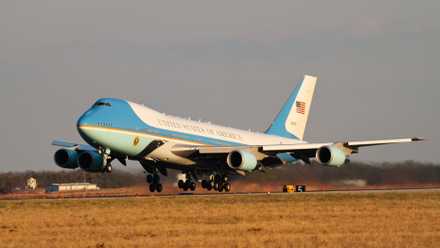
Will The Qatar 747 ‘Bridge Air Force One’ Be Ready For America’s 250th?
Trump wants his new jet ASAP.
What Is Similar About The Two Aircraft?

The strongest and most noteworthy similarity between the two is that both aircraft are commercial widebodies being given second lives as specialized US government aircraft. While neither began as a purpose-built military research platform, that is very much what they are today. The Qatar-linked Boeing 747-8 started as a luxury VIP derivative of a commercial jumbo jet, all while NASA’s 777-200ER previously flew airline service with Japan Airlines.
In both cases, the government is taking an existing long-haul Boeing airframe and rebuilding it around a mission that ordinary airline cabins were never designed to support. Both also show the appeal of repurposing proven aircraft rather than waiting for clean-sheet replacements. The 747-8 offers a modern widebody platform while the official Air Force One replacement program remains extensively delayed.
NASA’s 777 gives the agency a much larger and more capable successor to its aging DC-8 flying laboratory. Each aircraft also requires deep modification, including new wiring, new interiors, structural changes, mission systems, and specialized workspaces. Another key overlap is geography and contractor involvement. Both aircraft were modified in L3Harris facilities in Waco, Texas. Therefore, despite different operational purposes and engineering baselines, they are both retired airliners being transformed into advanced government platforms.
What Is Our Bottom Line?

At the end of the day, both Trump’s new interim Air Force One jets and NASA’s flying laboratory serve incredibly unique purposes. Frankly, comparing the two is actually relatively difficult to do once you move beyond the obvious fact that they are both specially configured, previously operated commercial widebodies. It is clear that they do not share a price tag in common (as the former is far more expensive), and their operational purposes are incredibly varied.
They do have different backstories, as one was designed as a VIP transport and was decked out in gold, alongside all other kinds of luxury details. The Boeing 777-200ER, by contrast, was designed principally as a commercial airliner, and it certainly was one that served a legacy carrier for over a decade.
The challenges that these two aircraft will face are somewhat similar in nature. Both will have to deal with the rigors of high-performance flight, and they are doing something that they were not initially designed by Boeing to do. That always creates a unique set of challenges for engineers to manage.