dailynewsnblog
Budget airline base fares have never been lower, and the fees that accompany them have never been higher. Carriers like Spirit Airlines, Frontier Airlines, Ryanair, and easyJet have built their business models around stripping the ticket price down to the seat itself and charging separately for everything else, including bags that most passengers assume are included in the fare. For travelers who pack light and plan ahead, the system works. For those who arrive at the gate with a bag that is slightly too large, it can add close to $100 to the cost of a flight before they even board.
The rules around carry-on size are more specific than most passengers realize. The difference between a free personal item and a gate-checked bag is often a matter of centimeters, and the features that push a bag over the limit are frequently built into the bag itself rather than caused by overpacking. Understanding exactly where the lines are drawn, which bag features trigger enforcement, and how the fee structure escalates depending on when you pay is the most reliable way to avoid an unpleasant and expensive conversation at the boarding door.
Why Budget Airlines Treat Your Bag As A Revenue Source

Budget airlines are built around a simple premise: advertise the lowest possible base fare, then charge separately for everything that used to be included. The seat gets you on the plane. Everything else, including bags, seat selection, priority boarding, and in some cases even printing your boarding pass at the airport, is priced as an add-on. Ancillary revenue generated by those add-ons is not a supplementary income stream. It is a core part of the business model, and baggage fees are among the most significant contributors to it.
The structure is designed to reward passengers who plan ahead and penalize those who do not. A carry-on bag purchased at the time of booking with Frontier or Spirit costs a fraction of what the same bag costs at the gate. The price escalates at each stage of the booking process, with the gate representing the most expensive point of purchase by a significant margin. That pricing ladder is intentional. It creates a financial incentive for passengers to make baggage decisions early, helping airlines predict load and revenue per flight, and it imposes a penalty fee on anyone who does not comply.
Enforcement at the gate is where the system becomes most visible. Ryanair employs bright yellow metal sizing frames at boarding gates across its network. Spirit and Frontier use similar devices. When a bag does not fit, the passenger does not board until the fee is paid. Ryanair has reportedly increased staff incentives for identifying non-compliant bags, removing caps on the bonuses agents can earn for catching oversized luggage.
The Sizing Rules That Catch Most People Off Guard

The free allowance on a budget carrier is almost always smaller than passengers expect, and the gap between what most carry-on bags are designed for and what these airlines actually permit is where most gate fees originate. On Spirit, the free personal item cannot exceed 18 x 14 x 8 inches, including handles and wheels, and it must fit under the seat in front. Frontier’s free personal item is similarly restrictive at 14 x 18 x 8 inches. Both of those limits are considerably smaller than a standard carry-on roller bag, which typically runs around 22 x 14 x 9 inches.
The European budget carriers operate on metric dimensions, but the underlying logic is the same. Ryanair’s free underseat bag is capped at 40 x 30 x 20 centimeters following a modest size increase that took effect in late 2025. easyJet allows a slightly more generous 45 x 36 x 20 centimeters for its free underseat allowance. Both carriers charge separately for access to the overhead locker, either through a priority boarding upgrade or a specific bag fee. A bag that qualifies as a free personal item on easyJet may not pass on Ryanair, and a bag marketed as cabin-approved by its manufacturer may not meet either airline’s dimensions.
The discrepancy in manufacturer dimensions often catches experienced travelers. Luggage companies typically measure a bag’s shell at its flattest point, without accounting for wheels, handles, external pockets, or protrusions from the frame. Airlines measure the bag as it actually presents, including every component that adds to its outer dimensions. A bag listed as 40 x 30 x 20 centimeters by its manufacturer can easily measure several centimeters larger once wheels and a top handle are factored in, which is the difference between boarding and paying a gate fee.
The New Baggage Policy Changes That Delta Air Lines Passengers Should Know About In 2026
Everyone from first-timers to frequent flyers should be aware of these alterations.
What Happens When Your Bag Fails The Sizer

When a bag fails the sizer at the gate, the airline’s written policy is straightforward: pay a fee and the bag goes in the hold. On Ryanair, that gate fee runs between £70 and £75. On Spirit, the gate rate for an oversized or undeclared carry-on is typically around $99. On Frontier, gate pricing for a carry-on outside the booked allowance can range from $99 to $117, depending on the route. These are the published figures, and they represent the most expensive point in each airline’s pricing ladder by a significant margin. The same bag, declared and paid for at the time of booking, would cost a fraction of those amounts on any of these carriers.
What the written rules do not capture is the inconsistency with which they are applied in practice. Gate enforcement varies considerably by airport, route, time of day, flight load, and the individual agent working the door. Passengers who fly Ryanair regularly will know that the same bag can pass without comment on one flight and be pulled at the sizer on the next. Spirit and Frontier enforcement follow a similar pattern. Some gates have agents actively sizing every bag. Others wave passengers through without a second glance. Busy flights with full overhead bins tend to lead to stricter enforcement simply because the space problem becomes visible.
The practical implication is that the gate fee is both a real financial risk and an unpredictable one. A passenger with a borderline bag might travel for months without incident, only to encounter an agent on a busy Friday evening who pulls every non-compliant item. The fee at that point is non-negotiable.
The Specific Bag Features That Trigger A Fee

The most common reason a bag fails a sizer is not that it is dramatically oversized. It is that one or two specific features push it just beyond the permitted dimensions. Wheels are the most frequent culprit. On a hard-shell roller bag, the wheels are fixed, rigid, and protrude beyond the base of the bag by anywhere from two to four centimeters. A bag whose shell measures exactly within the airline’s limit will fail the sizer if its wheels are not accounted for, and on a rigid frame, they cannot be compressed or folded away.
Top handles present a similar problem. Most roller bags have a short grab handle mounted above the main carry handle, and on many designs, that handle sits proud of the bag’s stated height even when retracted. External pockets are another consistent failure point, particularly when packed. A bag that meets the size limit when empty may not when a water bottle, laptop charger, and travel documents have expanded the front compartment beyond the bag’s flat dimensions. Expandable zippers are a related issue. Many carry-on bags include a zip-out expansion panel that adds several centimeters of depth. Passengers who travel with the expansion open and the bag fully packed are often unaware that they are carrying a bag that is technically several centimeters over the limit.
Hard-shell cases are inherently less forgiving than soft-sided bags at the sizer for all of these reasons. A soft bag that is marginally oversized can often be compressed enough to fit, and experienced budget travelers know that squeezing a soft backpack into a sizer that barely fits is a viable strategy. A hard-shell case offers no such flexibility. If it does not fit, it does not fit. On carriers with rigid metal sizing frames and agents instructed to enforce them, the material of the bag can be as consequential as its dimensions.
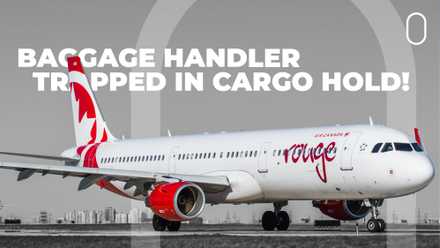
Air Canada Plane Nearly Took Off With Baggage Handler Trapped In Cargo Hold
News has emerged that a baggage handler went for an unexpected ride in the belly of an Air Canada Rouge Airbus A321 after the plane prepared for takeoff with the handler still in the cargo hold. The aircraft had started to push back and taxi for takeoff when passengers heard yelling and banging from below.
How To Pack To Avoid The Fee Entirely

The single most effective way to avoid a gate fee is to buy a bag specifically sized for the carrier you fly most frequently, and to measure it fully packed with wheels, handles, and all external pockets included in the total dimensions. Soft-sided backpacks and duffel-style bags are the most reliable choice for budget carrier travel because they compress into a sizer even when they are borderline, and they have no fixed wheels or rigid frames, adding to their outer dimensions. A structured roller bag is convenient for navigating airports but introduces the variables; fixed wheels, rigid shell, and top handles, that create the most common gate-check situations on carriers with strict enforcement.
On the fee side, the timing of your payments matters as much as what you pack. Adding a carry-on or checked bag at the time of booking on Spirit or Frontier costs significantly less than adding it during online check-in, which in turn costs less than paying at the airport. The gate is always the most expensive option on every carrier covered in this article, and the fee structure is designed to ensure that.