dailynewsnblog
The story of the Airbus A380 at  Qatar Airways has taken another unexpected turn in 2026. After briefly returning the superjumbo to service to meet strong post-pandemic demand, the airline has once again grounded all eight of its A380s for April and May, reflecting ongoing shifts in capacity planning and seasonal demand, pushed largely by the 2026 Iran Crisis. This stop-start approach has made Qatar’s A380 operations far less predictable than those of its competitors, and as a result, first class on the aircraft has become even more elusive. With limited deployment windows and a very small cabin, securing a seat on one of these flights is increasingly rare.
So how much does that level of exclusivity actually cost? While rivals like  Emirates continue to heavily promote their A380 first class as the pinnacle of luxury air travel, Qatar takes a more understated route, both in branding and pricing. In 2026, fares vary widely depending on when the aircraft is in service, the route, and overall demand, ranging from relatively attainable premium tickets to ultra-expensive long-haul journeys. That unpredictability makes pricing harder to pin down, but also more intriguing, offering a clear window into how scarcity and demand shape the economics of flying at the very top end.
The Return Of The Superjumbo: Qatar Airways’ A380 In 2026

The Qatar A380 story is a bit unusual compared to its Gulf rivals. While many airlines permanently retired the double-decker during the pandemic, Qatar Airways initially grounded its entire fleet, citing inefficiency and environmental concerns. It later brought the aircraft back to handle strong post-2023 travel demand on high-density routes, but in 2026, the situation has shifted again, with all eight A380s grounded for April and May as part of capacity adjustments. This stop-start deployment highlights how the airline views the Airbus A380 as a flexible, short-term solution rather than a permanent fixture, even on flagship routes like  London Heathrow Airport (LHR) to
  Doha Hamad International Airport (DOH) or
  Sydney Kingsford Smith Airport (SYD) to Doha.
Unlike competitors that lean heavily into first class branding, Qatar Airways has historically emphasized its business class product, particularly the award-winning Qsuite. This means its A380 first class cabin exists more as a complementary premium offering rather than the centerpiece of the airline’s identity. With the aircraft only operating at select times of the year, availability becomes even tighter, making pricing less predictable and often more sensitive to demand spikes when the A380 does return to service.
The A380 itself remains one of the most distinctive aircraft in commercial aviation. With a wingspan of 261 ft (79.8 m) and a maximum takeoff weight exceeding 1.2 million lb (575,000 kg), it offers unmatched cabin space. Qatar configures its A380 with just eight first class seats at the very front of the upper deck, creating an intimate, almost private-jet-like atmosphere, something that becomes even more exclusive when the aircraft is only flown during limited windows throughout the year.
Typical First Class Ticket Prices In 2026

In 2026, Qatar first class pricing on the A380 generally starts at around $4,500 (€4,100) for a one-way ticket on shorter long-haul routes such as London to Doha. Round-trip fares on the same route typically fall between $6,000 (€5,500) and $9,000 (€8,200), depending on booking timing, seasonality, and seat availability. These prices position Qatar slightly below some of its competitors, though not by a dramatic margin.
For longer itineraries, especially ultra-long-haul journeys such as Sydney to London via Doha, fares can rise significantly. It’s not uncommon to see return tickets priced between $10,000 (€9,100) and $15,000 (€13,700), with peak holiday periods pushing fares even higher. These routes often combine two long segments, each offering the full first class experience, which contributes to the elevated cost.
At the very top end, last-minute bookings or high-demand travel periods can push fares beyond $20,000 (€18,300) for a return journey. While these extreme prices are not typical, they highlight how dynamic airline pricing has become in the mid-2020s. The relatively small first class cabin, with only eight seats, means even slight demand increases can drive sharp price jumps.

Where Does Qatar Airways Fly Its Airbus A380s?
The Middle Eastern carrier reserves the superjumbo for use on a select handful of routes.
Route-Based Pricing: Why Your Destination Matters

One of the biggest determinants of price is the specific route you choose. Flights between major financial hubs, such as London Heathrow and Doha, tend to have more consistent pricing due to frequent service and predictable demand. These routes often fall within the mid-range bracket of $6,000 (€5,500) to $9,000 (€8,200) return, making them comparatively “accessible” within the first class spectrum.
By contrast, routes connecting Europe with Australia via Doha command much higher fares. A journey from London to Sydney covers approximately 10,600 miles (17,060 km), often split into two long-haul segments. The extended duration, combined with high demand for premium seating on such routes, pushes prices into the $10,000 (€9,100) to $15,000 (€13,700) range or higher.
Seasonal routes and limited-frequency services also influence pricing. When the A380 is deployed on routes like Paris (CDG) or Bangkok (BKK) during peak travel periods, reduced seat supply combined with strong demand can result in elevated fares. In these cases, even shorter routes can approach the pricing levels of much longer journeys, underscoring how supply constraints affect ticket costs.
What You Actually Get For The Price

Qatar Airways A380 first class delivers a cabin experience that is deliberately intimate and refined rather than flashy. With just eight seats located at the very front of the upper deck, the space feels closer to a private jet than a commercial airliner. Each seat is exceptionally wide and upholstered in premium leather, converting into a fully flat bed measuring around 83 in (210 cm) in length. The design prioritizes both comfort and privacy, with high shell walls and generous spacing ensuring passengers are never crowded, something that becomes especially noticeable on long-haul flights exceeding 6,000 mi (9,650 km). Storage compartments, large entertainment screens, and adjustable lighting all contribute to a highly personalized environment tailored to individual preferences.
Service is another defining element of the experience. From the moment passengers arrive at the airport, they benefit from dedicated check-in areas, fast-track security, and access to some of the most exclusive lounges in the network, particularly at Doha’s Hamad International Airport. Onboard, the crew-to-passenger ratio is extremely high, allowing for attentive, almost anticipatory service. Meals are served on demand rather than at fixed times, with menus featuring dishes inspired by international fine dining. Expect offerings like caviar service, premium cuts of meat, and gourmet desserts, all paired with top-tier beverages including vintage champagne and rare spirits. The emphasis is less on theatrics and more on consistency, precision, and quality.
One of the standout features of flying the A380 is the onboard lounge, located on the upper deck and shared with business class passengers. While not exclusive to First Class, it adds a unique social dimension to the journey, allowing travelers to stretch their legs, enjoy drinks, and interact in a space that feels more like a private club at 35,000 ft (10,700 m). Additional amenities include high-end amenity kits, luxury bedding, and spacious lavatories with premium toiletries. Although Qatar’s A380 first class does not include onboard showers like some competitors, the overall experience focuses on understated elegance, making it a compelling choice for travelers who value comfort and service over spectacle.
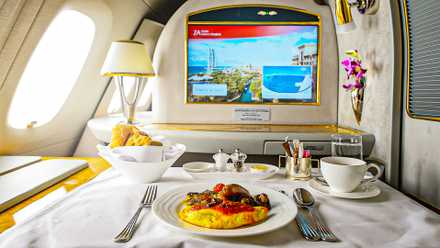
Here’s How Much A First Class Ticket On Emirates’ Airbus A380 Actually Costs In 2026
Emirates Airbus A380 first class is one of commercial aviation’s most iconic and luxurious products. A round-trip costs well into five figures.
How Qatar Compares To Its Competitors

When compared to Emirates, Qatar Airways’ A380 first class is often seen as more understated. Emirates is known for its lavish features, including private suites with sliding doors and onboard shower spas. These extras contribute to higher ticket prices, often ranging from $8,000 (€7,300) to over $20,000 (€18,300) for return journeys on similar routes.
Qatar’s approach, by contrast, emphasizes subtle luxury and service excellence rather than spectacle. This difference is reflected in pricing, which tends to be slightly lower on average. However, the gap is not always significant, especially during peak travel periods when demand equalizes prices across airlines.
Another key competitor, Singapore Airlines, offers one of the most exclusive First Class products in the industry, including fully enclosed suites on its A380. These can command even higher prices than both Qatar and Emirates, sometimes exceeding $20,000 (€18,300) return. In this context, Qatar Airways positions itself as a premium yet relatively “value-oriented” option within the ultra-luxury segment.
The Future Of A380 First Class Pricing

Looking ahead, the pricing of Qatar’s A380 first class is likely to remain volatile. The airline has made it clear that the A380 is not a long-term cornerstone of its fleet strategy, favoring more fuel-efficient twin-engine aircraft instead. This limited commitment means that A380 routes, and therefore first class seats, may remain relatively scarce.
Scarcity often drives exclusivity, and exclusivity drives price. As fewer airlines continue operating the A380, the novelty and appeal of flying on the world’s largest passenger aircraft could sustain or even increase demand. This is particularly true for aviation enthusiasts and luxury travelers seeking unique experiences.
At the same time, broader industry trends, such as the rise of ultra-premium business class products, may put pressure on first class pricing. Qatar’s own Qsuite, for example, already offers a level of comfort that rivals older first class products. This could limit how high prices can climb, especially on routes where business class provides a compelling alternative at a significantly lower cost.