dailynewsnblog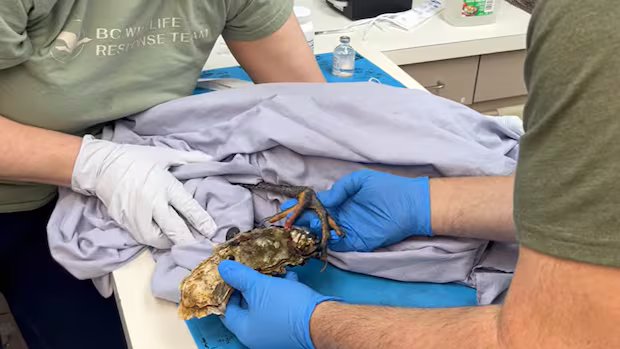

Listen to this article
Estimated 4 minutes
The audio version of this article is generated by AI-based technology. Mispronunciations can occur. We are working with our partners to continually review and improve the results.
Dr. Adrian Walton has seen some strange things in his career as the owner and lead veterinarian at Dewdney Animal Hospital, but never an “oyster attack.”
That changed on Saturday, when rescuers delivered him a Pacific great blue heron with its toe caught in an 18-centimetre mollusk that refused to let go — a potentially life threatening situation for the bird.
“It’s a lot of firsts. I’ve never had an oyster attack before. I’ve never had to anesthetize an oyster,” Walton told CBC News.

An unlucky heron was caught in the grips of a large oyster weighing 1/6 its weight. Here’s how rescuers saved the bird.
The heron was first spotted by a biologist and member of the Vancouver Aquarium’s Marine Mammal Rescue Society who happened to be paddling in False Creek on Saturday afternoon, explained Krista Tulloch with the B.C. Wildlife Response Team.
“[It was] wet, soggy, struggling to swim, struggling to stand as the tide was rising on the edge of False Creek — so it stood out because this is unusual behavior, unusual location,” she said.
“This bird was at risk, potentially, of either being overcome by water or, if left too long, also predation by nearby animals.”
Shellfish rescue
Fortunately the biologist knew who to call, and Tulloch said her team quickly deployed a pair of experienced rescuers.
They were surprised to find an oyster weighing more than 300 grams — about a sixth of the bird’s weight — gripping the bird’s toe.

“Very large for an oyster,” she said. “This was definitely impeding its ability to stand, to walk and certainly to fly.”
The next question was how to get it off, a collaboration that involved multiple experts including aquarists, wildlife technicians and a wildlife veterinarian.
Walton, fortunately, has a master’s degree in fish farming that includes experience with mussel and oyster farming.
He said the group brainstormed a variety of ways to get the shellfish off, but all the easy solutions would have irritated the oyster, causing it to tighten its shell even more.
“What we decided to do was have them bring it here and because we do a lot of amphibians and fish, we had an anesthetic called MS-222, which we were able to push into the oyster to allow it to basically anesthetize an oyster so that we could open up the shell,” he said.
Sure enough, the oyster popped open, freeing the heron’s foot.

Walton said the bird suffered ligament damage and will need to have a toe amputated, but otherwise is expected to recover with a few days of rehabilitation at the B.C. Wildlife Association’s Burnaby Lake facility.
While blue herons have had an established colony in Stanley Park for 25 years, they remain classified as a species at risk in B.C.
Tulloch said that’s one reason why successfully rescuing this bird was important, particularly given that it is currently fledging season.
“That was one of the questions, are there birds waiting back at the nest for this particular animal?” she said.
“We don’t know, but we know that every animal does belong where they are and we … wanted to ensure that it gets back where it belongs as quickly and safely as possible.”
As for the oyster?
Walton said the shellfish wasn’t safe to eat but that the rescuers plan to clean and keep the shell as a memento of the rescue.