dailynewsnblog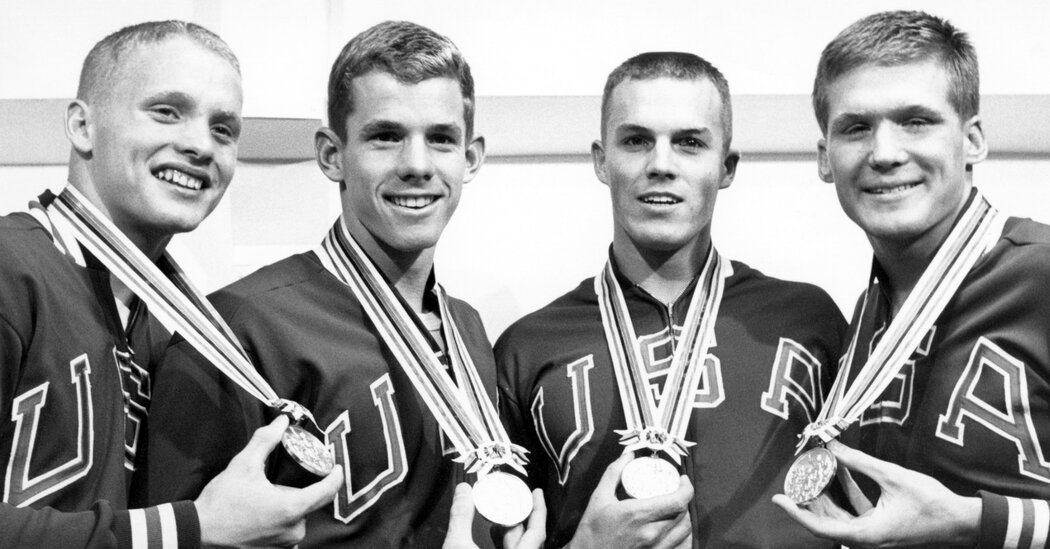
Steve Clark, a two-time Olympic swimmer who won three gold medals for the United States at the 1964 Summer Games in Tokyo and, decades later, candidly acknowledged the depression that he and many Olympians experience when their careers end, died on April 14 at his home in Larkspur, Calif., in the Bay Area. He was 82.
The cause was complications of Parkinson’s disease, his wife, Betsy Clark, said.
From the time of the ancient Greeks, Olympians have been viewed as the ideal of human form, might, speed and endurance, but out of the pool, away from the playing field, they have also been reminders of human susceptibility.
Prominent recent Olympians like the swimmer Michael Phelps and the gymnast Simone Biles have freely discussed mental health issues like anxiety and pressure that accompany careers. These often hinge on peaking every four years for the Winter or Summer Games, followed by a feeling of emptiness, sometimes called Gold Medal Syndrome.
“We all get depressed when we retire; it’s like, Who are we?” said Donna de Varona, who won two swimming gold medals at the 1964 Tokyo Olympics and has counseled athletes as they transition to different careers.
In Clark’s era, athletes were expected to be stoic. To acknowledge vulnerability was often viewed as a sign of mental weakness. In an unpublished 2012 essay, he wrote that he wrestled with depression intermittently for 30 years between 1966 and 1996 but kept it to himself mostly out of embarrassment and “faked feeling normal.”
Swimming for Clark was “like a mental and physical health practice,” his daughter Nicki Clark said in an interview.
“My dad struggled with depression most of his life,” Ms. Clark added. “I feel like it’s a big part of his story. I think he knew how important it was to move his body. Swimming was in his blood. Even when he didn’t want to, I think he would sort of make himself because it always made him feel better.”
Clark came to athletic prominence while still in high school in the Bay Area, when he competed in the 1960 Summer Olympics in Rome. In 1964, while attending Yale University, he delivered three stirring performances that helped lead to Olympic gold medals and team world records in the 4×100-meter freestyle relay, the 4×200-meter freestyle relay and the 4×100-meter medley relay.
During his career, he won five individual N.C.A.A. titles, set multiple world records and was the first man to swim the 100-yard freestyle under 47 and 46 seconds. He was inducted into the International Swimming Hall of Fame in 1966.
“If you want to work with and live with saints, get a bunch of Steve Clarks,” Phil Moriarty, his coach at Yale, told The New York Times in 1964. “He has everything good in an athlete — attitude, ability, importance as a team member, no temperament.”
Clark retired from swimming in 1965, the year he graduated from Yale with a bachelor’s degree in political science. The Olympics were for amateurs in those days. There was little or no money to be made. After a break, he entered Harvard Law School, from which he graduated in 1969, but realized immediately that the qualities that made him a great swimmer didn’t prepare him to think analytically as a law student.
“I had developed myself as a swimmer,” he wrote in the essay, “but what I didn’t develop was an identity apart from swimming.”
He described much of his law career, spent in Northern California, as unfulfilling. At times, he lacked confidence, something that did not elude him in the pool. His drinking increased and, in 1996, his first marriage — to Etta Müller, with whom he had three daughters — ended in divorce.
He soon began seeing a psychiatrist, who prescribed medication, and a psychologist, who provided talk therapy. He began to feel relief from his depression, ultimately stopped drinking with help from Alcoholics Anonymous, and repurposed his sports background by providing legal guidance and financial services to professional athletes.
De Varona said that Clark had supported the American swimmer Rick DeMont, who futilely sought to have his 1972 Olympic gold medal reinstated after it was stripped — many feel unjustly — when he tested positive for a banned substance contained in his prescribed asthma medication.
Clark also began swimming three or four times a week and participated in open-water events in places like the chilly currents near Alcatraz Island in San Francisco Bay. He also coached high school and masters swimmers. Along the way, he wrote, he learned “how not to be a perfectionist.”
In 2005, he donated one of his Olympic gold medals to Yale in honor of Moriarty, his former coach. “The gold is still shiny but the ribbons are as faded as I am,” Clark said at the time. “I don’t want to live on past athletic glory.” It was, he said, “not the way I was raised.”
Stephen Edward Clark was born on June 17, 1943, in Oakland, Calif. His father, Lyman Clark, worked in sales for the Westinghouse Electric Company. His mother, Mary Margaret (Simon) Clark, ran the household and did volunteer work.
At age 9, Steve began swimming competitively at the Santa Clara (Calif.) Swim Club, where the renowned coach George Haines helped develop Olympic champions like Clark, Don Schollander, de Varona and Mark Spitz.
Clark experienced tendinitis in his shoulder at the 1964 Olympic trials and did not qualify in individual events for the Tokyo Games. He did make the American relay teams, and his shoulder discomfort subsided before the Olympics began.
Clark’s searing leadoff leg in the 4×100-meter freestyle relay in Tokyo equaled the individual world record for the 100-meter freestyle, 52.9 seconds. Had he been eligible to swim the individual 100-meter freestyle race, he would have been a favorite. Instead, the victor was his teammate and rival, Schollander, who became the first swimmer to win four gold medals in one Olympics.
Before entering law school, Clark coached in Peru and wrote an early coaching manual, “Competitive Swimming As I See It” (1967). Among other things, he suggested with dry humor that the common practice of shaving the body to reduce drag in the water was overrated.
A prepared swimmer, Clark wrote, “is not going to abruptly swim a terrible race simply because he forgot to shave five hairs off his belly button.”
In addition to his daughter Nicki, he is survived by his wife, Betsy (Anderson) Clark, whom he married in 2000; two other daughters, Nina Sealander and Kim Fowler; a sister, Sally Clark Michel; and six grandchildren.
Clark spoke to young people, encouraging them not to feel guilty or ashamed of their depression. In his unpublished essay, he suggested that life balance and self-awareness could help ease the arduous transition to everyday life for world-class athletes.
“The goal is to help athletes break out of that tunnel-vision focus, workout-induced endorphins and singular drive for perfection,” he wrote, “in order to open them up to a different world which does not measure success by a stopwatch.”