dailynewsnblog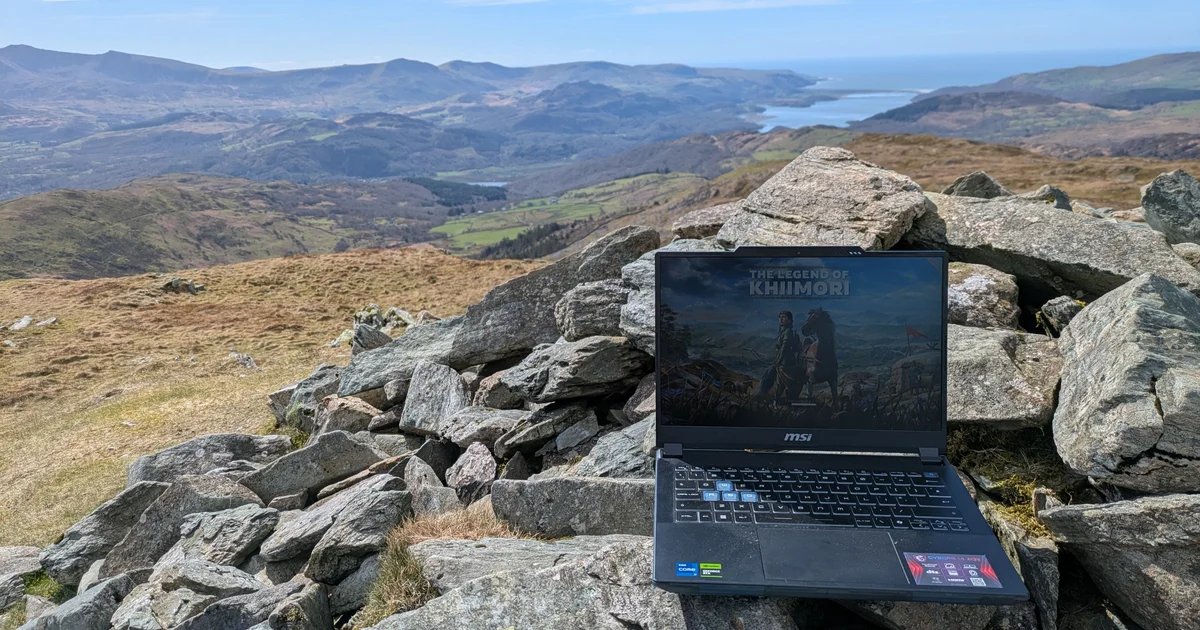
A little while ago our deputy editor James ‘RAM-bo’ Archer said he wanted us all to get more involved with hardware criticism, because we all appear to think that videogames are powered by telluric currents and swearing. He offered me specifically the chance to write about a laptop – the relatively affordable (I stress, “relatively”) MSI Cyborg 14, loaned to RPS for a few weeks by Swipe Right PR.
It was a grievous imposition, dealt out by somebody I had thought a friend. I do need a gaming laptop, and I am interested in the monstrous convolutions of the hardware industry, but I’m not really your guy for hot chat about keyboard depth and graphics card benchmarking. I care about that stuff a lot less than, to pick an example at random, climbing mountains. By happy coincidence, when James came knocking I was about to go on a 105 mile hike through the Eryri national park in Wales, including an ascent of Yr Wydffa, Britain’s second highest peak. The compromise was as obvious as it was irresistable: I would attempt to review the MSI Cyborg 14 while hiking up Welsh mountains.
Quick disclaimer: I am not a professional mountaineer and none of the below should be construed as practical insight or advice. Also, Swipe Right only supplied the laptop – I paid for the rest of it.

Day 1 – A Worrying Sense Of Calm
The clouds are massing overhead like sleepy hecklers as I quest boldly forth from Machynlleth, a few miles from the southern border of Eryri. Aside from the MSI Cyborg 14, now ceremonially entombed in about nine days of underwear, my trusty companion on this adventure is Alex Kendall, tousled and cherubic author of the Snowdonia Way guidebook. I consult his directions meticulously at Machynlleth’s outskirts, hold a finger to the breeze, and immediately go the wrong way. It turns out the council built a flyover right by the start of the Snowdonia Way, sometime after Kendall wrote his book – a treacherous serpent luring the unwary hiker off towards Crewe, where there are no mountains at all.
There’s a lesson for videogame developers in this, I say importantly to myself, after retracing my steps: how do you create worlds that offer incorrect or deliberately false directions, perhaps based on terrain that has altered, without this being perceived as a design flaw? We will revisit this lesson on day 2. After digging out my OS map, I find the correct turn-off and spend a pleasant few hours walking among old slate mines and spoil heaps, following the treeline towards the moor. I survive a bog and encounter a farmer whose dog tries to eat me, about which the farmer is apologetic, but not ashamed.

Having escaped the dog, I descend along grassy paths and minor roads, the dreaming bulk of Cadair Idris rearing to my left. I’ve timed my entrance to the actual mountains well: some cosmic disturbance called Storm David was in the vicinity the night before, but Dave has now slunk off to spook train drivers in Yorkshire, and the skies are clear. I worry that the going will prove too easy. But as I approach the town of Dolgellau through muddy fields, trying to figure out which tumbledown stone barn is the next landmark, my left knee suddenly transforms into an angry sea urchin. I hobble into my B&B two hours ahead of schedule, and decide to spend all the time I’ve saved in the bath.

Today’s videogame is narrative-heavy cardgame The Killing Stone, which begins aptly enough with a trudge through the wastes towards a frozen mansion in the deep Antarctic. My hotel experiences a blackout while I’m deciphering the card mechanics (it’s probably a hangover from Storm Dave), which really sets the mood.
Come to think of it, I didn’t mention The Killing Stone’s talking animal familiars in my early access impressions. One of them is a cat. There is also a cat in my hotel. He is a very talkative cat. Somebody lets him in at 2am and he spends the next two hours miaowing at the walls. I stir fitfully and he is right outside the door, his voice deepening and lengthening. It’s possible that the cat is a demon, but he is also an adorable doofus. I consider taking him along in my rucksack, but alas, I have no room, because I have to carry this stupid gaming laptop.
Laptop testing notes: Aww I’m sorry, MSI Cyborg 14, you’re not that hefty. You’re a trim 31.5 x 23.4 x 2.1 centimetres, weighing in at a balletic 1.6kg. I do not feel your mass, even while clambering up a rocky streambed and almost stepping between a ewe and her newborn lamb. If I am murdered by sheep on my voyages, it will not be because I have exceeded my inventory capacity by loading up on GDDR6.

Day 2 – The First Ascent
My second day is my first attempt at climbing an actual mountain, Y Garm. It’s a smaller one at around 600-700 metres, but I am worried that my left knee will rebel. I’m still trying to work out how long it takes my tendons to recover, between days of hiking. I proceed up through some dense timber plantations like I’m trying not to step on a sleeping dragon. I also experiment with a walking stick, which only tires me out, and does not make me feel like Gandalf at all.
Thankfully, my knee holds up and, indeed, somehow strengthens as I claw my way upward among gorse and rhyolite, the plaited turquoise of the Irish sea spilling into view on my left. I advance through almost unholy sunlight to the cairn, and it’s time for the hardware analysis to commence in earnest: is the MSI Cyborg 14’s screen bright enough to withstand the midday glare on a mountain’s summit? The answer: lol, no. I fire up The Legend of Khiimori, an early access open world game about a courier riding through 13th century Mongolia, and can barely see my character. I’m also a bit concerned that the MSI Cyborg 14 is going to blow away. Heftier laptops have their merits. Still, the machine does look handsome perched on the cairn, soaking up the rays.

While I can’t see enough to actually play it much on the mountain, Legend of Khiimori proves a good intro to the descent from Y Garm, in the sense of advertising a few ways I might die. It’s a game about plotting safe paths through a lightly signposted world of marshes, thorn bushes and slippery rockpiles. There’s a touch of Death Stranding in the pressure to look after your horse. You need to keep them warm on the heights. You need to check their hooves for stones, and brush them down to steady their nerves. Even a shorter, day-length expedition is an exercise in pacing your steed’s stamina and steering carefully around obstacles, while pruning down the route as much as possible.
Aspirational open world gamers love stuff like this. “Don’t hold our hands!” we caterwaul, like toddlers at zebra crossings. “Let us ‘genuinely’ explore. Let us feel the contours underfoot.” It’s different when you’re at strong risk of breaking your ankles. There’s no path down from Y Garn in my guidebook, just a generous invitation to travel about 300 metres west of the summit, avoiding some crags, then tack down towards a forest, where I am supposed to look for three stones jutting out of a wall of jutting stones.


The slopes themselves consist of boulders heaped with waist-high heather, forming a maze of secret cavities. Underground streams tinkle sweetly as I sink my heels into deceptively thick hummocks, trying not to overcommit to each step. The water! It hungers for my bones. I fall over twice, laughing like a parrot and resisting the temptation to launch into a Sonic the Hedgehog spindash, which I think Alex Kendall would frown upon. I feel like I am not actually travelling anywhere: everytime I look up, it’s the same Star Trek Away Mission circle of rocks and undergrowth, undergrowth and rocks, plus one scruffy tree that appears to be stalking me like a vulture.
Then I reach the wall and realise that the forest has been partly chopped down. This makes the guidebook’s subsequent descriptions almost incomprehensible, with paths through the trunks now effectively vanished, and landmarks visible long before I’m supposed to spot them. I feel like I have accidentally toggled no-clip mode.

I blunder through coiling bracken, jamming my toes against resentful stumps, before reaching the sanctuary of a vehicle track. This leads me swiftly out to what the guidebook calls “faint paths”, but which I think are more properly described as “quagmires”, at least at this time of year. Both soggy and dehydrated, I follow scuffs and divots across open moor. The guidebook urges me to watch for forks, but I am unclear about the distinction between a fork and a “junction” or the unsteady footprints of a hiker diverging around a “faint path”.
I finally lumber onto a mercifully even track winding down through a farm. At the bottom, I’m about to turn in relief towards the lakeside town of Trawsfynydd, today’s final destination, when the guidebook hurries me up another hill instead, onto a choppy Roman road that probably gave more than one legionnaire early onset arthritis.
Maddened by water loss, with blisters blooming on each ankle, I begin to entertain terrible doubts of Alex Kendall. I do suspect him of trying to save page space by merging this stage with a parallel route, allowing him to efficiently refer me to a previous chapter, at the cost of adding another uphill slog to my day. Having worked in magazines, I can sympathise, but also, I am going to turn him into trailmix, just as soon as my thighs and calves unfuse.
Laptop testing notes: the MSI Cyborg 14 has quite noisy fans, which settle into a singsong refrain when playing anything demanding. The undulating tone is almost soothing, but I imagine it’ll annoy people without headphones. Fortunately, you can’t really hear the fans when you’re on top of a goddamn mountain.

Day 3 – From the Woods to the Caves
When they say the road to Hell is well-paved, they actually mean that Hell is a well-paved road and you have to walk it in hiking boots. After a couple days of tramping, I’ve developed a moderately scientific understanding of the cumulative effects of various surfaces and gradients on my legs and feet. Ascents are actually the best part, because the human body feels more comfortable moving forward, aiming its weight into the slope. Descents are vicious, because now your shellacked knees have to both hold you up and bear you downward. But saunters along “minor roads” in footwear designed for cragwalking? These are the slowest and most insidious of annihilations.
My walk from Trawsfynnyd to Beddgerlert is supposed to be an easier stretch. It starts off beautifully with a looping stroll around a lake, then heads west through a spongy wildlife reserve towards a forested gorge. A couple of RAF jets show up for a training dogfight mid-morning, and there is the wyrd spectacle of a disused nuclear power station in the distance – a couple of huge, somehow Evangelion-esque cubes parked against the scree – but the ambience is otherwise refreshing. I dip my aching toes in a reservoir and a thousand icicles stab me in the shins. Do not be deceived by the sun round these parts. The waters of Wales do not acknowledge its dominion.

I also stop in the woods to see how the MSI Cyborg 14’s screen fares in such conditions. The answer: better! I have a quick game of Slay the Spire 2 while perched on a log. Amongst other things, there are parallels between the roguelite’s branching routes – each branch offering a different sequence of threats and rewards, before reuniting for the boss fight – and my own cautious examination of places where the path splits around dodgy ground. Sure, if I hang left it’ll be kinder to my joints than scrambling over the rightward rocks, but I’ll also have to brave a puddle that looks… hungry, somehow.
I’m having a pretty decent time till mid-afternoon, when I round a hill and begin an agonisingly protracted journey to the bottom of a valley. The mountains hereabouts are mountainous indeed. Cnict, or ‘Knight’, looms behind me. Ahead rises Moel Hebog, aka ‘Bald Hill of the Hawk’. The skies are steely blue and the route is clear, but all I can think of is that the soles of my feet feel like whoopee cushions full of dogfood.

After crossing an old mining railway I think I’ve finally reached Beddgelert, but then Alex Kendall swings me right onto a higgledy track along the Afon Glaslyn – “a fantastic end to the day” for which Alex Kendall would be egged and feathered, if there were any justice. I am humiliatingly overtaken by a silver-haired jogger who moves like he’s half my age. On the upside, I’m able to test out the MSI Cyborg 14’s screen inside a cave.
I was planning to play a whole chunk of Mandragora: Whispers of the Witch Tree in that cave, actually. Mandragora is a good fit for the context – a grim and colourful side-scrolling metroidvania set in a fallen kingdom, with lots of sunken spaces to uncover. It has writing from the original designer of Vampire: The Masquerade – Bloodlines, and backdrops that remind me fondly of Medieval for PS1. I was having fun in that cave. But then something went splash in the cave, somewhere beyond the glow of my laptop screen, and I didn’t want to be in the cave anymore.

Onward to Beddgelert, where I fortify myself for the next day’s ascent by playing Idols of Ash, a game about spelunking through catacombs with a colossal centipede in pursuit. Alas, I dream not of centipedes or caves, but of minor roads.
Laptop testing notes: The MSI Cyborg 14 has a battery-saving refresh rate alteration feature that causes the screen to black out briefly, when you plug it in or unplug it. You can disable this in the MSI diagnostics centre. I wish I’d figured that out before I wrote this up. During the hike, I worried it was a malfunction born of dropping my bag in a marsh. Which, now that I think about it, I absolutely did not do. It still works fine, Swipe Right. I haven’t even lost the little velcro strip for the charger.
Day 4 – Throat of the World
The fourth day begins with another earnest interrogation of my knees. Are they feeling springy enough to carry me up and down 1100 metres of mountain? Because our next waypoint is Yr Wydffa, aka Snowdon, the highest peak in Wales, and I do not want to get trapped up there with a budget slab like the MSI Cyborg 14, which can’t even play Cyberpunk 2077 on ultra at greater than 65fps. Also, there is stuff like “dying of exposure” to consider.

I walk five kilometres along a lakeshore, frowning at every tectonic cramp and twinge. I buy a Lucozade at a cafe and nurse it like a guttering candle. I am careful to fully occupy the cafe owner’s attention while casually referencing my itinerary and key physical quirks, in case he has to describe me to a helicopter pilot later. I put all my snacks in the jacket pocket nearest my head, in case I get wedged in a crevasse and have to fish out an emergency Oreo with my teeth. Then I bravely embark, and Yr Wyddfa turns out to be a doddle. Well, maybe not a doddle, but far from the ligament-rupturing ordeal I was expecting.
It’s partly that it’s even drier today, but mostly that Yr Wyddfa is a tourist hotspot, with several well-trodden paths to the summit. No floundering through pothole country towards vanished forests. No asking Alex Kendall why he has forsaken me. I join a carnival of folk of all ages and backgrounds, following a stony route up through glacial ampitheatres that delight with sparkling rivers and the melancholy remains of quarries.

You’d think all the foot traffic would ruin the mood, but I enjoy the sociability of the climb as much as the views. There’s an invigorating sense of shared purpose and difficulty. Each hiker unconsciously guides the one behind, helping them make out the slippery rocks and handholds. Remember one of Hidetaka Miyazaki’s inspirations for Souls multiplayer – drivers pushing each other up a mountain? Listening to people talk as they pass does feel a bit like reading soapstone messages, although nobody tells me to “try jumping”.

There’s an actual cafe on top of Yr Wyddfa, though it’s closed for repairs during my visit. It makes me think of King Arthur, who slew the bloodthirsty giant Rhitta Gawr many centuries ago and buried him on Yr Wyddfa’s summit, “Yr Wydffa” being a Welsh word for tomb. Now, the indolent English sip oat lattes among the giant’s bones. I squat down by the peak, with dozens of smaller mountains peeking between my toes, and decide to unpack these strange emotions by playing 9th century strategy game A Total War Saga: Thrones of Britannia. I begin a new save as King Anaraut of Gwynedd, and set forth to rid Eryri of the hated Anglo-Saxons, lest their descendants return and drink lattes on mountains hundreds of years later.
With Yr Wyddfa’s cairn overshadowing the laptop screen, I can just about see the smaller approximation of Yr Wyddfa in Thrones of Britannia. I rally my banners and send them east of the mountain, but unfortunately, Anaraut’s burgeoning crusade is thwarted by a neighbouring Welsh ruler, who dupes me into an alliance and politely boxes me off from the rest of the country. I’m weighing my diplomatic options when a bunch of fellow climbers ask me to take a group photo. Nobody comments on my game of Total War, and I feel aggrieved. Where’s your sense of wonder, you asshole townies? How often do you see a man playing Total War at 3000 feet?

Then comes the descent. I follow another path across the slopes, high above two dusty sapphire lakes. The afternoon is bright and still, but I feel a growing urgency. Remember Idols of Ash, that game I was playing last night? There is no centipede to chase me down Yr Wydffa. There is something worse: the setting sun.
The path is relatively easy to follow, but it is still a jumble of warring angles. There are places where it fattens into lethally smooth volcanic rock, places where long square stones enclose a cracked multitude, places where brooks bleed out of the heather, places where the strata folds upward like the spine of a whale. I’d hate to be on this thing at night. As I near my next lodgings, a busy youth hostel perched in a high valley, I look with alarm at all the people walking the other way. I hope they’re allowing enough time. I hope they don’t stop to play any lengthy strategy games while they’re up there. Who knows, if King Anaraut had marched all the way to West Seaxe I might not be writing this now.
Laptop testing notes: I’m pretty sure I got melted chocolate under the MSI Cyborg 14’s keys while having lunch on the mountain. Sorry about that, Swipe Right, but I really needed the sugar. Some friendly feedback for the manufacturer: perhaps if the laptop had been 0.1kg lighter, I wouldn’t have needed the sugar?

Day 5 – Winter Comes
The fifth day is as soggy and discouraging as the fourth day was radiant. I have to go up another, less visited mountain, Moel Siabod or “shapely hill”. Moel Siabod doesn’t like me. It dispenses rain by the pondful as I squidge across the valley, then wraps itself obstinately in mist during the ascent.
While crossing the valley, I encounter a bunch of kids doing a Duke of Edinburgh Awards hike. The kids are all wearing pointy red coats and look like they’ve recently escaped from Santa’s workshop. One of them keeps pace with me for a few minutes, pointing out that I’m much harder to see from afar in my grey-black gear, and asking me what I’d do if I broke my leg in a place with no phone signal and all my emergency equipment fell in a hole. “I would be screwed,” I explain to him, and he nods in satisfaction. I do not mention the MSI Cyborg 14.
The climb starts with much huffing and puffing among wiry, watery trees before I burst out into a wilderness of gold and ash. I have to walk along another ridge to the summit. Helpfully, there’s a fence I can follow that runs the length of that ridge. Unhelpfully, there’s the weather. In the course of what the day’s forecast described as “sunny intervals”, the visibility shrinks below 100 metres, and a blizzard springs up from the south-west, shoving me towards cragtop pools of frigid water, where tiny aquatic organisms who perhaps never ever saw a human before gaze in astonishment as I try to eat Oreos without falling in.

It’s nice to have the wind at my back, less nice that it appears to be snowing horizontally. What does all this remind me of? It reminds me of Stario: Haven Tower, a mystical vertical city builder, which I dipped into on day 2, after failing to make headway in Legend of Khiimori. The game consists of six atmospheric layers, each subject to specific meteorological disasters. I like Stario for how abrupt these divisions feel. It certainly corresponds to my experience of mountain weather – one moment you can actually see other mountains, the next you are the centre of a howling ball of vapour.
I get to the top of Moel Siabod after what feels like a partial reenactment of the Dark Souls 3 intro. There is no question of testing the MSI Cyborg 14 in these conditions. The summit is the province of djinns and poltergeists. If I let them, they would pluck the laptop from my hands and send it swooping in raucous glissando over miles of moraine and moss, all the way to the sea, and then I would have to pay Swipe Right PR £1100. I navigate another boulder field and creak down the hill towards a mountaineering hostel in Capel Curig, where I am outraged to discover that I have forgotten to book breakfast.

Laptop testing notes: In general, I find the MSI Cyborg 14 sorely deficient as a piece of emergency mountaineering equipment, when compared to (e.g.) the pair of thick gloves I left on my desk a week ago, but I will concede that it makes pretty fair thermal insulation. Between the laptop and nine pairs of underpants, I can barely feel the chill against my spine. It’s just as well my coat has nice deep pockets.
Day 7-8 – The Long Endgame
I’m going to combine the last two days, because Day 7 is fairly uneventful, albeit beautiful. I basically walk in a straight line along Ogwen Valley, the Glyder range to my left. The views are brain-emptying, the terrain is forgiving, and I do not think of gaming laptops at all.

The one moment of mild drama comes when I use my OS map to follow a path that isn’t quite there anymore, but it’s nothing crawling under a bush won’t fix. My hotel that night is an unromantic Travelodge by a motorway, where I sleep in a bizarre L-shaped room comparable to the apartment in Konami’s horror game PT, except that the bathtub is smaller. I improve the ambience by starting a new game of The Legend of Heroes: Trails in the Sky – the classic RPG in which a pair of mercenary children run errands in a world of luxuriant, continually refreshed NPC writing that makes every settlement a pleasure to return to.
It’s the perfect morale boost for the final leg of my journey, a 24 mile hike along the coast to Conwy, in which I pass through a number of hamlets and villages. So much of the happiness of these old RPGs consists of stop-offs in small towns – one-horse burgs kept in business by the presence of a savepoint. From what I’ve played of it, the first Trails in the Sky is a game’s worth of such places. The freshly kindled memory of its opening few hours warms my heart, even as the weather struggles to work out which season we’re in. I encounter a wild-eyed man who is ecstatic to discover that I’m heading to Conwy, which contains his favourite pub. I’m worried he’s going to follow me there, but then a torrent of hail rolls out of Anglesey and carries him away.

It’s today that I make the extremely sensible decision to avoid the mountains. Alex Kendall gives me the option of going over the Carnaddeu, a stegosaurian expanse which is apparently Eryri at its most remote. Sounds like fun, but there is a moderate risk of thunderstorms, and I have all this copper and silicon attached to my back. I don’t really know how lightning bolts function, and there is nothing relevant in the MSI Cyborg 14’s manual, but we’ve all played The Legend of Zelda: Breath of the Wild, right? Besides, the way is long and my bum is sore.
I have a windy climb along another Roman road, looping under electricity pylons that wail and sigh like the ghosts of bygone emperors. I also meet some nice wild ponies during the last couple hours of tramping. A few moments later, two of the nice wild ponies appear on the path behind me, tossing their heads and hissing like xenomorphs.
I gauge our respective character levels, then stride confidently into the bushes, not quite running to the shelter of a telegraph pole. I’m pretty sure I could take a sheep in a fistfight. I would teach that sheep the meaning of pain. But ponies? That’s another matter. Those things know how to flank. Besides, if I’m kicked to death the MSI Cyborg 14 might get damaged, and then James would have to pay Swipe Right PR £1100.

Fortunately, the ponies overtake me without incident, though I’m careful to keep checking behind me as I loop and wobble down towards the coast and my final B&B. I spend the last hour of my hike arguing out loud with Alex Kendall’s author portrait about whether a hut with a green door is the same thing as a “green hut”, a clash over hiking scripture that eventually sees me wading through a stream.
My knees hurt so much after tottering down a long hillside path toward Conwy Castle that I begin to giggle uncontrollably. This is how Ezio Auditore and his peers should arrive in every freshly discovered city: hingeing and squealing like a possessed washing machine, all dignity and glamour discarded. Having found my B&B, I eat enough takeaway food for three people, then fall asleep in front of Trails in the Sky. I dream that King Anarut, Alex Kendall and I are riding a demon cat up the flank of Moel Siabod, pursued by wild ponies.
Closing laptop miniature review: After walking 105 miles with it, my hottest take on the MSI Cyborg 14 remains that it’s light and compact, which I’m not sure I needed to walk 105 miles to demonstrate. Beyond that, it’s just another box that makes pictures. Still, lugging it through Eryri has supplied a pretext for publishing 4500 words about mountains on a videogame website, when I probably should have written another 10 GTA 6 posts. So thank you for this, James. Can I take one to the Highlands, next?