dailynewsnblog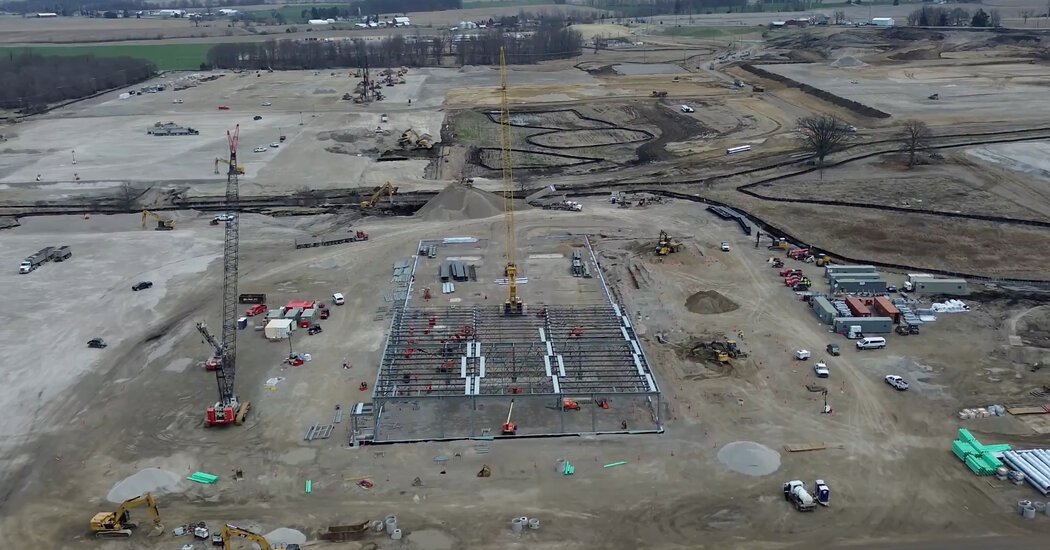
The monthly meeting in Lyon Township, a small town in southeast Michigan, was packed on a recent Monday, even though the main item on the agenda was an easement for a drain.
Residents, holding notes and water bottles, lined up at the mic to talk about the actual issue on everybody’s minds: the proposed large-scale data center.
They had come prepared.
“Just a reminder,” said a man in a black puffer vest, who identified himself as Larry. “An N.F.L. football field is 57,600 square feet. A 1.8-million-square-foot hyperscale data center is about 32 football fields.”
A motorcyclist asked about the potential effects on traffic. Someone asked if the proper procedure had been followed to preserve a habitat of endangered bats. A woman in a pink shirt played a recording of noise from a data center in another Michigan town.
When a town board member gently interrupted a speaker to say her time was up, she exclaimed, “I haven’t even gotten off my first page!”
Lyon Township voted for Donald J. Trump in 2024, but party loyalties hardly seemed to matter. In an era when Americans are divided on everything — even the cars they drive and the TV shows they watch — data centers seem to have bridged the partisan divide.
Early evidence suggests that Americans — once agnostic — are now souring on them. Last month, Maine became the first state to pass a moratorium on data centers — only to have the governor, a Democrat, to veto it — and similar measures have been introduced in at least 13 other states and dozens of municipalities.
In Virginia, a recent poll found the public had turned sharply against data centers. The same is true in Wisconsin, said Charles Franklin, director of the Marquette University Law School Poll, which found that around 70 percent of people now say the costs outweigh the benefits.
Even more interesting, he said, the state’s deep partisan divide seems to have vanished when it comes to data centers.
“There was stunningly little difference for our normally extremely polarized state,” Mr. Franklin said.
Or, as Charlie Berens, a Milwaukee-based comedian, put it recently at a meeting in Juneau, Wis., about a data center: “This is the most bipartisan issue since beer.”
That matches what is happening in Michigan, where citizens of all political stripes are filling once empty town meetings to voice their opposition. Republicans are strategizing with Democrats on Signal chats and Facebook pages. People are becoming experts at extracting government documents, gathering signatures and fund-raising to pay for lawyers. They are even writing songs for the cause.
In Mason, just south of Lansing, Paula Caltrider, 53, who voted for Mr. Trump and runs the Michigan for Jesus Facebook page, teamed up with Rita Leolani Vogel, 51, a Never-Trumper, to fight an ordinance they said favored data centers. (Town leaders said they were simply trying to regulate them.)
They were never friends, and Ms. Caltrider had even blocked Ms. Vogel on Facebook over what she said was unfair criticism of a Christian friend who had spoken out against a drag brunch at a brewery.
“We laugh about it now,” said Ms. Vogel, who served eight years on the Mason City Council.
Data centers do have supporters: local officials desperate to bring jobs and tax money into sagging economies, aging farmers who want to sell their land and labor unions eyeing construction jobs. Many also recognize that A.I. can be a societal good, and that data centers should not be blocked entirely but simply be regulated, much like civil aviation or road traffic.
Some new bills in Congress are moving in that direction, and, reflecting just how politically unpredictable the issue is, they have come from lawmakers as far apart ideologically as Senators Bernie Sanders and Josh Hawley.
Meanwhile, data center construction is surging, with politics racing ahead of policy, sometimes with dangerous consequences. Last month, an Indianapolis councilman said a gunman fired 13 shots into his home, injuring no one, after he voted to approve a center. An accompanying note read, “No Data Centers.”
In Michigan, where, according to one count, at least 50 towns have passed efforts to pause data centers, the issue has the potential to scramble politics in a year with three crucial House races, a dead-heat Senate race and an open governor’s seat. And because Democrats run the state, and Gov. Gretchen Whitmer pushed for a law that offered tax incentives for data centers, they could be the first to feel the backlash.
“There is a political realignment going on,” said Christy McGillivray, an environmental activist. “Doing this work right now, I feel like the ground is shifting under my feet. The words I have used my entire life to describe politics are not adequate anymore, or accurate.”
Data Centers Everywhere, All at Once
Data centers are being built to power the A.I. boom, and the projects are vast, often multibillion-dollar endeavors. They are powerful new forces in local economies, and because they demand a lot of energy and water, and are massive structures, they also threaten to change the land itself.
In interviews with residents in seven towns in Michigan, people cited different reasons for their opposition — higher electricity prices, decreased home values, environmental damage and fear of A.I.
But it was the sheer scale of the proposals, the suddenness with which they’ve appeared and the secrecy surrounding them that is punching emotion into the issue, turning out thousands of Democrats and Republicans for tense town hall meetings around the state.
Residents said they often discovered a data center project in their town through a quiet rezoning request by a company no one recognized. They said their small town boards were outmatched compared with wealthy companies in a hurry to break ground.
There is no official count of the number of proposed projects in the state, but Michael Bommarito, a Michigan-based former tech worker who published an activist handbook, “How to Fight a Data Center,” counted at least 16 major projects as of December.
In Lyon Township, Starlet Peedle, 79, a retired teachers’ assistant, said she first heard about the project after the town’s planning commission had given it provisional approval.
Worried that the center would be too close to a school and would diminish the value of her home, she began going to town meetings.
She said she heard few answers to her questions. How much would her electric bill go up? What company was behind the project? How would it affect her well?
A town meeting in January intended to answer people’s questions felt more like a marketing session, residents said.
“I think it’s sneaky,” Ms. Peedle said of the approach.
Projects are given obscure names, like “Project Cannoli,” and “Project Cherry Blossom.”
In Lyon Township, the proposal is called “Project Flex.”
“I don’t know why it wasn’t just called ‘Project Data Center,’” Geoff Barker said at the Monday meeting. “I mean it could have been ‘Project Evasive’ or ‘Project Disingenuous.’”
Lise Blades, a high school English teacher who is one of the township’s seven trustees, said the town did not name the project and the words “data center” were on the agenda when it was first discussed last September. She said trustees were stuck between angry residents and state officials, who, she argued, had lured the data centers with the tax breaks, but were now offering no help.
“Tiny townships are left with no resources” to handle the issue, she said, noting that calls to state officials have gone unanswered. “We have nothing. Colloquially, our butts are in the wind.”
A spokesman for Ms. Whitmer did not respond to a request for comment.
In towns across the state, suspicions are still rife, sometimes far-fetched. Residents in different towns expressed worries about effects on fertility. Others worried the centers could end up as military targets, pointing to Iran’s strikes on data center infrastructure in the Persian Gulf.
People in Michigan also pointed to two contracts between a data center project in Saline Township and the state’s main electric utility that were so heavily redacted that the state’s attorney general is challenging them in court. A special fast-track process was used to bypass public hearings. Even the signatures are blacked out.
Oracle, the company behind that project, said the redactions protected sensitive information from competitors, and that it had complied with all of the state regulator’s requests for information.
The effect of all of this, residents said, was an uneasy feeling, as if they had been lied to. In Lyon Township, Ms. Peedle, a Republican, said that feeling was motivating, regardless of political affiliation.
“I don’t care if you’re a Democrat or Republican, we’re all coming together to fight this,” she said.
The Trust Dividend
Once people come together, their work builds trust. That is breaking down divides, and making our entrenched, nationalized politics local again.
Ryan Wagner, founder of the Northern Michigan Hunters club, used to think of himself as a strong MAGA supporter. He owned a hat. He once created a Facebook page called “Freedom from Tyranny.”
But when preparations for a data center began in his small town of Kalkaska, in northern Michigan, he joined forces with Seth Bernard, a left-leaning musician and environmental activist.
“The Ryan of five years ago probably wouldn’t have talked to him,” Mr. Wagner, 41, said.
But they started talking and found shared interests: Worry for the river where Mr. Wagner fishes; fear, as fathers, of how to handle A.I. chatbots for their children. They also had common enemies — powerful tech companies, Michigan Democrats who gave those businesses tax breaks, and Mr. Trump, who opposes state regulation of A.I.
“It’s a great antidote to doomscrolling and feeling helpless and overwhelmed,” Mr. Bernard, 46, said of his work with Mr. Wagner.
And when a conservative friend of Mr. Wagner’s expressed contempt for the liberals opposing the data centers, Mr. Wagner defended them.
“He said, ‘It’s just a bunch of stinky hippies,’” Mr. Wagner said. “I said, ‘I guess I’m a stinky hippie too.’”
Politics Rewired
This data center revolt is a new live wire in our politics, but how it will change things is far from clear.
Kelly Coleman, a nurse who lives in Saline Township, the first town where a large-scale project has broken ground, usually votes for Democrats. This November, though, she does not know how she will vote.
“I’m confused for this next election cycle,” she said.
Mr. Wagner has become less sure of his politics too. He said he is still conservative but doesn’t feel Republican anymore. The data center is part of the reason.
“We’ve been foes for a long time,” he said of Democrats, “but when it comes down to our backyards, we realized we are really just the same people.”