dailynewsnblog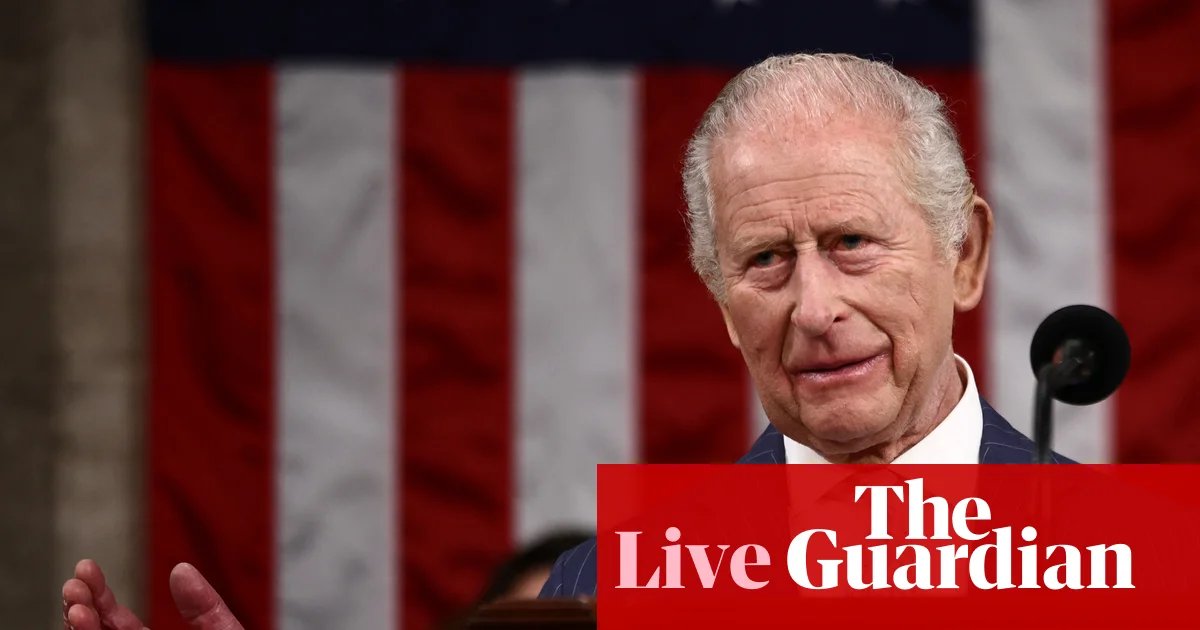
King Charles praises ‘ambitious’ Aukus in speech to US Congress
King Charles’s address to the US Congress has been covered over in our US politics blog (check it out here).
But it’s worth noting that Australia got a shout-out, and specifically the Aukus nuclear submarine program, in a section of the speech that pointedly dwelt on the importance of defence ties between the US and UK (and Nato more broadly).
The king said:
Our defence, intelligence and security ties are hardwired together through relationships measured not in years, but in decades.
Today, thousands of US service personnel, defence officials and their families are stationed in the United Kingdom, as British personnel serve with equal pride across 30 American states.
We are building F-35s together.
And we have agreed the most ambitious submarine programme in history, Aukus.
And we do so in partnership with Australia, a country of which I am also immensely proud to serve as sovereign.
We do not embark on these remarkable endeavours together out of sentiment.
We do so because they build greater shared resilience for the future, so making our citizens safer for generations to come.

Key events
Paterson says US alliance still ‘robust’ despite voter disapproval

Luca Ittimani
James Paterson, the Coalition’s defence spokesperson, was also asked about how the opposition would deal with the Trump administration and he said it was “inarguable” that Australians have less support for the US alliance under the current US government.
But the Liberal frontbencher said public opinion did not affect the “robust” alliance.
Despite the clear signal of disapproval for Trump in Australian polls, he told ABC’s 7.30 last night:
I don’t think that actually changes the fundamentals of the US-Australia alliance. It’s still incredibly robust at other levels but I think we should be adult and be honest and acknowledge that that has had an impact on how Australians view the United States. … It doesn’t mean, though, that Australia’s national interest has changed, even if Australians disapprove of this administration.
Paterson said Australia’s bases for US submarines and the Pine Gap intelligence base tied the countries together.
The alliance is about more than just the personalities of any one commander-in-chief … Frankly, it’s in America’s national interest. What Australia offers the United States, it cannot get from elsewhere.
Good morning, Nick Visser here to pick up the blog. Let’s see what the day has in store.

Dan Jervis-Bardy
The projects would need to comply with proposed new national environmental standards, which government sources insist will be in place before the bilateral agreements are negotiated.
Albanese has previously explained that instead of a costly two-stage, two-track process, the government wants a one-step process, “with one, clearer, faster, yes or no” that can act as a “circuit breaker”.
The prime minister will address the miners following reports last week that he had ruled out introducing a new tax on gas exports in the 12 May federal budget – a policy the industry vehemently opposes.
In the speech to the Chamber of Minerals and Energy WA, Albanese will frame the budget as the most ambitious and important since Labor returned to power in 2022 as the government grapples with the impact of the Iran war and global fuel crisis.
Albanese will say:
None of us here can determine when this war will end. But all of us can choose how we respond to the economic challenges it is creating. We can choose what we learn from this global crisis, even before it ends. And we can choose what we are going to do differently, as a country. What we will build and change and reform, so that Australia does more than weather this storm, we emerge from it as a stronger, fairer and more resilient country.
Dan Jervis-Bardy
The federal government has pledged new funding to help the states and territories strike agreements that would allow them to assess and approve projects themselves under new federal nature laws.
Anthony Albanese will make the four-year, $45m announcement in a speech to a mining industry event in Western Australia, describing the deals as a “circuit-breaker” that will fast-track mining, energy and housing applications.
The new “single-touch” regime was a feature of Labor’s re-write of the Environment Protection and Biodiversity Conservation Act (EPBC Act), which passed the parliament last year under a deal with the Greens.
Labor had previously opposed handing federal environmental approval powers to state and territory governments, including iterations of the policy that were put forward by the Abbott and Morrison governments.
If deals are struck, the states and territories would be able to greenlight projects without requiring a separate commonwealth assessment.
Markets braced for inflation shock

Patrick Commins
Consumer price data released later this morning will confirm the Iran war is delivering a major inflationary shock to the economy thanks to soaring fuel prices.
Economists at Westpac predict inflation jumped by 1 percentage point to 4.7% in the year to March, based on the monthly consumer price index figures.
The Australian Bureau of Statistics also reports more established quarterly figures, and by this measure annual inflation will jump to 4.2%, from 3.6% in the year to the December quarter.
Inflation was already running too high for comfort before the US and Israel began the Middle East conflict on February 28, and the latest numbers will underline the case for another Reserve Bank interest rate hike next Tuesday.
Economists say inflation is set to accelerate from here as higher fuel costs spread through the economy and drive a broader lift in prices.
For example, the Westpac economists expect inflation to reach 5.8% in May, and only retreat to 4.7% by the end of this year.
For context, the RBA’s official target is 2.5%.
But central bank officials will be aware that the Iran war will smash economic growth, and the RBA’s board will be weighing this against the need for more rate hikes.
Read more here:
King Charles praises ‘ambitious’ Aukus in speech to US Congress
King Charles’s address to the US Congress has been covered over in our US politics blog (check it out here).
But it’s worth noting that Australia got a shout-out, and specifically the Aukus nuclear submarine program, in a section of the speech that pointedly dwelt on the importance of defence ties between the US and UK (and Nato more broadly).
The king said:
Our defence, intelligence and security ties are hardwired together through relationships measured not in years, but in decades.
Today, thousands of US service personnel, defence officials and their families are stationed in the United Kingdom, as British personnel serve with equal pride across 30 American states.
We are building F-35s together.
And we have agreed the most ambitious submarine programme in history, Aukus.
And we do so in partnership with Australia, a country of which I am also immensely proud to serve as sovereign.
We do not embark on these remarkable endeavours together out of sentiment.
We do so because they build greater shared resilience for the future, so making our citizens safer for generations to come.
Welcome
Good morning and welcome to our live news blog. I’m Martin Farrer with the top overnight stories and then it’ll be Nick Visser with the main action.
Consumer price data coming out today is expected to show the sharp shock that the US-Iran war has dealt to our economy (and our wallets).
And overseas, King Charles has addressed the US Congress and found time to praise Australia and spruik the Aukus nuclear submarine program, in a section where he dwelt on the importance of defence ties between the US and UK.
More on these stories, and more, coming soon.