dailynewsnblog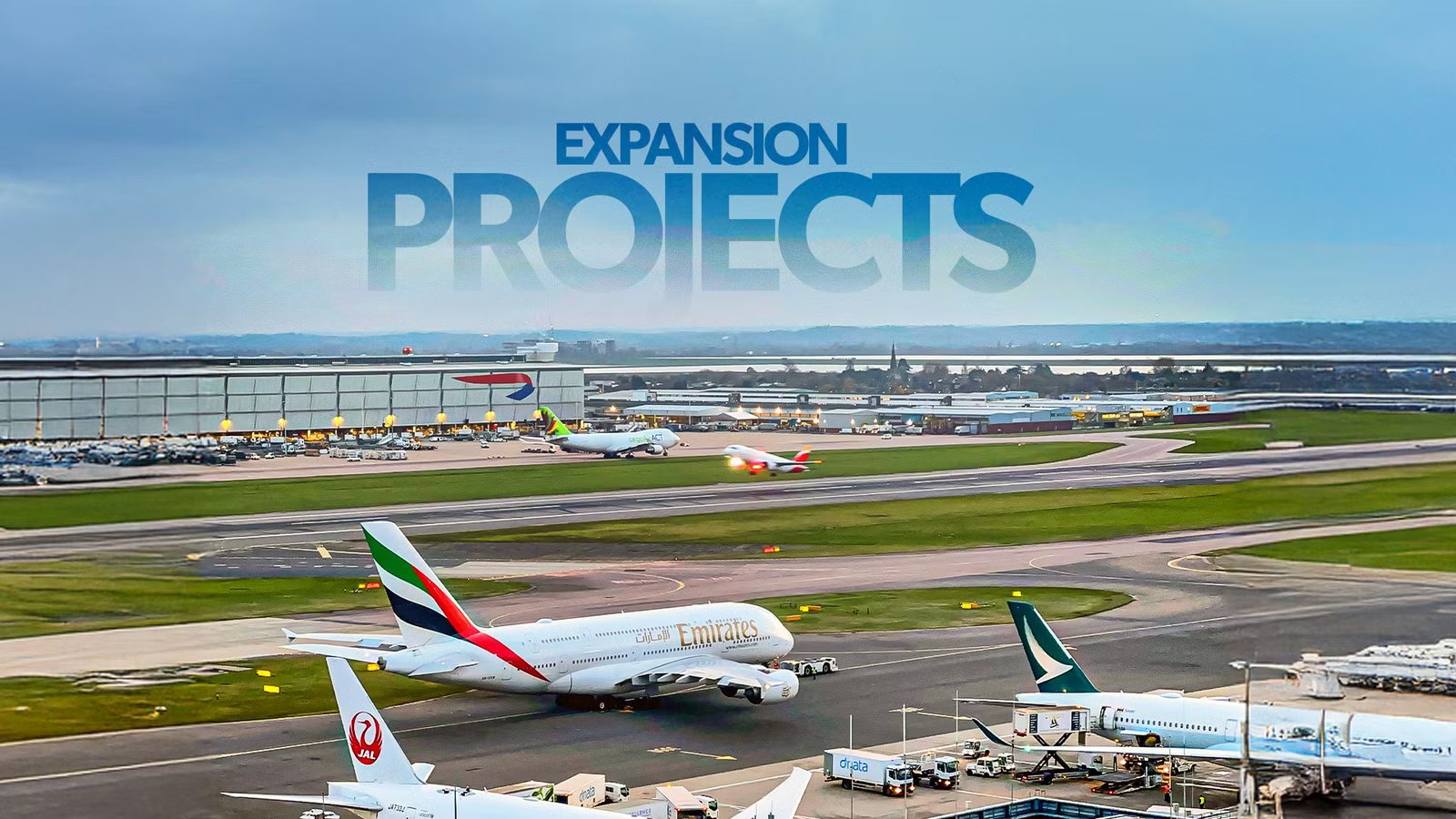
The world’s busiest airports are largely facing the same challenge: they don’t have enough space or barely have enough space to accommodate their current flight volumes.  London Heathrow Airport has less than 10% the land area of Denver International Airport and a third of the runways, yet has nearly 70% the number of yearly aircraft movements and handles more passengers. As such, Heathrow and similarly constrained airports are essentially at capacity, while demand for flights continues to climb.
However, some of these constrained airfields are now embarking on expansion projects. This most commonly involves adding another runway, since this is the main area of constraint. Runway expansion projects are extremely expensive in certain parts of the world and are disruptive to nearby neighborhoods. However, a new runway is game-changing for an airport that’s close to or at maximum capacity, and it also has significant implications for the markets in which these airports are located.
Dublin Airport’s New Runway

Dublin Airport (DUB) has quietly become a sleeper hub in Europe, with Irish flag carrier  Aer Lingus operating a substantial hub connecting Europe to North America. Despite being one of the smaller European airlines, it plans to operate 20 nonstop routes from Dublin to the United States this upcoming summer, in part enabled by its use of the Airbus A321LR and A321XLR to serve smaller destinations in the US. Until recently, however, DUB operated with an 8,652-foot (2,637-meter) main runway.
Meanwhile, its secondary runway was only 6,798 feet (2,072 meters) long, representing a notable constraint. After years of delays due to the Great Recession and subsequent predictions of softening demand, DUB finally announced that it would construct a new runway in 2016. Construction began in December of that year, with completion scheduled for 2021 (although the project actually concluded in 2022).
The new runway, designated Runway 10L/28R, is the airport’s longest, at 10,203 feet (3,110 meters), allowing for longer flights that require more runway length. The airport’s prior main runway was redesignated as Runway 10R/28L, while the shorter Runway 16/34 is commonly used as a taxiway.
Dublin is now Europe’s 12th busiest airport, and there are now talks of constructing a new terminal located west of the current terminal complex. In addition, DUB is planning to expand aircraft parking positions and increase the size of its US pre-border clearance facility. The Irish government is now looking to lift the airport’s long-standing cap of 32 million passengers. If this passes, it will allow airlines to further expand their operations, truly growing Dublin into one of Europe’s biggest aviation hubs.
The North Runway At Hong Kong International Airport

As part of the facility’s 2030 master plan, Hong Kong International Airport (HKG) opened a third runway in 2022. Also known as the North Runway, it’s 12,467 feet (3,800 meters) long, meaning that it can accommodate any widebody aircraft, and the land dedicated to the runway, as well as its accompanying taxiways, is around the same size as Gibraltar. Following the opening of the third runway, the Centre Runway was closed for construction, and since its reopening in 2024, HKG has operated with three runways.
With all three runways, HKG can now accommodate up to 620,000 flights annually, representing 102 per hour or one flight every 36 seconds. Given Hong Kong’s position as one of Asia’s leading financial hubs and the world’s leading hub for cargo flights, there’s strong demand to ensure that the airfield can meet demand for the foreseeable future. With all three runways operational and other expansion projects in the works, HKG is designed to accommodate up to 120 million passengers yearly, as well as ten tons of cargo annually.
|
HKG Runway |
Length (Feet) |
Length (Meters) |
|---|---|---|
|
07L/25R |
12,467 feet |
3,800 meters |
|
07C/25C |
12,467 feet |
3,800 meters |
|
07R/25L |
12,467 feet |
3,800 meters |
In addition to the third runway, HKG is also working on expanding the existing Terminal Two building, which is set to reopen in May 2026. Originally a facility for processing check-ins and arrivals, it’s intended to connect to a new midfield concourse located between the North and Centre runways, although it will initially mainly serve to process passengers before sending them to the existing facilities. In 2027, the airport will begin a staged opening of the new midfield concourse, which will provide 57 additional parking positions.

easyJet At Heathrow: Will A Third Runway Welcome Low-Cost Carriers?
The new project could also open the door for low-cost carriers such as UK-based easyJet.
A Fourth Runway At Charlotte Douglas International Airport

Charlotte Douglas International Airport (CLT) is one of American Airlines’ largest hubs and one of its most profitable due to its location as well as low operating costs. As such, the carrier has been strong prioritizinf this hub, and CLT’s new runway will be the primary enabler for future expansion. Located between the current runways 18C/36C and 18R/36L, the airport broke ground in 2023, and the runway is expected to be completed by fall 2027, costing a total of $1 billion.
CLT originally planned to construct a 12,000-foot (3,658-meter) runway, but this was trimmed to 10,000 feet (3,000 meters) to save space. The new runway will be parallel to the existing three, and the runways will be renamed accordingly. The existing Runway 18L/36R, located on the airfield’s east side, will be renamed Runway 18/36, while Runways 18C/36C and 18R/36L will be renamed 19L/01R and 19R/01L. The new runway will be designated as Runway 19C/01C.
With all four runways, CLT will be capable of quadruple parallel approaches and departures, one of only a handful of airports in the US that can accommodate this procedure. This will dramatically increase the airport’s flight capacity, allowing for further expansion. In addition, CLT is also planning new taxiways on the west side of the airfield, which will allow aircraft to taxi around the runways rather than having to cross them. While this will add distance, it will save time overall since taxiing aircraft won’t need to wait for arrivals or departures to clear the runway.
Moving Gatwick’s Secondary Runway

London Gatwick Airport (LGW) is the second-busiest airport serving the London metropolitan area, but despite technically having two runways, it fundamentally operates as a single-runway airfield due to the proximity of its two runways. In practice, this means that the smaller Runway 08L/26R can only be used when LGW isn’t using the larger Runway 08R/28L, essentially as a standby, and is otherwise used as a taxiway. This significantly constrains its maximum capacity.
After decades of debate, plans were announced in 2020 to shift Runway 08L/26R by 39 feet (12 meters) to the north, allowing it to be used simultaneously with Runway 08R/26L. In 2025, this project was formally approved by UK Transportation Secretary Heidi Alexander. This comes in turn with CAA approval for LGW to increase flight capacity to 50,000 per year, requiring routine use of both runways. The project is budgeted at £2.2 billion and is projected to be completed before the end of the decade.
London has the world’s busiest system of airports, and expanding Gatwick to become a true two-runway airport will allow for dramatically more flight capacity into a city with seemingly limitless demand. By the late 2030s, the airport aims to accommodate up to 80 million passengers annually, whereas it currently handles just over 43 million. While Heathrow is the preferred airport for many traveling to London, Gatwick is closer to many South London neighborhoods and is also home to a secondary  British Airways hub.

Overdue Expansion: Dubai Airports CEO Urges Heathrow To “Get On With” Third Runway & Capacity Growth
Despite having made considerable steps forward, Heathrow’s growth plans continue to face strong opposition.
Heathrow’s Long-Awaited Third Runway

London Heathrow (LHR) is the world’s busiest two-runway hub by aircraft movements, and it is also London’s largest airport. This means that demand is extremely high, especially from business travelers, yet the airport lacks the capacity to accommodate additional flights. LHR is slot-controlled, meaning that airlines are assigned specific times for takeoffs and landings. While slots are always available, the only ones left at Heathrow are during undesirable off-peak hours.
This means that the only way to enter or expand at LHR is to acquire slots from another airline, in transactions that are valued at tens of millions of pounds. For years, there have been discussions on building a third runway at LHR to alleviate the airport’s constraints, but these were met with fierce opposition on environmental grounds and noise concerns.
|
Current LHR Runways |
Current LHR Terminals |
|---|---|
|
Runway 09L/27R |
Terminal Two (including one satellite) |
|
Runway 09R/27L |
Terminal Three |
|
Terminal Four |
|
|
Terminal Five (including two satellites) |
In 2025, however, the government elected to proceed with an expansion of Heathrow, selecting a proposal from Heathrow Airport Holdings (owner of LHR) to deliver a third runway by 2035 while also thoroughly overhauling the airport’s terminals and taxiway layout. The third runway will be located to the northwest of the current airfield, and will boast a length of 11,500 feet (3,500 meters).
It’ll be accompanied by several taxiways to connect it to the rest of the airport, while the M25 highway will be diverted to the west via a tunnel that will pass under the airport’s new land. Terminal Three will close, to be replaced by new Terminal Two satellite buildings, while a new Terminal Five satellite building will be located near the third runway. In total, Heathrow should be able to accommodate up to 756,000 annual flights and 150 million passengers, up from today’s maximum of 84 million.