dailynewsnblog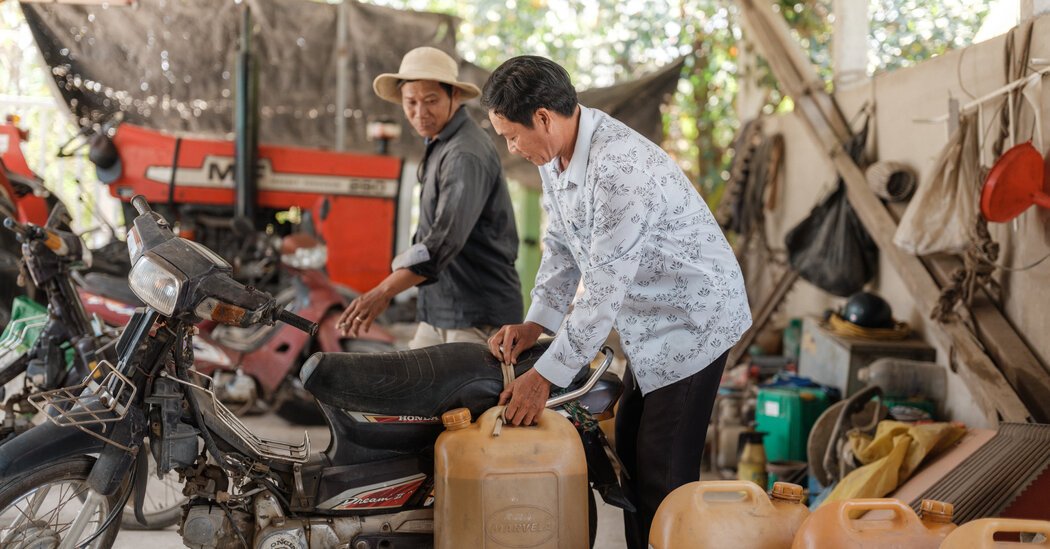
The fallout from two months of war in Iran is shuttering textile mills in India and Bangladesh, grounding airplanes in Ireland, Poland and Germany, and prompting energy rationing in Vietnam, South Korea and Thailand. The only country, it seems, that has been relatively spared from the economic chaos is the one that started the war: the United States.
While warning signs of a recession are flashing across countries in Asia and Europe, the United States is likely to outperform most of the world’s advanced economies. Growth is steady and unemployment low. “It’s still hard to bet against the U.S. economy,” the Royal Bank of Canada said last week.
The United Arab Emirates, one of the world’s richest countries, with sovereign wealth funds that total more than $2 trillion, has asked the United States for a financial lifeline in the wake of missile-damaged gas fields and a halt to shipping in the Strait of Hormuz.
In just eight weeks — less time than it takes to age a traditional English fruitcake — the global economic outlook has been knocked sideways.
The worst economic pain will be felt in poor countries, where consumers cannot afford higher energy prices, and governments cannot afford to provide aid to offset the costs. And as financing tightens, the cost of desperately needed borrowing for these countries increases.
Soaring prices now for fuel and fertilizer mean higher prices for food later in the year. In Africa, “food insecurity looms large,” the International Monetary Fund said last week. In the Asia-Pacific region, millions of people are at risk of falling into poverty because of the conflict, the United Nations Development Program warned.
Already, many countries in Asia are grappling with fuel shortages, which will grow only worse as the war drags on, said Raghuram Rajan, an economist at the University of Chicago and a former governor of the Bank of India.
“The shortages will start hitting more and more,” said Mr. Rajan, who formerly served in a top role at the International Monetary Fund. In many countries, the real consequences are only just beginning to be felt.
Energy inventories are running out, and some shipments have stopped. “The water’s on the boil, the frog is in the water and the temperature’s rising,” Mr. Rajan said. “And now, increasingly, you’re going to see industry shut down.”
Steel plants in India and automakers in Japan have cut production because of higher energy prices and concerns about reduced demand. Toy factories in China, already suffering from U.S. tariffs, are contending with discontent from thousands of workers angry about losing their jobs.
One morning last week, in Firozabad, a city in northern India, workers were idly milling at an open-air labor market. “Because of the war, work has dwindled,” said Muhammad Waseem, a plasterer. He was haggling with a potential employer who wanted to pay him 500 rupees ($5.30) for a construction job, significantly less than what he usually earns.
Aas Muhammad, 25, a laborer who loads bricks and cement onto trucks, had walked five miles to the market from his home. He was willing to take the 500 rupees, but even that wouldn’t go far. A kilogram of cooking gas that would normally cost 80 rupees now costs 200.
Millions of other Indian workers who usually live and work in the Emirates and Saudi Arabia, and collectively send billions of dollars in remittances home every year, are stranded abroad without work.
Shortages of other commodities that ordinarily travel through the Strait of Hormuz, like helium, aluminum and naphtha, are affecting the supplies of a dizzying array of other goods, from condoms to microchips.
Of course, the U.S. economy isn’t entirely insulated from the shock. Gas prices have jumped more than $1 a gallon since the war began, a tax on American consumers that has hit lower-income households especially hard.
On Wall Street, banks have marked their growth forecasts down and their inflation forecasts up since the war began and have all but given up on the possibility of further interest rate cuts before the fall at the earliest.
Compared with the rest of the world, though, the impact on the domestic economy has been muted. Consumer spending remains strong, layoffs remain low and forecasters still expect solid growth this year.
Economists say it would take a much more significant spike in oil prices, perhaps as high as $150 a barrel, for them to begin worrying seriously about the possibility of a recession in the United States.
That is not the case elsewhere, where the dreaded combination of slower growth and higher inflation is already raising alarms about stagflation.
Around the world, scarcity and high prices are setting off a worrying cycle of reduced economic activity: High prices lower the demand for fuel, and the lower demand, in turn, shrinks production, employment and spending.
The German airline Lufthansa canceled 20,000 flights scheduled for this summer. As jet fuel prices have doubled, all 20 of the world’s top air carriers have cut at least some flights, according to Freightos, a digital shipping marketplace. Fewer flights cut sharply into tourism and business travel, reducing spending at hotels, restaurants and retailers.
For the United States, the biggest advantage is that, unlike most of its global peers, it produces more oil and gas than it consumes. That doesn’t mean it is unaffected by what happens in global energy markets, but it helps dampen the impact.
The U.S. economy is also heavily based on services and depends relatively little on the energy-intensive manufacturing industries that have been hit hardest by the spike in oil prices. And it went into the war with a stronger economy than many other countries, giving it more of a buffer against a slowdown.
“We’re not feeling the same pain the rest of the world is,” said Jason Bordoff, the founding director of the Center on Global Energy Policy at Columbia University.
“In a shock this large, the physical shortages are showing up in Asia, and they’re trickling through to Europe,” he added. “We’re the last to feel the effects.”
The toll on the U.S. economy will grow if the war drags on. Higher fuel prices will further raise the cost of shipping, and that could drive up prices for other consumer goods.
“We don’t know how long this shock will last, and I think if it persists we’ll probably be having a very different conversation six months from now,” said Ben Harris, a Brookings Institution economist who served as chief economist at the Treasury Department under the Biden administration.
Even if the war were to end tomorrow, most energy executives and political analysts doubt that traffic through the Strait of Hormuz, a critically important shipping lane for oil and gas, will ever return to the way it was before. The war has demonstrated how easily free passage can be stopped, raising risks and costs.
The shortfall caused by the halt in oil and gas production and the missile damage inflicted on infrastructure also mean that oil prices are likely to remain elevated or rise over the next four years, according to High Frequency Economics, a research consulting firm.
“We are more resilient to energy shocks, but I don’t think that’s going to last,” said Adam Posen, president of the Peterson Institute for International Economics.
Many countries, including allies, had already been re-evaluating their relationship because of President Trump’s punitive trade policies and erratic behavior, including his demands to take over Greenland.
Now American pre-eminence has been undercut by Mr. Trump’s decision to start a war with Iran that has had severe economic consequences for much of the world, Mr. Posen said.
“As a snapshot at the moment, the U.S. is less directly troubled,” Mr. Posen added. “I wouldn’t make too much of that.”
Keith Bradsher contributed reporting from Beijing, and Alex Travelli from Firozabad, India.