dailynewsnblog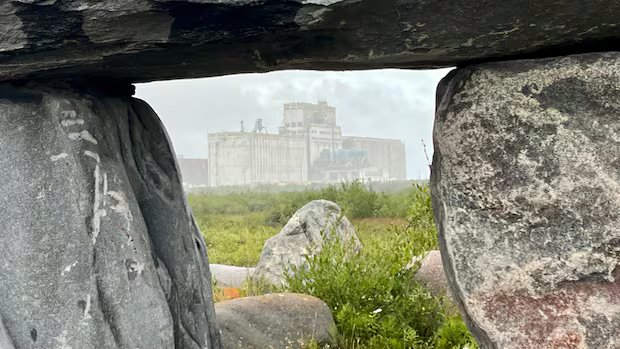

Listen to this article
Estimated 5 minutes
The audio version of this article is generated by AI-based technology. Mispronunciations can occur. We are working with our partners to continually review and improve the results.
Some time over the past six months, Premier Wab Kinew appears to have grown less optimistic about the prospects of Manitoba quickly shedding its have-not status.
Last fall, Kinew claimed three pending Manitoba megaprojects could wean this province off federal equalization payments within 10 years.
Now he says only one of those projects is capable of transforming the provincial economy from one that requires an infusion of cash to one that could stand fully on its own within confederation.
That project happens to be the expansion of the Port of Churchill, which remains in the conceptual stage and requires more studies, engineering, environmental assessments, community consultations and likely a major private investor before it can proceed.
Speaking in Toronto in October, Kinew told The Empire Club of Canada that Manitoba was planning three energy projects that could generate $30 billion in new economic activity — a value equal to more than a third of the province’s existing gross domestic product.
“One that we’re almost certainly going to do, a second that we’re trying to put the financing piece together and the third which has been very public, which is the Port of Churchill,” Kinew told podcaster and former federal Liberal adviser David Herle at the Empire Club event.
“If we build the three of those out to the full extent, then Manitoba can become a ‘have’ province — and not, like, 40 years in the future. Like, within the next five, 10 years type of thing.”
At the time, Kinew declined to identify the two other energy projects.
During question period on Monday, Kinew identified the two other projects as Manitoba Hydro’s $3-billion plan to build a trio of $250-megawatt natural gas turbines in Brandon by 2029 and a 600-megawatt series of wind farms Hydro is asking new Indigenous-led companies to build by 2035.
Both the gas turbines and wind farms are previously announced projects. The only new information Kinew offered about them on Monday was that the wind farms would be built in “western Manitoba.”
CBC News asked Kinew on Friday if these three particular projects are capable of weaning Manitoba off equalization payments.
“The Churchill one would be, if we do that,” Kinew said in Lockport.
“The combustion turbines, the wind projects — that’s baked into our existing trajectory of that diversified economic growth that we are used to in Manitoba.”
The Port of Churchill expansion would fit the bill, Kinew said, provided the province manages to figure out how to build a natural gas pipeline over hundreds of kilometres of muskeg, erect an LNG terminal on Hudson Bay and move liquefied gas through the bay’s often ice-choked waters within four years — and obtain all the regulatory approvals to do so in that time frame, not to mention find the cash to make it all happen.
“If we get private-sector investment and we can deliver on the Prime Minister’s timeline of LNG out of Churchill by 2030, that takes us to a whole new level of economic growth,” Kinew said.
“You’re talking about $10 billion, $20 billion, $30 billion worth of investment. So that would be huge.”
It’s fair to say this is an extremely ambitious timeline for a near-unprecedented feat of engineering.
In the 1970s, it took nine years to plan and build the 1,300-kilometre Alaska Pipeline, which carries oil from the U.S. state’s north slope to the ice-free Gulf of Alaska. The cost of that project was USD $8 billion, or something closer to USD $44 billion today.
More recently, it took 12 years and CAD $34 billion to plan and build the 1,180-kilometre Trans Mountain Pipeline Expansion to carry oil from Alberta to the Pacific Ocean.
It also took 13 years to build the 670-kilometre liquefied natural gas pipeline from Dawson Creek, B.C. to Kitimat B.C., at a cost of $15 billion for the pipeline and $18 billion for the LNG terminal at the end of the Douglas Channel, a protected waterway connected to the Pacific.
There does not appear to be a protected harbour to place a new and expanded port on Hudson Bay. The construction of an artificial barrier to protect an LNG port from the elements, should this project proceed, would drive up engineering and construction costs.
All of this is to say the Port of Churchill expansion faces many hurdles to clear, in terms of geography, engineering, regulatory approval and financing.
This means Kinew’s push to transform Manitoba into a have province hinges on a very difficult Port of Churchill expansion, especially since the premier says a trio of gas turbines in Brandon and several wind farms won’t transform the provincial economy.
In the long term, Canada’s parliamentary budget office doesn’t envision fantastic economic fortunes for Manitoba. The PBO expects Manitoba’s net debt to outgrow its gross domestic product for many decades to come as it envisions poor fiscal sustainability for this province.
It remains to be seen what — if anything — can be done to avoid this.