dailynewsnblog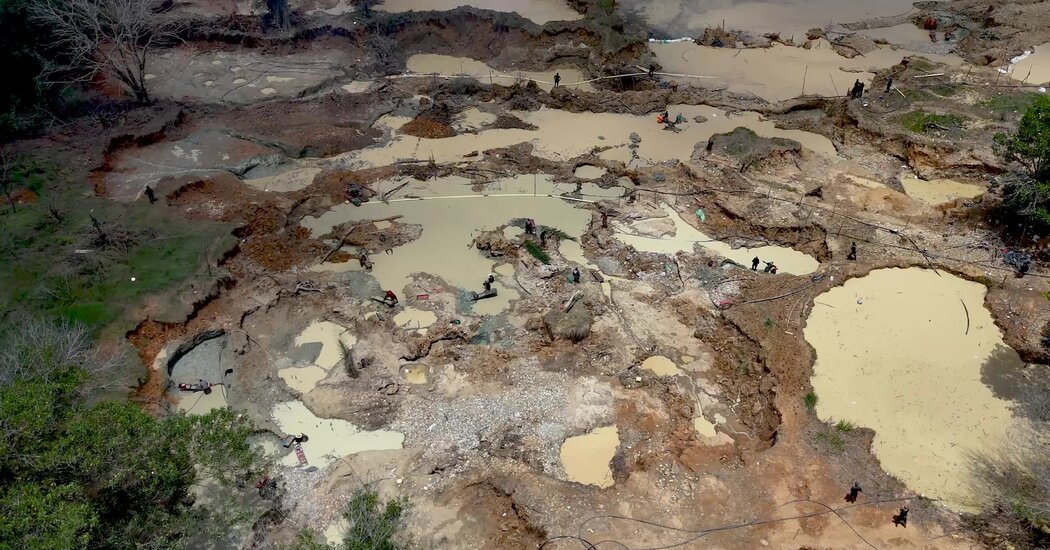
It was during my third visit to La Mandinga, a gold mine controlled by a Colombian drug cartel, when I understood just how badly the institutions that are supposed prevent illegal mining had failed.
The mine abutted a Colombian military base. Weren’t people worried about operating under the noses of the authorities? After all, the mine supported the notorious Clan del Golfo cartel.
Hardly. One miner told me and my colleagues that the operation had even expanded beyond the military perimeter line and that workers were mining for gold directly on the base.
“Fly a drone and see,” the miner said.
So we did. The images were clear: Miners with high-pressure hoses were tearing up a forested area of the base, home to the Rifles Battalion 31, a Colombian military unit. We could see what appeared to be a former fence line — but no sign of a fence separating the base from La Mandinga. After we shared the images with the military and asked for comment, the base’s commander, Col. Daniel Echeverry, denied any gold mining was happening on his base.
That made no sense to us. The diesel generators on a working mine are deafening and, from satellite imagery, we could see that the mines had expanded to within about 150 yards of the base’s swimming pool and outbuildings.
Colonel Echeverry invited me to the base to talk, so I went. He told me that in the six months he’d been in charge, he’d been aware of the illegal miners next door but noted that the military was hesitant to take armed action against civilians, even if they were committing crimes. But he was adamant that the miners were not on the base.
As a journalist, I’m not in the business of leading the authorities to the site of criminal activity. I never want to become part of the story. But here was a colonel denying, on the record, what I had seen with my own eyes.
So I asked if we could go for a walk.
I could hear the generators in the distance. After five minutes, the forest opened into a panorama of torn-up soil and muddy pits. Miners with high-pressure hoses were running a full-scale illegal gold-mining operation, just as we’d seen from the sky.
Colonel Echeverry froze. “This is inside the base,” he said. He ordered the miners to leave. “We can shoot you for trespassing!” he shouted.
I don’t know whether the miners had been working there surreptitiously or whether they’d had an understanding with someone on the base. Either way, I expected them to scatter.
Instead, they shouted obscenities and kept working.
As we were on a military base, reinforcements were close by.
Soldiers arrived with gasoline canisters. They doused the mining equipment and lit it on fire.
“You can’t burn our equipment!” shouted a miner working in his underwear. He swore at the soldiers before grabbing his gold ore and running off.
Some miners pulled out machetes. Others threw rocks. The soldiers began cutting hoses with chain saws.
Workers tried to rescue their equipment and to extinguish the flames with buckets of muddy runoff.
The miners pay the Clan del Golfo for the right to mine at La Mandinga. It was clear that, as far as many of them were concerned, they believed that right extended to where we stood — military property or not.
One miner threatened the colonel with a stick. Then he doused the soldiers and me with gas and shouted, “We’re all going to burn!”
The colonel said it was time to go. The soldiers and I retreated.
Colonel Echeverry seemed shaken. He oversees about 800 men who are responsible for clamping down on the Clan and other armed groups in the area. The gold trade keeps those groups awash in arms and in control of the region.
We hadn’t come to La Mandinga to report on the military base. We came because we had learned that Clan del Golfo gold was making its way to the U.S. Mint, despite laws requiring the Mint to buy only gold mined in the United States.
Colonel Echeverry initially had the same reaction to our findings that many others in the gold supply chain had displayed. Like the Mint, the Mint’s suppliers and the exporters who send the gold to the United States, the colonel had insisted that there was no way illicit gold was moving right under his nose.
When we showed him the evidence, he, like everyone else, said he was surprised and promised to crack down.
It left us wondering: We had such an easy time tracking this gold. Were others even looking?
Justin Scheck contributed reporting.