dailynewsnblog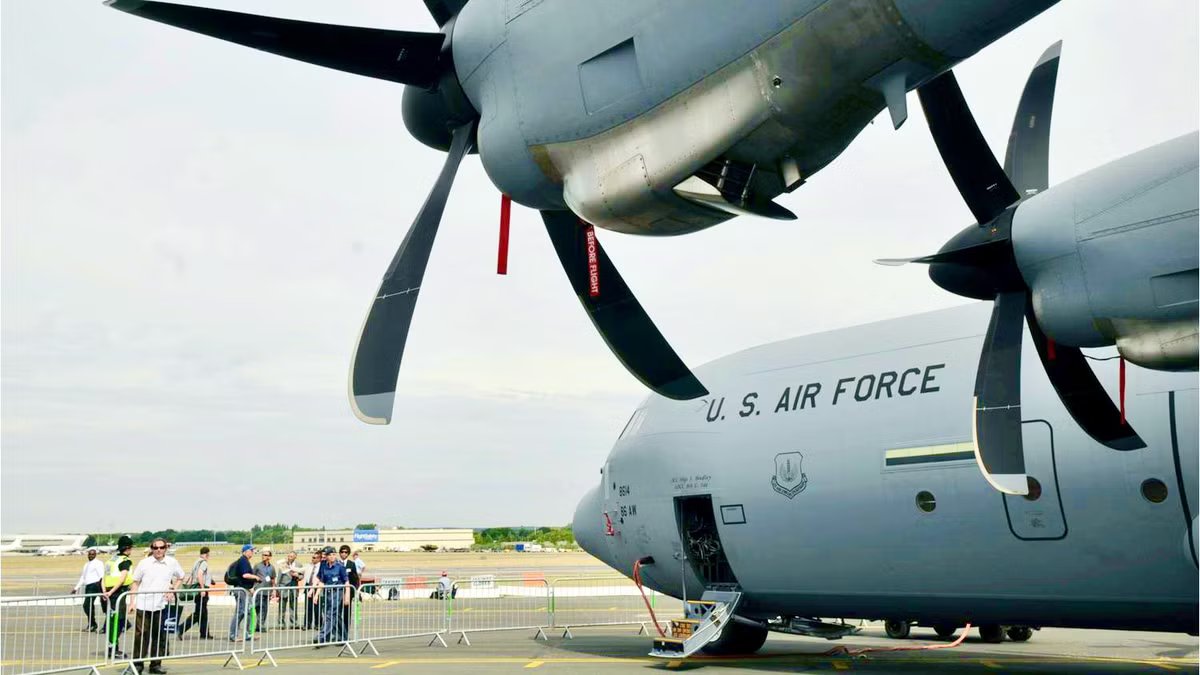
A US Air Force (USAF) Lockheed Martin C-130 Hercules was put out of service by an anti-war protester with a hatchet on April 11 while it was parked at Shannon Airport (SNN) in Ireland, a country that is famous for its military neutrality. The man in his 40s was acting alone, but it is not the first time something like this has happened at Shannon. It was 23 years ago when a US Navy C-40 transport suffered a virtually identical attack.
Ireland is a firm supporter of the United Nations, but its very small Defense Forces are not equipped or trained to engage in or support conventional wartime operations because the nation has deeply institutionalized neutrality. Yet in the last two years, more than 1,300 aircraft serving the US Armed Forces have touched down at Shannon or flown through its airspace, with an especially large number of Hercules relying on the Emerald Isle to make transatlantic transits.
A Shannon Man With An Axe To Grind: The Facts As We Know Them

The C-130, belonging to the Missouri Air National Guard’s 139th Airlift Wing, was sitting idle on the ramp around 9:45 AM. The unauthorized individual in his 40s scaled a perimeter fence and breached the remote taxiway where the military transport aircraft was parked. The man climbed onto the aircraft’s wing and repeatedly struck the fuselage and wing with a hatchet, causing what is described as ‘extensive’ structural damage.
The Irish police, or Gardai, and airport emergency services used mobile stairs to reach and detain the man while he was still on the aircraft. Originally en route to a military exercise in Poland, it was taken out of service and grounded for repairs. Operations at Shannon Airport were suspended for approximately 25 to 30 minutes during the security response. Restarting at 10:15 AM, the shutdown led to brief delays for several commercial flights.
While authorities haven’t officially confirmed a motive, Shannon Airport has a history of being a site for peace protests by activists who oppose the use of Irish soil for US military transit. There were two anti-war protests that took place at Shannon 23 years ago during the build-up to the US military intervention in Iraq. Each targeted the same US Navy Boeing C-40 Clipper transport jets. The first culprit even used a hatchet, and another group was inspired to execute a second bout of costly vandalism.
Shannon’s Unwelcome Wagon And Hercules’ Essential Pitstop

Owing to its lower operating range, the C-130 Hercules uses Shannon Airport more frequently than bigger strategic airlifters. Its fuel capacity is at its limit when traveling across the Atlantic from the East Coast of the United States to Central Europe. The C-130 is a medium-range tactical aircraft, whereas the C-17 Globemaster and C-5 Galaxy are intended for long-range strategic transport. The range of a fully laden C-130J is just 2,100 to 2,400 nautical miles.
Shannon is appealing because it is less congested than major military airfields such as Frankfurt, with ample ramp space and Ireland’s longest runway for big takeoffs. While bigger aircraft may generally avoid Ireland by flying directly to major hubs such as Germany’s Ramstein Air Base, the C-130’s mission profile frequently requires stops. Shannon is the first and final major runway before or after crossing the Atlantic. This makes it a crucial refueling stop for C-130s en route to bases in Germany, Poland, or the Middle East.
The Missouri Air National Guard routinely uses C-130s for international exercises such as Hussar Saber 26-1 in Poland, where the most recently damaged Hercules was heading. These smaller troops rely on civilian-military centers such as Shannon for logistical assistance. C-130s are frequently utilized for intra-theater transport, carrying soldiers and equipment from bigger hubs to smaller, more remote airfields in Eastern Europe or the Middle East.
A Bad Day For The Navy: Mary Kelly And The Pitstop Ploughshares

On January 29, 2003, Anti-war activist Mary Kelly breached airport security at Shannon Field and struck the nose of a parked US Navy C40 Clipper with her hatchet. She then proceeded to continue striking the fuselage of the plane, and after making almost 30 wounds to the defenseless jetliner, it was estimated that the damage exceeded 1 million dollars. Although Kelly was arrested, a few days later, others were inspired by her and broke into the hangar where the plane had been moved.
Later dubbed the Pitstop Ploughshares, the Gang of Five activists managed to gain access to the hangar where the C-40 was parked awaiting repairs. The group used hammers and a pickaxe to continue where Kelly had left off and incurred more damage to both the nose of the plane and its landing gear. They also painted the slogan ‘Pit Stop of Death’ with spray paint on the hangar before finishing with the jet.
None of these individuals would serve time in jail for their crimes against the Navy’s Boeing Clipper. There was a series of trials, but in the end, Mary Kelly was given a two-year suspended sentence. She was convicted of criminal damage in 2004, but her stated defense of intending to disarm the aircraft from participating in the impending war in Iraq was not punished by the courts.
Similarly, the Ploughshare activist group was tried in a high-profile case in 2006. All five members were acquitted by a Dublin jury following the 21-day trial. The jury accepted the group’s stated defense of acting to save lives as a lawful excuse. Since 2003, there has not been another incident like this. However, Operation Epic Fury and the conflict between the US and Iran appear to have reignited the ire of anti-war protesters in Ireland.

Neutrality To Combat Readiness: Ireland’s €1.5 Billion Defense Push Signals New Chapter In European Air Power
The Air Corps is headed for a landmark moment.
Strict Conditions For Military Transit: The Neutral Airspace Over Ireland

For those who are unfamiliar with the relationship between the United States and Ireland, there appears to be a very clear conflict of interest, which begs the question of why the C-130 was even parked at this airport at all. The answer comes from Irish law, specifically the Air Navigation Foreign Military Aircraft Order of 1952, which states that while foreign military aircraft may transit the airspace, they must obtain diplomatic clearance from the Minister for Foreign Affairs to land at Shannon Airport or enter Irish airspace.
The Irish government maintains that these clearances are granted only if the following strict conditions are met. First and foremost, the aircraft must be completely unarmed. That means it cannot carry any weapons, ammunition, or explosive devices of any kind. Nor can these aircraft conduct any intelligence gathering activities or perform any surveillance while inside Irish territory.
Ireland also prohibits military aircraft from conducting any active military exercises or operations within the nation’s territorial boundaries. The most common reason for permission being granted for a military aircraft, like those of the United States, to land in Ireland is for basic logistical reasons. This primarily means refueling or transporting passengers in and out of the area.

US Air Force’s MC-130Js Destroyed In Iran Cost Over $100 Million Each, Special Ops Says
The latest figures reveal extreme risks, advanced tactics, and rising aircraft losses in contested airspace.
The Don’t Ask, Don’t Tell Policy For US Warbirds On Irish Airfields

Ireland is not part of military alliances like NATO due to its policy of military neutrality, but the government utilizes two primary arguments to permit passage even when it disagrees with some international policies. The aforementioned stringent requirements serve as the initial justification for permitting the aircraft. The second has a more pragmatic foundation.
A large number of US soldiers fly in rented commercial aircraft. These are controlled under the 1944 Chicago Convention, which permits civilian aircraft to refuel at international airports without requiring specific state authorization.
Nevertheless, in order to transport armaments, they must apply for exemptions. However, there is a lot of pressure on the Irish government in relation to the Middle East as of April 2026. Authorities claim there is no proof that Shannon is being used to transfer weapons to areas of ongoing fighting, but recent legislative motions have called to immediately close the airport to all US military-contracted flights.
A major point of political contention is that the Irish government does not routinely inspect US military aircraft to verify they are unarmed. Instead, they rely on diplomatic assurances from the US government. Critics and peace activists argue that this ‘don’t ask, don’t tell’ approach makes Ireland complicit in foreign conflicts despite its stated political opposition.

Why The World’s Largest Military Transport Aircraft Doesn’t Use Winglets
Simplicity meets power on the world’s largest ‘big wing’ jets.
More And More US Warbirds Over The Emerald Isle

Since the invasion of Ukraine in 2022, there has been a surge in USAF overflights through Irish air. There were more than 2,000 US military and military-contracted aircraft that landed in Ireland during a two-year period after the invasion began, according to Irish public radio station RTE. The media outlet states that the jets often fly to and from hubs in Poland, Germany, and Bulgaria after departing Ireland.
The larger trend shows that almost 12,000 US military planes have flown across Irish airspace in the past decade. According to observations made by the local activist organization Shannonwatch, the airport has also become a logistics center supporting Israeli military operations since 2023. Following the events of Operation Epic Fury, there is now a rising movement in Ireland to close Irish airspace to US military aircraft, as Spain, Italy, and Austria have recently announced.