dailynewsnblog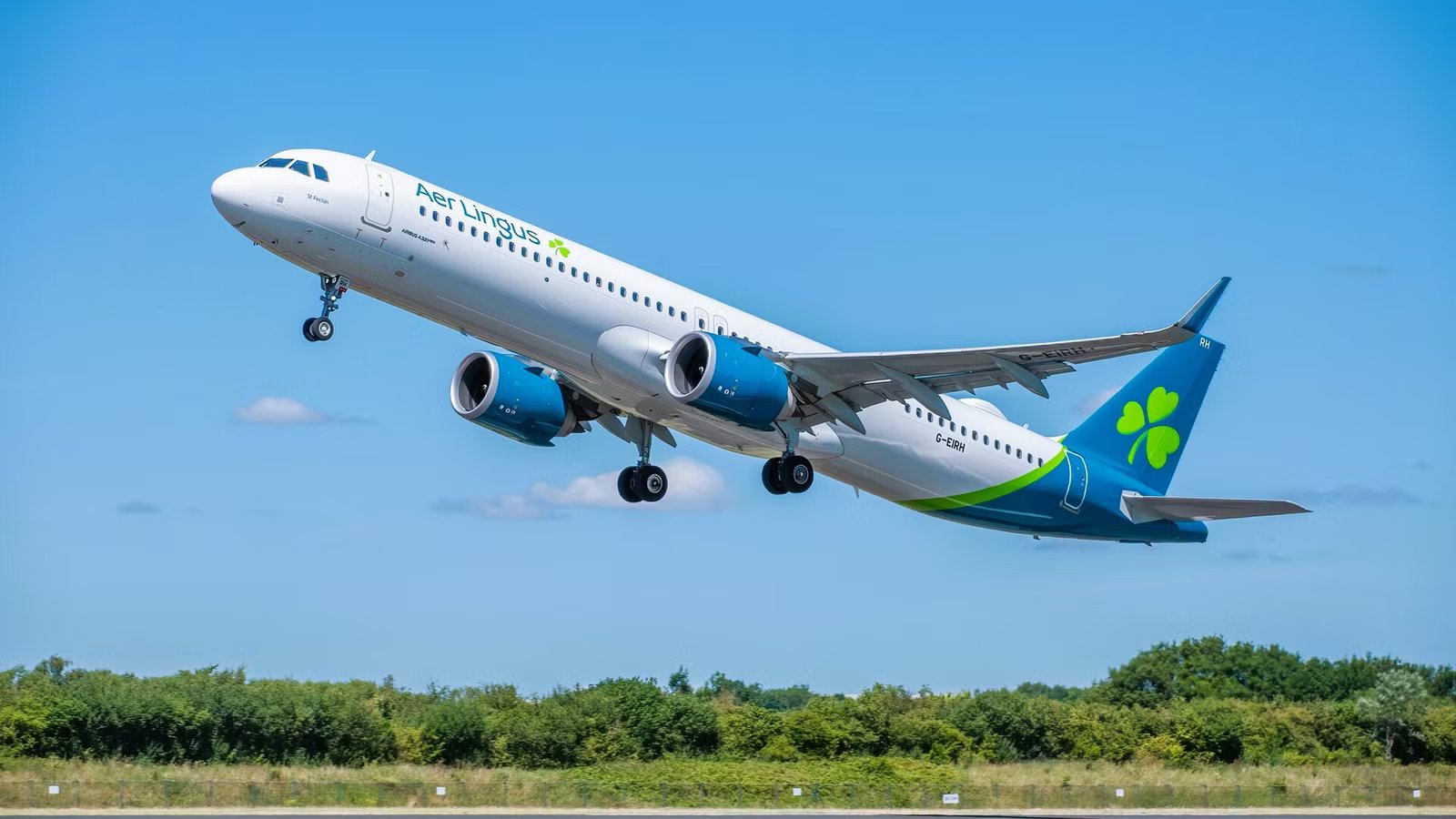
 Aer Lingus is preparing for its biggest-ever summer across the Atlantic, with the Irish flag carrier set to operate a record 20 US routes in summer 2026. The third quarter, from July to September, is when most carriers generate a large proportion of their annual revenues, and schedules show Aer Lingus operating over 4,000 US flights during this period, up 21% year-on-year, while seat capacity will pass 1 million in the summer quarter for the first time.
The expansion is especially notable because it comes even as Aer Lingus exits long-haul flying from Manchester Airport (MAN). The airline confirmed the closure of its Manchester base earlier this year, operating its last transatlantic flights from there in March. It has now shifted the focus firmly back to Ireland, especially its hub at  Dublin Airport (DUB), as the engine room for its continued US growth.
Aer Lingus’ Biggest US Summer Ever

Aer Lingus’ transatlantic strategy has become central to its identity within IAG, its parent company. Positioned as more of a value player, the airline has carved out a niche as a Dublin-based connector between North America and Europe, leveraging Ireland’s geographic advantage and US preclearance facilities. By targeting both major gateways and underserved secondary cities, Aer Lingus competes not just on price, but on convenience—offering shorter journey times than traditional hub connections via London, Paris, or Frankfurt.
A look at Aer Lingus’ Q3 schedule using data from Cirium shows a steady post-pandemic climb in the number of flights and available seats. But 2026 is the real step change. Flights are up 21% year over year, with more than 1 million available seats for the quarter. The net result is that over the past five years, Aer Lingus has increased its US flying by nearly 70%, growing from an average of 13 daily flights to 22 per day across the 20 US destinations it serves.
|
Aer Lingus’ 5-Year Summer Growth |
||||
|---|---|---|---|---|
|
Quarter / Year |
Flights |
YoY Change |
Seats |
YoY Change |
|
Q3 2022 |
2,400 |
— |
657,896 |
— |
|
Q3 2023 |
2,802 |
+17% |
738,392 |
+12% |
|
Q3 2024 |
2,994 |
+7% |
790,838 |
+7% |
|
Q3 2025 |
3,354 |
+12% |
856,294 |
+8% |
|
Q3 2026 |
4,056 |
+21% |
1,011,802 |
+18% |
An interesting note is that the percentage increase in seats is consistently lower than the increase in flights, pointing to the growing role of narrowbody long-haul aircraft, rather than this being a pure widebody-led expansion. Aer Lingus currently has eight Airbus A321LRs and six A321XLRs, giving it a small but mighty long-haul narrowbody sub-fleet.
Dublin Is Doing The Heavy Lifting

Dublin is the heart of the growth story. While Shannon Airport (SNN) still has its two historic daily US links to  John F. Kennedy International Airport (JFK) and
  Boston Logan International Airport (BOS) served with an A321LR, the scale, breadth, and innovation are all coming through Dublin. The capital will have 18 US routes in summer 2026, stretching from legacy trunk routes with multiple daily flights to increasingly thin secondary markets.
|
Aer Lingus’ US Routes From Dublin In Q3 2026 |
|||
|---|---|---|---|
|
US City |
Weekly Flights |
Aircraft Used |
Route Launch |
|
New York |
21 |
A330 / A321LR |
1958 |
|
Boston |
18 |
A330 / A321LR |
1960 |
|
Chicago |
14 |
A330 |
1996 |
|
Washington DC |
14 |
A321LR / A330 |
2015 |
|
Orlando |
7 |
A330 |
2007 |
|
San Francisco |
7 |
A330 |
2014 |
|
Newark |
7 |
A321LR |
2016 |
|
Los Angeles |
7 |
A330 |
2016 |
|
Philadelphia |
7 |
A321LR |
2018 |
|
Seattle |
7 |
A330 |
2018 |
|
Hartford |
7 |
A321LR |
2023 |
|
Minneapolis |
7 |
A321LR |
2024 |
|
Cleveland |
6 |
A321LR |
2023 |
|
Denver |
5 |
A330 |
2024 |
|
Nashville |
5 |
A321XLR |
2025 |
|
Indianapolis |
5 |
A321XLR |
2025 |
|
Raleigh-Durham |
5 |
A321XLR |
2026 |
|
Pittsburgh |
4 |
A321LR |
2026 |
|
Total |
153 |
||
The pattern is clear. Aer Lingus still has its traditional heavyweight routes to the largest US cities. But the growth has come from secondary cities, and this is all down to the A321LR and A321XLR, which have changed the equation. For example, Aer Lingus wouldn’t consider Nashville International Airport (BNA) if it had to use one of its A330-300s. But the airline says that it’s the first route to fully use the A321XLR’s extended range, allowing it to match demand with the right-sized aircraft.
Lynne Embleton, Aer Lingus CEO, said the aircraft allows the carrier to expand its network.
“The new route to Nashville is a milestone for our airline, enabling us to reach further into the US, flying to previously unserved markets in North America. The new Airbus A321XLR, with its extended range, and our geographic position on the Western edge of Europe, opens up exciting new destinations and opportunities for Aer Lingus, and most importantly for our customers.”
This builds on Aer Lingus’ brand promise, as a direct connection between Nashville and Dublin is significantly more convenient that having to connect via a large hub. And it doesn’t just benefit passengers, it also benefits the communities being connected: After launching in 2023, the route to Cleveland Hopkins International Airport (CLE) was estimated to have generated around $28 million in economic impact in its first 18 months.

Ireland To The Innovation Hub: New Aer Lingus A321XLR Route to Raleigh-Durham
This is the carrier’s fourth A321XLR route across the Atlantic, and its furthest destination so far with the type.
Raleigh-Durham & Pittsburgh Join The Map

Raleigh–Durham International Airport (RDU) is the new headline route for summer, with a five-times-weekly service launched earlier this month using the A321XLR. The “Research Triangle” is one of the fastest-growing regions in the US, with strong ties to technology, life sciences, universities, and businesses. That has made it equally attractive to other airlines like  Delta Air Lines and Breeze Airways, which have set up bases there, and Embleton described it as “a vibrant and thriving region with well-established links to Ireland.”
The new route to  Pittsburgh International Airport (PIT) will start at the end of next month, with four weekly flights operated by the Airbus A321LR. The route gives Pittsburgh its third European route — after London (British Airways) and Reykjavík (Icelandair) — and its first nonstop link to Ireland. It also provides Midwest travelers a choice of connecting to other European destinations via the Dublin hub, rather than making a connection via much busier stateside hubs.
The next move is  Miami International Airport (MIA), which returns in October as a winter sun destination. Previously operated with the A330, it could very likely switch to the A321XLR as well. That underlines the broader point: Aer Lingus is no longer just a widebody operator linking Ireland with the biggest US gateways. The A321LR and A321XLR have radically changed its transatlantic profile, giving the airline a tool to build a much denser US map from Dublin, add secondary cities, and turn long-thin routes into viable nonstop markets.