dailynewsnblog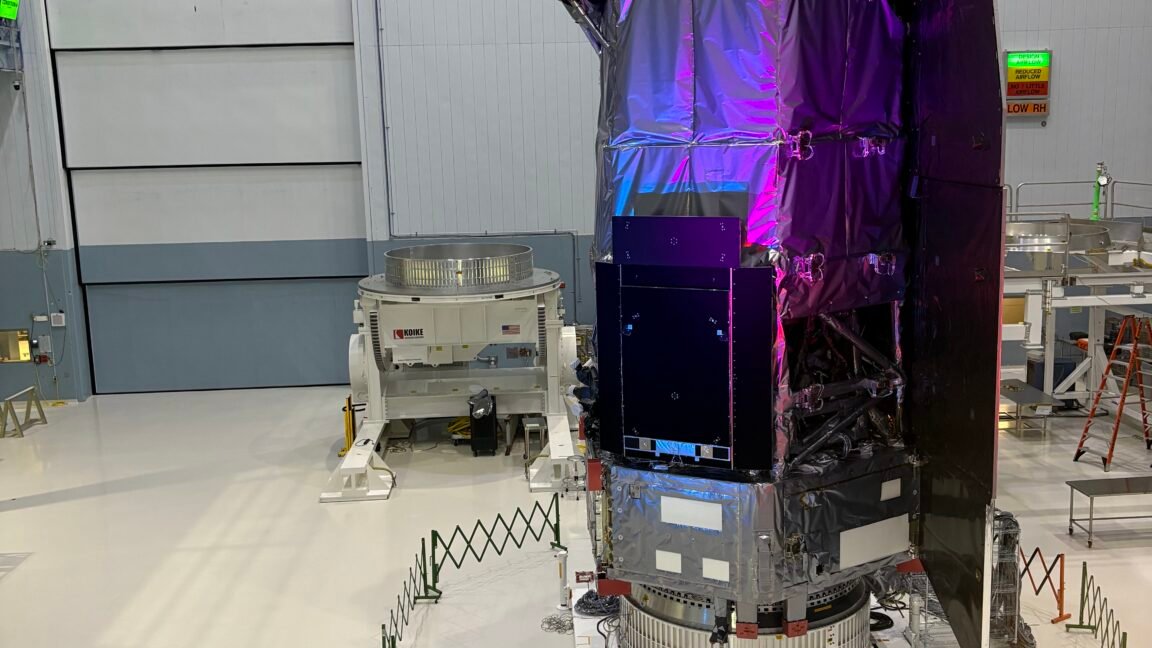
Scientifically, it will be used to image exoplanets in distant orbits from their stars. But it also serves an engineering purpose: starting the development of a coronagraph for the planned Habitable Worlds Observatory that will need to be 100 times more effective at blocking out stars.
Compared to something like the Webb Telescope, Roman is also delightfully simple. It has relatively few moving parts that need to be deployed once in space, and those that exist, like the solar arrays and high-gain antenna, are simple spring-loaded devices. Once latches are released, they’ll simply open into place, a process that NASA’s Melton said will start as soon as 20 minutes after the NGRST separates from the launch vehicle. Commissioning is planned to take only 90 days, and Melton told Ars that it could be doing science before it completes the final burn to put it into orbit around the L2 Lagrange point.
He said the fuel needed to keep it in orbit will be the primary factor limiting the observatory’s life. Using very conservative estimates of its rate of use, NGRST will be sent to space with 10 years of fuel, so barring a major hardware failure, it’s likely to be operational for quite a bit longer.
What will we be looking for?
One of the key targets of the NGRST surveys is what are called baryon acoustic oscillations. In the extremely early Universe, matter was dense enough that sound waves could create interference patterns in the material, with areas forming that had higher or lower densities than average. As the Universe expanded, these patterns were frozen into place and ultimately formed regions with a higher or lower density of galaxies.
Identifying these patterns at large scales can tell us about the composition of the Universe, including the factors that shape most of its structure: dark matter and dark energy. Tracking how they evolve over time could also help us determine whether dark energy is changing with time rather than being in constant acceleration. There have been hints that some details of our understanding of these factors are wrong, and the NGRST will provide an independent measure of them.