dailynewsnblog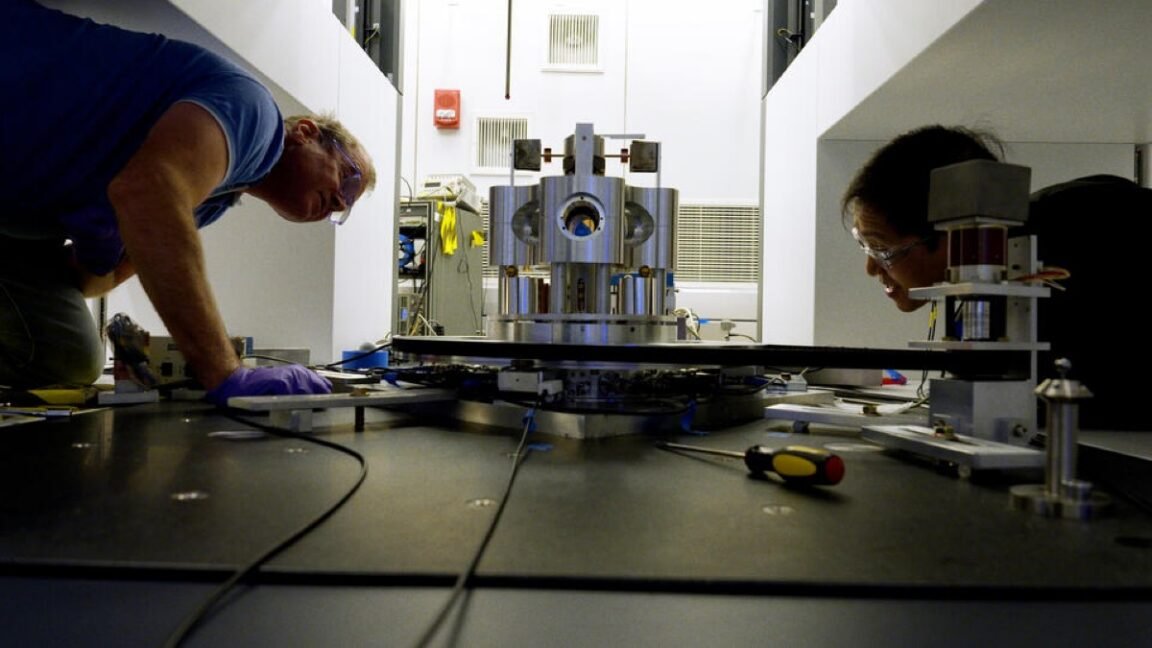
The gravitational constant, affectionally known as “Big G,” is one of the most fundamental constants of our universe. Its value describes the strength of the gravitational force acting on two masses separated by a given distance—or if you want to be relativistic about it, the amount a given mass curves space-time. Physicists have a solid ballpark figure for the value of Big G, but they’ve been trying to measure it ever more precisely for more than two centuries, each effort yielding slightly different values. And we do mean slight: The values vary by roughly one part in 10,000.
Still, other fundamental constants are known much more precisely. So Big G is the black sheep of the family and a point of frustration for physicists keen on precision metrology. The problem is that gravity is so weak, by far the weakest of the four fundamental forces, so there is significant background noise from the gravitational field of the Earth (aka “little g”). That weakness is even more pronounced in a laboratory.
In the latest effort to resolve the issue, scientists at the National Institute of Standards and Technology (NIST) spent the last decade replicating one of the most divergent recent experimental results. The group just announced their results in a paper published in the journal Metrologia. It does not resolve the discrepancy, but it gives physicists one more data point in their ongoing quest to nail down a more precise value for Big G.
Isaac Newton introduced the concept of a gravitational constant when he published his law of universal gravitation in the late 17th century, although it didn’t get its Big G notation until the 1890s. Newton thought it might be possible to measure the strength of gravity by swinging a pendulum near a large hill and measuring the deflection, but he never attempted the experiment, reasoning that the effect would be too small to measure. By 1774, the Royal Society had established a committee to determine the density of the Earth as an indirect measurement of Big G, using a variation of Newton’s pendulum concept.