dailynewsnblog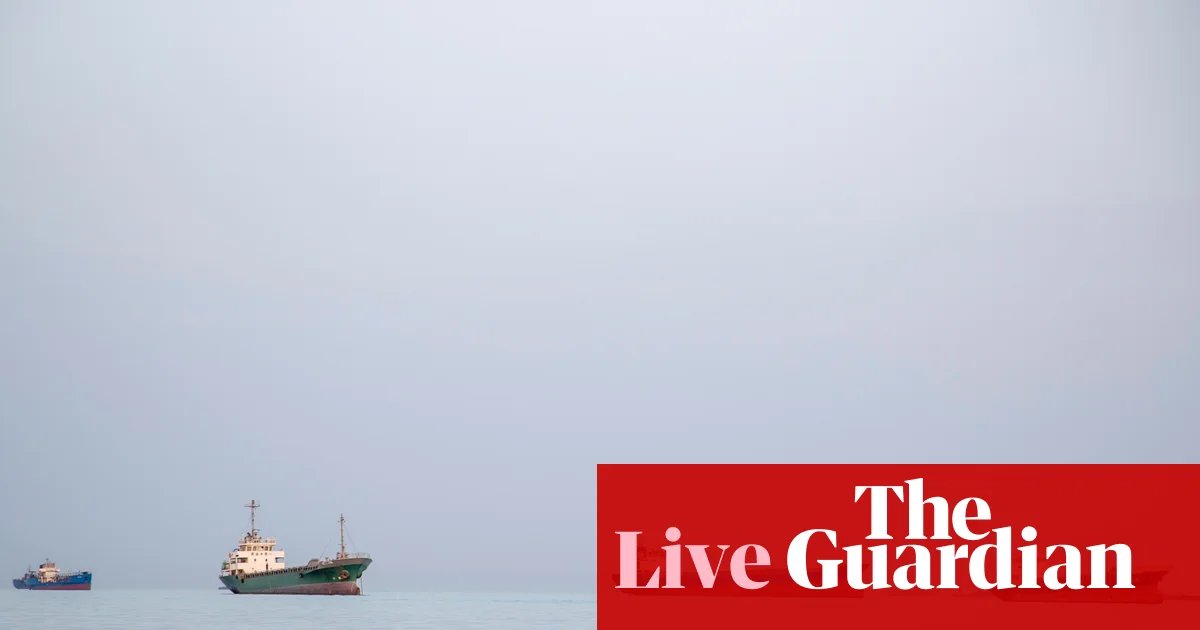
Key events
Most stockmarkets in Asia have fallen in response to the latest Iran war developments.
Tokyo, Hong Kong, Shanghai, Sydney, Singapore and Wellington are all down. But Seoul rallied more than 1% to a new record due to a fresh rally in the tech sector that has been the backbone of a surge in the Kospi index this year.
Taipei, Manila and Jakarta were also up.
Oil prices remain elevated, with Brent holding above $100 after a surge on Wednesday, although they pared Thursday’s initial gains.
Brent crude briefly jumped above $105 earlier today, before dropping to hover around $103.
Iran’s Revolutionary Guards released video footage earlier today purportedly showing their forces seizing two vessels in the strait of Hormuz.
The Islamic Revolutionary Guard Corps (IRGC) said it seized the vessels for what it called maritime violations, and escorted them to Iranian shores, according to statements by the shipping companies and Iran’s semi-official Tasnim news agency.
It is the first time Iran has seized ships since the war began at the end of February.
Tasnim said the IRGC had accused the two ships – the Panama-flagged MSC Francesca and Liberia-flagged Epaminondas – of “attempting to exit the strait of Hormuz covertly”.
At the White House, spokesperson Karoline Leavitt said Donald Trump did not consider the capture of the two container ships to be a violation of the US-Iran ceasefire because the vessels were not American or Israeli.
Leavitt said:
No, because these were not US ships, these were not Israeli ships. These were two international vessels.”
Opening summary
Welcome to our live coverage of events in the Middle East.
Iran has seized two ships in the strait of Hormuz a day after Donald Trump announced he was indefinitely calling off US attacks, while there is no sign of peace talks restarting.
The status of a two-week-old ceasefire – due to expire earlier this week – remained unclear. In an about-face hours after threatening renewed violence, Trump made what appeared to be a unilateral announcement on Tuesday that the US would extend the ceasefire with Tehran until it had discussed an Iranian proposal in peace talks to end the two-month war.
But Iranian officials did not say they had agreed to any extension of the truce, and criticised Trump’s decision to maintain the US navy blockade of Iranian ports. Lead Iranian negotiator Mohammad Bagher Ghalibaf said a full ceasefire only made sense if the blockade was lifted.
Iran’s Islamic Revolutionary Guards Corps seized two vessels on Wednesday for what it called maritime violations and escorted them to Iranian shores, according to the shipping companies and Iran’s semi-official Tasnim news agency – the first time Iran has seized ships since the war began in late Februar.
In other key developments:
-
Trump was “satisfied” with the US naval blockade and “understands Iran is in a very weak position”, White House press secretary Karoline Leavitt said. The US president had not set a deadline on Iran submitting a peace proposal, she said, after Trump on Tuesday said he was indefinitely extending the ceasefire at the request of mediator Pakistan until Tehran responded to the US’s negotiating positions or until talks were concluded “one way or the other”.
-
The Pentagon announced that the US secretary of the navy, John Phelan, would depart the office “effective immediately”, without providing an explanation for his sudden exit amid the naval blockade.
-
The US-Israeli war against Iran is “starting to weaken Europe”, Turkish president Recep Tayyip Erdoğan has told his German counterpart. Erdoğan said: “If we do not address this situation with an approach that prioritises peace, the damage caused by the conflict will be far greater.”
-
Israeli strikes in southern Lebanon killed a Lebanese journalist, Amal Khalil, and wounded a photographer accompanying her, a senior Lebanese military official and Khalil’s employer said. The death of Khalil, 43, brought the death toll to five people on Wednesday – the deadliest day since a 10-day truce between Israel and Hezbollah was announced on 16 April. There was no immediate comment from the Israeli military on Khalil’s death.
-
Khalil and freelance photographer Zeinab Faraj were covering developments near the town of al-Tayri when an Israeli strike hit the vehicle in front of them, Reuters reported. They ran into a nearby house that was then also targeted by an Israeli strike, said Lebanon’s health ministry. Lebanese prime minister Nawaf Salam said Israeli targeting of journalists and obstructing relief effort constituted war crimes.
-
Oil prices leapt 4% on Thursday after Iran vowed not to reopen the Hormuz strait amid the US naval blockade despite the truce extension. Around 0025 GMT, the benchmark US oil contract West Texas Intermediate (WTI) rose 4.06% to $96.73 a barrel, while the international oil benchmark Brent North Sea crude climbed 3.62% to $105.63. Both eased back minutes after.
-
Two Palestinians, including a 14-year-old schoolboy, were killed in the occupied West Bank after Israeli settlers opened fire near a school amid mounting assaults on education in the territory, witnesses and local officials have said.
-
United Airlines implemented broad-based rises of 15-20% on fares as it sought to offset the surge in petrol prices while protecting profits, executives said. The big US carrier has also cut its 2026 flying capacity by 5%.