dailynewsnblog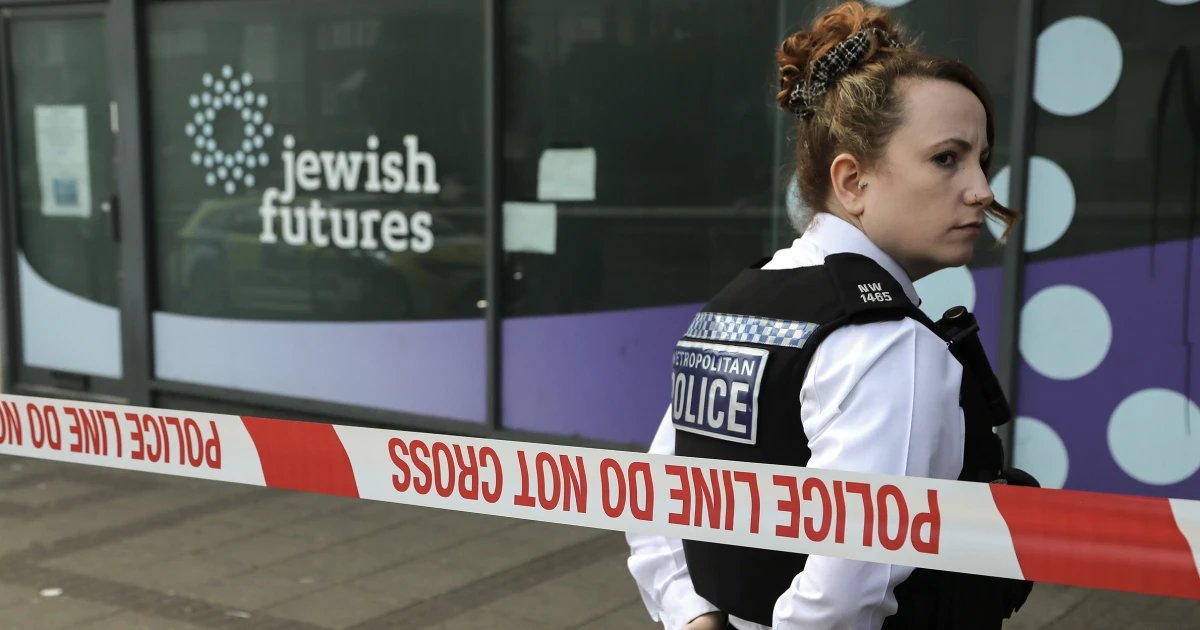
After a spate of arson attacks targeting Jewish sites in London, British authorities are investigating a shadowy online group with possible ties to Iran.
Subscribe to read this story ad-free
Get unlimited access to ad-free articles and exclusive content.

The group, Harakat Ashab al-Yamin al-Islamia, or HAYI, has claimed responsibility for at least eight arson attacks on Jewish locations in London and several others across Europe in recent weeks.
“As the conflict in the Middle East continues to evolve, counterterrorism police and our partners remain alive to the threat of Iranian hostile activity in the U.K.,” Vicki Evans, the U.K.’s senior national coordinator for counterterrorism, told reporters Sunday.
“We are aware of public reporting that suggests this group may have links to Iran. As you would expect, we will continue to explore that question as our investigation evolves.”

The latest attack took place overnight at Kenton United Synagogue in Harrow, authorities said. The building sustained smoke damage, but there were no injuries, officials said.
It was the third such incident over the past week, authorities said. Finchley Reform Synagogue faced an arson attack Wednesday, London Metropolitan Police said, and on Friday a business in northwest London was targeted in what police have described as an “antisemitic hate crime.”
“We are seeing a concerted campaign against Londoners and, specifically, against British Jews,” Matt Jukes, the deputy commissioner of the Metropolitan Police, told reporters.
In an interview with NBC News on Friday, Jukes said that his police force is used to dealing with complex threats but that the current situation is uniquely challenging.

“We have seen hate crime, divisive protests. We have seen radicalization towards terrorism, and we’ve seen foreign interference,” he said. “All of those phenomena have appeared at some point in the history of this city, but the way that they are aligned now is truly extraordinary.”
Jukes added: “We do have that work to do now to test whether there are any connections between these incidents or whether they’re part of that wider phenomenon that has already been seen, sadly, in terms of hate crimes or whether there is a more organized hand operating behind them.”
Terrorist group or facade?
HAYI first appeared on social media in early March, days after the U.S. launched air strikes against Iran. The group’s name roughly translates to the Islamic Movement of the Companions of the Righteous.
It claimed responsibility for a March 9 attack on a synagogue in the Belgian city of Liege. A makeshift bomb detonated outside the building around 4 a.m., blowing out windows but causing no injuries, officials said.

HAYI published self-recorded video of the attack on a Telegram channel affiliated with a pro-Iranian militia group in Iraq, according to the International Center for Counter-Terrorism, or ICCT, a Netherlands-based think tank.
HAYI also claimed responsibility for a March 13 attack on a synagogue in Rotterdam, Netherlands, and an explosion outside a Jewish school in Amsterdam the next day. In both cases, HAYI’s claims of responsibility were released on Iranian-aligned Telegram channels within hours, according to ICCT.
“The suspicious dissemination patterns raise the question whether HAYI is a genuine terrorist group or merely serves as a façade for Iranian hybrid operations that enable plausible deniability,” ICCT said in a report published last month.
Sajjan Gohel, a U.K-based terrorism expert who has been tracking HAYI, said he suspects the group is linked to the Islamic Revolutionary Guard Corps, the primary security arm of the Iranian government.
“The working hypothesis is that this is something closer to outsourced, deniable sabotage, which the Islamic Revolutionary Guard Corps certainly excels in,” said Gohel, who is the international security director at the Asia-Pacific Foundation.
British police have made several arrests in the arson attacks.
Six people – including two teenagers, both 18 – have been arrested in connection with a March 23 attack on a Jewish charity’s ambulances in north London. Two people — a 46-year-old man and a 47-year-old woman — have been arrested and accused of carrying out the attempted arson of Finchley Reform Synagogue on Wednesday.

One of the avenues detectives in the U.K. are looking into is whether the people arrested in the arson incidents have been hired by HAYI or an Iranian state actor.
“I have spoken at length of the Iranian regime’s routine uses of criminal proxies,” Evans, the counterterrorism coordinator, said Sunday. “We are considering whether this tactic is being used here in London — recruiting violence as a service. Individuals carrying out these crimes often have no allegiance to the cause and are taking quick cash for their crimes.”
Jukes, the Met deputy commissioner, said anyone who might consider carrying out such crimes should expect to pay the consequences. He referenced the case of a British man, Dylan Earl, who was sentenced to 17 years in prison for setting fire to businesses providing satellite equipment to Ukraine – crimes carried out at the behest of Russian intelligence operatives.
“They are left looking really foolish, because those who’ve hired them drop them like a stone, and they end up in our courts facing justice on their own,” Jukes told NBC News. “If we make that connection in these cases again, then the same consequences will follow.”