dailynewsnblog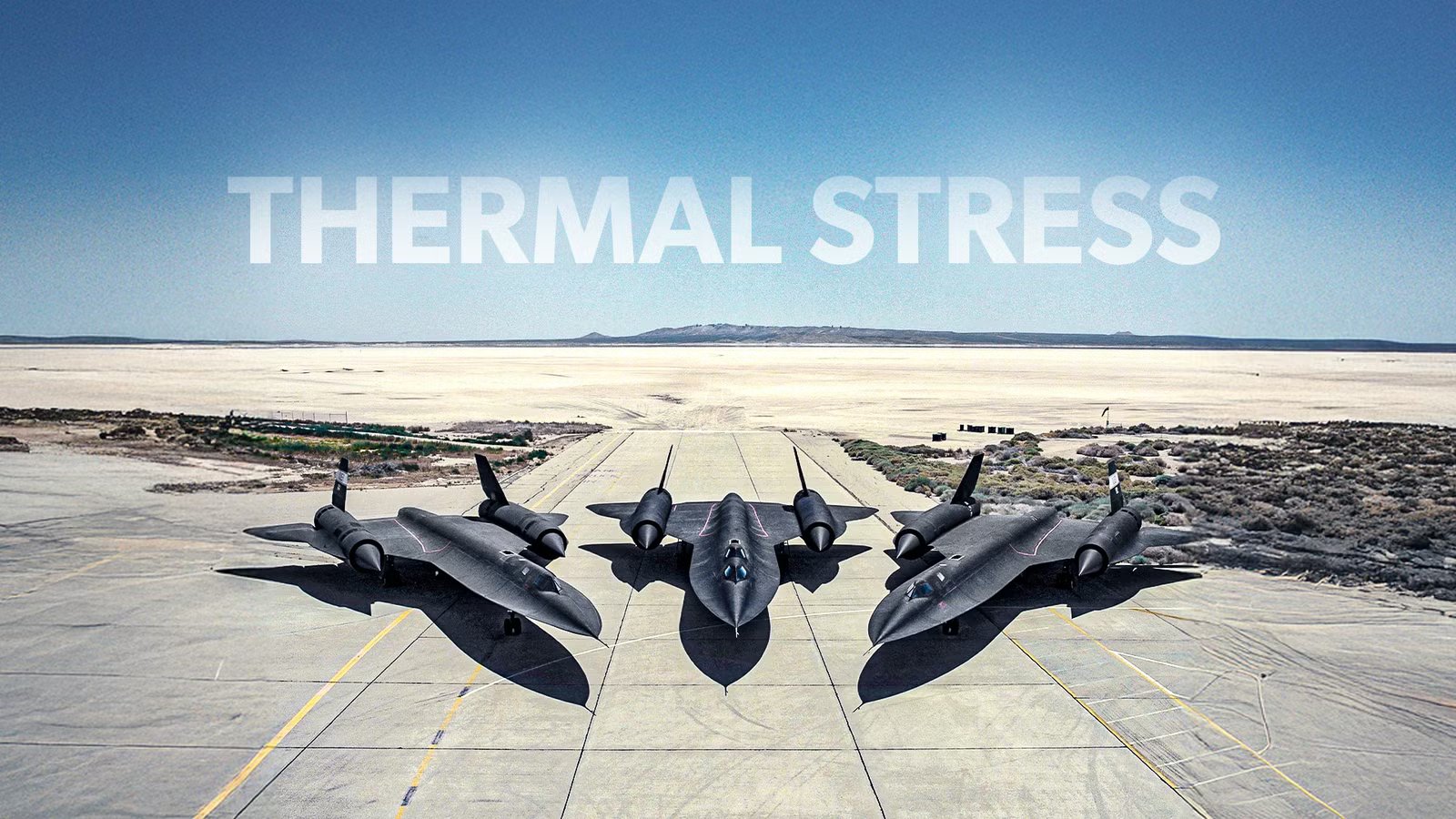
To this day, the Lockheed SR-71 Blackbird remains the fastest manned, air-breathing aircraft ever to enter service. It was constructed with a unique 93% titanium airframe and skin optimized for the high speed of its Mach 3 mission, which notoriously bled jet fuel all over the runway as it prepared to get in the air.
The SR-71’s exotic alloy construction was designed to withstand the 1,000-degree heat generated by screaming through the air at over Mach above 80,000 feet. The titanium skin would only become sealed when it was heated, hence the Blackbird’s leaky reputation. In a classic twist of Cold War espionage, the titanium used to produce SR-71s was sourced from inside the same nation it flew over to spy on, Russia.
The Flexible Jet: Uncompromising Performance

Titanium, specifically the Beta B-120 alloy used in the Blackbird, is incredibly strong for its weight, but it is also an excellent thermal conductor, as Boyer and Briggs wrote. As the skin heated to 600 degrees Fahrenheit, that heat would normally soak inward and compromise the internal electronics, hydraulics, and pilot. But that titanium airframe worked as part of a thermal management triad where the JP-7 fuel and black paint actively compensated for the material’s specific physical limits.
The SR-71 actually used JP-7 fuel as a massive heat sink. JP-7 had an exceptionally high flash point, allowing it to be safely pre-heated by the airframe’s thermal energy without igniting prematurely. Before being burned in the engines, the fuel was circulated through heat exchangers to absorb heat from the airframe, engine oil, and cockpit. The titanium stayed within its best structural strength range by offloading its thermal load into the fuel.
While titanium is great at holding its shape when hot, it isn’t naturally good at shedding heat into a vacuum or thin air so the aircraft’s titanium skin was also painted with a special high-emissivity black paint. This was not just for stealth. The black color helped the plane efficiently radiate heat away from the skin and into the surrounding atmosphere, lowering internal temperatures by at least 50 degrees Fahrenheit.
Friction with the air caused the SR-71’s skin to expand by roughly three to four inches in length during high-speed flight. To prevent buckling or structural failure, engineers designed it with intentional panel gaps and corrugated skin that caused its characteristic fuel leaks on the tarmac. Because the fuel tanks were part of the external skin, they lacked flexible rubber liners, which would have melted at operating speeds.
On the ground, the fuselage panels were manufactured to fit loosely, leaving noticeable gaps. The panel gaps caused the aircraft to leak fuel on the runway until the Blackbird reached speed and the heat sealed the tanks. Aside from the strangely loose skin of the jet, large sections of the wing skin were corrugated rather than smooth. The uncharacteristically rough surface on the supersonic jet allowed the titanium to expand and contract like an accordion, preventing the skin from warping or curling under thermal stress.
Designed By Kelly Johnson: Soviet Titanium And American Ingenuity

Invented amid the Cold War arms race, the Blackbird was designed with cost as no object to accomplish a mission with stakes so high that there was zero room for compromise. It was conceived for the Central Intelligence Agency under the name A-12 Oxcart. This jet was the first in the family to achieve Mach 3. It was smaller and faster than the SR-71 and only carried a single pilot.
The SR-71 was technically the longer, heavier two-seat variant built for the US Air Force. It was designed to carry more fuel and advanced reconnaissance sensors. The physics-defying jet was made of over 90% titanium by Lockheed’s Skunk Works division. The mastermind behind the record-breaking spy plane was none other than the legendary Kelly Johnson, who created many iconic planes like the P-38 Lightning, F-104, U-2 Dragon Lady, and others.
Even the best titanium found on the SR-71 was still rejected frequently, as the exotic metal is sensitive to corrosion from chemicals and other alloys that most metals are not affected by. Transforming raw titanium ore into the proper alloy material was not cost-effective for Lockheed to make the jet. Thus, the Central Intelligence Agency used shell companies to obtain the alloy, which the Soviet Union was making in far greater quantities than the US at the time.

Why The Pentagon Is Worried About International Stealth Fighter Development
The new 5th-generation arms race.
The Lockheed Hangar Queen: Crafted By Skunk Works

The severity of the Blackbird’s flight conditions, as well as the intricacy of its construction and systems, required roughly 24 hours’ notice to launch a mission, and when they returned, it took about a week to turn the plane around. They required several small part repairs because of the high wear and tear on the titanium skin from even routine missions. Then there were rigorous examinations of every component and system, from nose to tail.
By the end of its active service, the fleet’s total flying hours had surpassed 53,000. SR-71 missions were operating every day at their height in the early 1970s. Over 11,000 flying hours, or more than three times the speed of sound, were recorded by the aircraft during more than 2,700 trips at speeds exceeding Mach 3. Despite being a maintenance beast, the Blackbird performed excellently because of committed staff on the ground, in the air, and back at the factory.
The program’s expense was a major factor in the CIA’s decision to stop using the A-12. Even with the emergence of space-based surveillance systems, the USAF was able to absorb that cost, and the Blackbird continued to be worthwhile. The Blackbird was far from obsolete, even though satellites provided a considerably less costly and dangerous means of spying. The jet’s incredible performance is still unmatched.

How Fighter Jets Have Evolved Over The Last Decade
A closer look at the arms race for the smartest warbirds.
Faster Than A Speeding Bullet: SR-71 Blackbird

The SR-71 Blackbird’s speed can be demonstrated in a novel comparison. That is to say that the jet could literally fly faster than a ‘speeding bullet.’ The SR-71 traveled at more than 3,200 feet per second, faster than a shot from the renowned Springfield ‘thirty-aught-six’ sniper rifle. The Blackbird was so extreme that its principal protection against surface-to-air missiles was simply accelerating at a stunning rate of more than 0.5 miles per second.
While a typical commercial airliner cruises at 530 mph, the Blackbird flies past at four times that speed, allowing it to span the United States in just over an hour, from Los Angeles to Washington, D.C. The Lockheed SR-71 Blackbird has an official top speed of 2,193 mph (Mach 3.3), although unverified pilot reports say it could even approach Mach 3.5, according to BGR.
Thomas Estes and Dewain Vick flew more than 15,000 miles (24,000 km) in 10 hours and 30 minutes in 1971, shortly after the jet was put into service. James Sullivan and Noel Widdifield crossed the starting (radar) line in New York on September 1, 1974, at a speed of more than 2,000 miles per hour and 80,000 feet. According to The SR-71 Blackbird, they would set a new world speed record from New York to London, England, in one hour and fifty-four minutes.

5 Aircraft That Define Modern Air Combat
The warplanes at the top of the food chain.
The Hit List: Blackbird’s Unrivaled Speed Record

Many of the world records set by the SR-71 Blackbird are still in place more than 45 years later. According to SR71Blackbird.com data, its most well-known accomplishments occurred during official record attempts in July 1976 and on its record-breaking last retirement flight in March 1990. Prior to these illustrious runs, in 1971, Major Thomas Estes and Dewain Vick set a world record for endurance flight when they flew over 15,000 miles in 10 hours and 30 minutes while refueling in midair several times.
In 1976, near Beale Air Force Base in California, the Blackbirds set absolute speed and altitude records of 2,193 mph and 85,068 feet, respectively. It also set a record on a closed circuit, averaging 2,092 mph over 1000 kilometers. Already in 1974, the Blackbird achieved the record for the quickest transatlantic crossing, which stands today at 1 hour and 54 minutes and an average speed of 1806 mph.
On its final voyage from Palmdale, California, to the Smithsonian’s Udvar-Hazy Center in Washington, D.C., the Blackbird broke four speed records. The SR-71 flew from Los Angeles to Washington, D.C. in 64 minutes and 20 seconds, averaging 2,144 miles per hour. It also set the transcontinental, or coast-to-coast, record, as well as the records from Kansas City to Washington, D.C., and St. Louis to Cincinnati.

The 5 Fastest Fighter Jets In Service Today
A closer look at the world’s highest performance warbirds.
Blackbird’s Last Hurrah: The Sunset Of The SR-71

During the highs and lows of the Cold War, the SR-71 was in service. Diego Garcia and RAF Mildenhall used Blackbirds to fly missions over terrorist camps in Libya and the Soviet Bloc. Before its legendary career came to an end in 1999, the iconic airplane was greatly missed during the Gulf War in 1991.
The SR-71 even had a brief stint with the National Aeronautics and Space Administration prior to its final grounding. NASA used the Blackbird to test laser air-data sensors to reduce sonic boom noise.
The USAF flew the Blackbird for far longer than the CIA, temporarily retiring it in 1989 but bringing the fleet back online in 1990, with the final, real sunset occurring in 1999. Every surviving member of the Blackbird family can now be located in museums around the United States, as well as the Imperial War Museum in Duxford, United Kingdom.