dailynewsnblog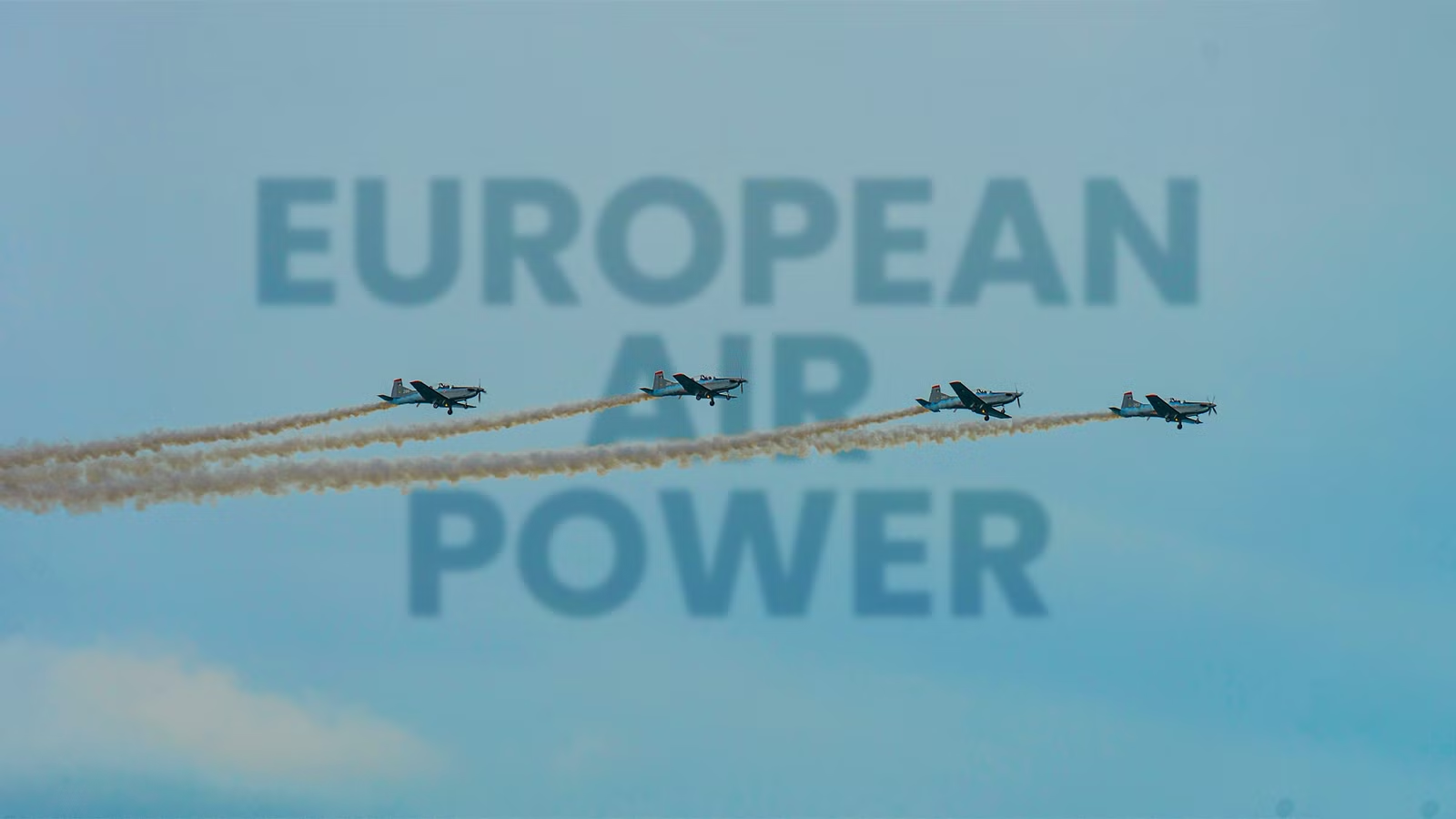
The Irish Air Corps is gearing up for a renaissance in technology, capability, and readiness that it hasn’t seen since at least 1998, when the last fighter squadron was disbanded. That unit flew the Fouga CM.170 Magister, which was a limited, light strike platform, but now the national government is considering procuring advanced 4th-Generation or even 4.5-Gen fighters.
The government is considering procuring as many as 14 jets in what would be the nation’s first dedicated Fighter Squadron in 50 years. The current top candidates include the Lockheed Martin F-16 Fighting Falcon, Saab Gripen, Dassault Rafale, or even the KAI FA-50. The talks are still ongoing to decide which airframe will be selected, but in the meantime, the armed forces are preparing. Ireland is revamping training for pilots, building ground-based radar infrastructure, and updating joint operating policy with partner nations like the United Kingdom.

As part of the transformation, the Irish Air Corps is scheduled to be formally renamed the Irish Air Force as early as 2027. The jets are expected to be based at Shannon Airport, which offers a longer runway and better proximity to Ireland’s western approaches, where Russian flight incursions are most frequent.
The government has requested funding for a squadron of combat aircraft, with an estimated total investment of up to €2.5 billion over 20–25 years. The immediate priority is ending decades of reliance on the RAF for intercepting threats in Irish airspace. Current plans lean toward a preferred fleet of 12 to 14 jets, with a minimum of eight required for around-the-clock air policing.
The General Officer Commanding of the Irish Air Corps, Brigadier General Rory O’Connor, gave these remarks on the procurement program to the European Defense Review last month:
“Fighter aircraft such as the Saab Gripen or FA-50 could be options if funding is available. However, it would have to involve a new advanced training programme. The PC-9N needs replacing, and options could include a new fleet of jet trainers, using the International Flight Training School in Italy, or via a training package included in a contract for a new combat aircraft.”
Before procuring fighter jets, Ireland is securing the necessary support infrastructure and training programs. Ireland is investing approximately €300 million to install its first-ever national primary radar network. This system, expected to be fully operational by 2028, will allow the state to detect and track aircraft and drones across its sovereign territory.
By The Numbers: Ireland’s Next Fighter Jet

The Dassault Rafale would be the most high-end option for the revitalized Irish Air Force to acquire. The French 4.5 Gen fighter jet has capabilities and performance that are equal to many 5th-gen platforms, except for the lack of stealth technology. As an omni-role airframe, it is capable of air-to-air intercept, ground strike, maritime patrol, and reconnaissance missions without landing to reconfigure. The operating cost of the jet is around $20,000 to $30,000 per hour, which is not extraordinarily high. However, procurement costs can exceed $100 million.
Acquiring 12 to 14 examples of the Rafale would consume the vast majority of the available budget for the total program, making it a cost-prohibitive option. On the other hand, the Saab Gripen is a ruggedized and low-cost multirole fighter that can be operated by small crews in austere conditions. It is the lowest cost aircraft per flight hour of any 4.5 Gen fighter. Recent upgrades have also made it compatible with all NATO ordnance, including the new long-range Meteor missile.
|
Specification |
Dassault Rafale F4 |
Lockheed F-16V |
Saab Gripen E |
KAI FA-50 (B20) |
|---|---|---|---|---|
|
Max Speed |
Mach 1.8 |
Mach 2.0+ |
Mach 2.0 |
Mach 1.5 |
|
Combat Radius |
1,150 miles (1,850 kilometers) |
342 miles (550 kilometers) |
808 miles (1,300 kilometers) |
280 miles (450 kilometers) |
|
Max Range |
2,299 miles (3,700 kilometers) |
2,610 miles (4,200 kilometers) |
2,485 miles (4,000 kilometers) |
1,150 miles (1,850 kilometers) |
|
Service Ceiling |
51,919 feet (15,825 meters) |
50,000 feet (15,240 meters) |
52,493 feet (16,000 meters) |
48,000 feet (14,630 meters) |
|
Unit Price |
$125,000,000 (€115,000,000) |
$63,000,000 (€57,960,000) |
$15,050 (€13,846) |
$35,000,000 (€32,200,000) |
|
Operating Cost Per Hour |
$19,250 (€17,710) |
$26,300 (€24,196) |
$15,050 (€13,846) |
$5,000 (€4,600) |
|
Key Capability |
Advanced Omnirole |
Global Parts Network |
Low-cost Omnirole |
Light Attack / Trainer |
Similarly, the Lockheed Martin F-16 Fighting Falcon, or Viper, would also be a very economical option thanks to its massive supply base created over a production run of more than 4,600 units. Flown by 25 air forces around the world at different points in time, the aircraft is cheap to acquire and cheap to maintain. It is less rugged than the Saab but also far less delicate than the Rafale, with a proven combat track record.
The KAI FA-50 is the most budget-friendly option due to its price point of just 40 million per aircraft. This jet would be an entry-level fighter, but it can hit Mach 1.5, unlike other training jets, which it is typically compared against. This would leave the new Irish Air Force with limited capability and performance, but sufficient to accomplish the basic mission of air policing.

How Much Does A Fighter Jet Cost To Fly Per Hour?
A closer look at the true price of military air power.
Adversary At The Gates: The Russia Problem

The justification for Ireland’s fighter program is rooted in a sharp escalation of Russian military activity within Irish-controlled airspace and maritime zones. The primary historical and ongoing threat involves Russian strategic bombers, specifically the Tu-95 Bear and the supersonic Tu-160 Blackjack. These incidents challenge Ireland’s sovereignty and civilian aviation safety.
By operating ‘dark,’ with transponders off, in one of the world’s busiest air corridors, Russian planes also pose a collision risk to commercial flights, forcing Irish Air Traffic Control to reroute civilian planes. Currently, the Air Corps must rely on the UK’s Royal Air Force to scramble Typhoons in order to perform interceptions. These aircraft must depart from Scotland in order to perform escort flights, which is significantly slower from takeoff to the time when they have ‘eyes on’ the target aircraft.
A good case point for the imperative need to raise an organic quick reaction alert Squadron came in 2022. The Irish Times reported that a Russian signal using a high-frequency radio channel from an unknown aircraft or vessel disrupted Air Traffic Control signals. This effectively rendered emergency communications impossible for transatlantic commercial flights. The lack of a complete air picture from primary radar and fighters made it impossible to pursue the source and investigate where the transmitter was.
In 2024, The Ditch also reported that over six tons of firearms and ammunition destined for Russian allies in Central Asia have been transported through Irish sovereign airspace on commercial cargo flights. More recently, Russian activity has shifted toward electronic warfare and surveillance. With the tactics of the malicious parties evolving to become more sophisticated, the need for a true QRA Force is becoming more urgent.

5 Fighter Jets With The Most Advanced Radar Systems
A closer look at some of the fighters with the longest striking range.
Persistent Probing By Russian Forces

Russian spy ships, such as the Yantar in 2024, have also been spotted patrolling key undersea data cables in the Irish Sea. These ships are frequently accompanied by planes used for submarine communication, such as the Tu-142 Bear F. In April 2025, an Irish C-295 tracked the Russian spy vessel Viktor Leonov after it ignored communication signals. The ship violated maritime law by transiting Ireland’s Exclusive Economic Zone without first establishing communications.
Recent months have seen sophisticated incursions targeting the capital and diplomatic visits. In December 2025, military-style drones violated a no-fly zone at Dublin Airport just as President Volodymyr Zelenskyy was arriving for an official visit. These drones later hovered over an Irish naval vessel, an act described by EU leaders as a hybrid attack. Again, toward the end of last year, the Irish Naval Service also reported GPS spoofing incidents that presented ‘ghost ships’ on surveillance sensors.
When electronic systems are compromised, fighters play a crucial role in providing visual confirmations. Under a Memorandum of Understanding that links Irish military procurement with UK security cooperation to counter escalating Russian gray zone activities, Ireland is strengthening its partnership with the UK until the new jets arrive. By combining with larger UK orders, the alliance now promotes joint procurement initiatives, enabling Ireland to purchase military equipment at a lower cost.

5 Aircraft That Define Modern Air Combat
The warplanes at the top of the food chain.
Rebuilding Dogfight Skills In The Air Corps

Russian probing frequently tests response times; having domestic interceptors stationed at Shannon Airport allows Ireland to “shadow” intruders without waiting for RAF Typhoons to arrive from Scotland. The purchase of 12 to 14 fighter jets aims to create a credible deterrent. However, since the Air Corps disbanded its last fixed-wing combat aviation jet squadron, there is no pool of skilled aviators to train new fighter pilots.
In order to recreate the lost combat experience, the Irish Air Corps has started hiring private military training companies to start ‘train the trainer’ programs. This is intended to fill the knowledge gap left by the decades-long lack of skilled fighter jet pilots following the divestment of the last Magisters. With the Pilatus PC-9M already in the Air Corps’ inventory, training is underway.
Four senior Air Corps instructors are undergoing a six-week intensive program in Basic Fighter Maneuvering and Air Intercept training, according to the Irish Times. The training will take place over 70 flights to cover basic dogfighting, radar intercepts, battle formation, and gunsight tracking. In the absence of jet-powered training platforms, speculation is that the Irish Air Force will outsource training to partners in the United States or possibly the Leonardo International Flight Training School in Italy.
IFTS would offer future Irish fighter pilots the opportunity to train in the Leonardo M346 before taking control of a combat airframe. Ireland has a history of aviation training overseas with multiple international partners, including helicopter pilots who graduated from a UK program last month. A number of Irish pilots have been trained at CAE USA in Alabama and even attended US Air Force high alpine training in 2024 at Malstrom AFB in Montana.