dailynewsnblog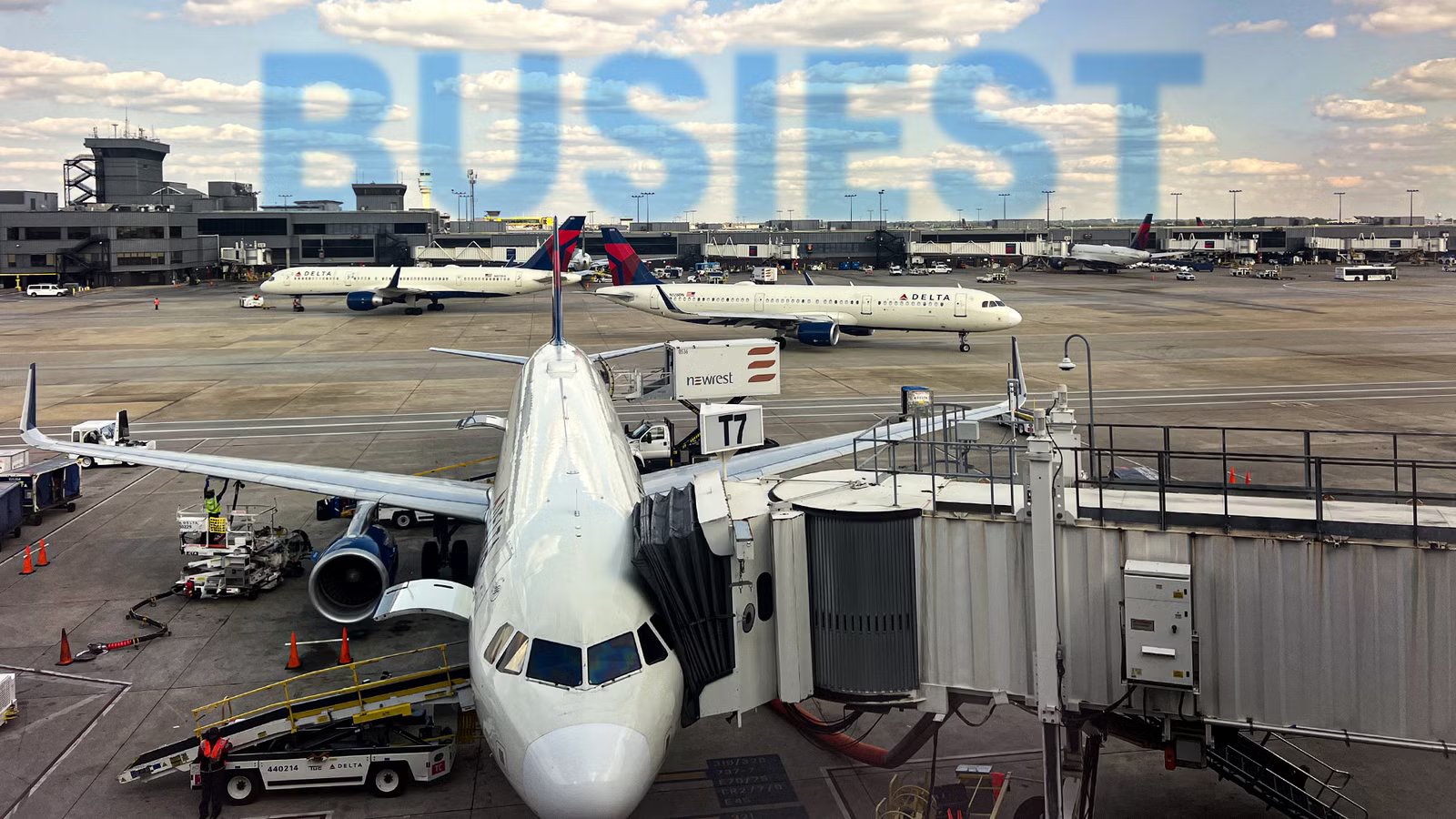
Airports keep getting busier and keep expanding — and no airport exemplifies this better than  Hartsfield-Jackson Atlanta International Airport (ATL).
ATL once again holds the title of the world’s busiest airport by total passenger traffic, processing over 108 million passengers in 2024, a position it has held for almost three decades, claiming the crown in 26 of the last 27 years. The  Delta Air Lines hub has consistently dominated global rankings, with only a brief interruption in 2020 when pandemic-era travel restrictions caused traffic to collapse.
 Dubai International Airport (DXB) ranked second, claiming the top spot for international passenger volume, while
  Dallas/Fort Worth International Airport,
  Tokyo Haneda Airport, and
  London Heathrow Airport rounded out the top five. These record-breaking figures came as global air travel reached 9.4 billion passengers in 2024, marking an 8.4% increase over 2023 and surpassing pre-pandemic levels by 2.7%. So what exactly makes ATL the busiest airport in the world? This article explores the airport’s operations in more detail.
Record-Breaking Passenger Traffic

ATL has long held the title of the world’s busiest airport by total passenger volume. Annual totals have consistently exceeded 100 million passengers, except for the years between 2020 and 2022, when the airline industry was recovering from the COVID-19 pandemic.
The sheer volume of passengers passing through Atlanta each year places ATL ahead of every other US airport and at the top of global rankings. The graph below illustrates how ATL performs compared to other airports among the busiest in the world, based on one-way seat capacity.

OAG Megahubs 2025 report
According to ATL’s data (two-way traffic), it handled 108.1 million passengers in 2024, a 3% increase over 2023, driven by growth in both domestic and international travel. This made 2024 the second-highest year in the airport’s history, trailing only its all-time record of 110 million passengers set in 2019.
In 2025, total passenger numbers reached 106.3 million — a slight decline of approximately 1.6% from 2024, though still firmly above the 100 million threshold that defines ATL’s dominance. The breakdown of 2025 traffic further highlights the airport’s role as a major domestic hub. Of the 106.3 million total passengers, 91.4 million (approximately 86%) were domestic travelers, while the remaining 14.9 million (around 14%) traveled internationally. These figures reflect ATL’s primary function as a connecting airport rather than a typical origin or destination, with millions of passengers transiting through Atlanta en route to other destinations.
Seat capacity data further underscores the airport’s efficiency. Load factors at ATL remain consistently high, reaching 88% in 2019 and 86% in 2025, indicating strong demand relative to available capacity.

According to ATL’s data, early 2026 figures suggest continued momentum. January recorded 7.59 million passengers, a slight increase of 0.63% compared to January 2025. February followed with 7.61 million passengers, up 1.65% year-on-year and marginally higher than the previous month. March figures are yet to be released, but the early trend points to steady growth heading into the busier spring and summer travel seasons.
Unmatched Flight Operations

Hartsfield-Jackson Atlanta International Airport handles a volume of aircraft operations that is unmatched by any other airport in the United States. In 2024, ATL recorded 796,224 total takeoffs and landings (a 2.6% increase over 2023), and by 2025 that figure had risen further to 805,268, representing a 1.14% year-on-year increase and equating to roughly 2,200 flights per day.
The vast majority of these operations are driven by commercial aviation. Domestic air carriers accounted for 708,136 operations in 2025, by far the largest category and up 1.08% from the previous year. International air carrier operations reached 82,330, growing 2.05%, while domestic and international carriers combined accounted for over 99% of all aircraft movements at the airport. General aviation saw modest growth of 5.74%, while air taxi operations declined 5.99% and military operations fell sharply by 34.80%, though military movements remain a very small fraction of overall traffic at just 193 operations.
Beyond sheer volume, ATL also leads on punctuality. The airport recorded a high on-time performance among the largest airports in North America, achieving 84.2% in 2019. In 2025, Delta Air Lines (ATL’s main carrier) maintained an on-time performance of 83.18%, demonstrating that the airport sustains its operational efficiency even as traffic continues to grow.
|
Aircraft Operations |
2025 |
2024 |
Change |
|---|---|---|---|
|
Domestic Air Carrier |
708,136 |
700,541 |
1.08% |
|
Air Taxi |
7,553 |
8,034 |
-5.99% |
|
General Aviation |
7,056 |
6,673 |
5.74% |
|
Military |
193 |
296 |
-34.80% |
|
International Air Carrier |
82,330 |
80,680 |
2.05% |
|
Total Aircraft Operations |
805,268 |
796,224 |
1.14% |
Together, these figures paint a picture of an airport that not only handles an extraordinary number of flights but also does so with a level of reliability that sets it apart from its competition.

Hartsfield–Jackson Atlanta International Airport Remains North America’s Busiest By Total Passengers
With over 100 million passengers handled in 2025, ATL continues to dominate global rankings for the world’s busiest airport.
A Global Cargo Hub

ATL is not only a passenger airport, it is also a major hub for global cargo operations. In 2024, cargo operations increased by 6% compared to 2023, and in 2025, ATL handled a total of 640,494 tonnes of cargo, demonstrating the airport’s sustained importance as a freight and logistics center.
The bulk of this volume came from freight and express shipments, which reached 617,109 tons in 2025, accounting for the vast majority of all cargo moved through the airport. While this represented a modest decline of 2.36% from 2024, it was largely offset by a significant 69.03% surge in mail volumes, which rose from 13,835 tonnes in 2024 to 23,385 tonnes in 2025.
|
Cargo (tones) |
2025 |
2024 |
Change |
|---|---|---|---|
|
Freight & Express |
617,109 |
631,999 |
-2.36% |
|
|
23,385 |
13,835 |
69.03% |
|
Total Cargo |
640,494 |
645,834 |
0.83% |
ATL’s cargo capabilities are underpinned by an extensive and purpose-built infrastructure. The airport operates three main airfield complexes — North, South, and Midfield — spanning 7.8 million square feet across 198 acres. These complexes house cargo facilities, airline support and maintenance operations, fixed base operations, and fuel farms. Dedicated cargo warehouse facilities are located in both the North and South complexes, alongside a USDA propagated plant inspection station to support agricultural and perishable shipments. In total, the airport provides 28 parking positions for cargo aircraft (20 at the North complex and eight at the South complex), ensuring the capacity to handle a high volume of freight movements simultaneously.
Together, these figures and facilities highlight ATL’s role not just as the world’s busiest passenger airport, but as a critical hub in the global supply chain.
World-Class Connectivity

The airport continues to expand its reach year-on-year, with new airlines and destinations regularly joining its roster. The image below illustrates how well-connected to the rest of the world ATL is.

Following the arrival of Ethiopian Airlines in May 2023, 2024 brought a wave of new entrants and returning carriers. Notable additions included Aeromexico, returning to Atlanta for the first time since 2019, and SAS from Copenhagen — a route that marked the Danish capital’s return to Atlanta’s map following Delta’s last flight there in 2011, and also reflected SAS’s broader strategic shift from Star Alliance to SkyTeam. The full list of new services launched in 2024, in order of start date, was:
- 8 January 2024 — Aeromexico
- 24 March 2024 — Sun Country
- 2 May 2024 — Avelo
- 17 June 2024 — SAS
- 2 December 2024 — Denver Air Connection
Comparing ATL’s destination network in 2024/2025 with 2023 reveals that 22 new destinations joined the airport’s network, of which 13 are international and nine are domestic. Eight of these are entirely new to Atlanta’s aviation map, including Naples in Italy and Abu Dhabi.
Winter 2025 saw ATL push further into transatlantic and leisure markets. Delta launched a new route to Marrakech, with CEO Ed Bastian framing the expansion as part of the airline’s strategy to become the dominant US carrier to the African continent, serving both business and leisure travelers.
In 2026, Delta continued this growth by adding new Saturday routes designed to stimulate spontaneous leisure travel. From Atlanta specifically, new services launched to Grenada and Saint Vincent and the Grenadines in the Caribbean, as well as Vancouver. Beyond Atlanta, Delta’s leisure-focused expansion across its wider network included new routes from Boston to Aruba and Nassau, Los Angeles to Jackson Hole and Bozeman, Seattle to Albuquerque, and New York LaGuardia to Destin, Fort Walton Beach, and Nassau.

These Airlines Operate The Longest Flights From The World’s Busiest Airport
Some are more than 8,000 miles long.
Historical Ranking Of ATL

ATL has held the title of the world’s busiest airport by passenger traffic almost without interruption since 1998. The sole exception came in 2020, when the COVID-19 pandemic and its associated travel restrictions caused a temporary but dramatic collapse in passenger volumes.

In 1999, ATL’s leadership launched the Development Program: “Focus On the Future”, which was an ambitious long-term investment initiative comprising multiple construction projects designed to prepare the airport for a projected demand of 121 million passengers by 2015. Originally budgeted at $5.4 billion over ten years, the scale of the program reflected the confidence Atlanta had in its own growth trajectory. As the scope of the work expanded, the budget was revised upward to over $9 billion by 2007.
That foresight has paid off. Thanks to this sustained investment in infrastructure and capacity, ATL has consistently ranked as the world’s busiest airport year after year, maintaining a lead over its global competitors that few airports have come close to challenging.
Future Outlook Of The World’s Busiest Airport

ATL shows no signs of slowing down. Airport leadership has set an ambitious target of 125 million annual passengers within the next five years, underpinned by plans to strengthen airline partnerships, expand capacity, and invest in smart technology and terminal modernization.
The airport currently operates five runways and a terminal complex spanning approximately 7.7 million square feet across 176 acres, with 155 domestic and 43 international gates across concourses T through F. The most significant construction project currently underway is the renovation of Concourse D — the narrowest of ATL’s concourses at just 60 feet wide, now being widened to 99 feet and extended by 288 feet to accommodate Delta’s newer, larger aircraft. Using an innovative modular construction approach, the concourse remains almost fully operational throughout, with no more than six to eight of its 39 gates closed at any one time. The project is due for completion in summer 2029.
Looking further ahead, ATL’s long-range plans include a sixth runway. The construction trigger is set at 925,000 annual operations (compared to the approximately 800,000 recorded in 2025), meaning the runway is unlikely to become operational until the 2040s. There has also been speculation about a second Atlanta airport, though this has historically faced strong resistance, with Delta widely seen as a key opponent given the competitive implications. For now, all eyes remain on making the most of what is already a well-established aviation facility.