dailynewsnblog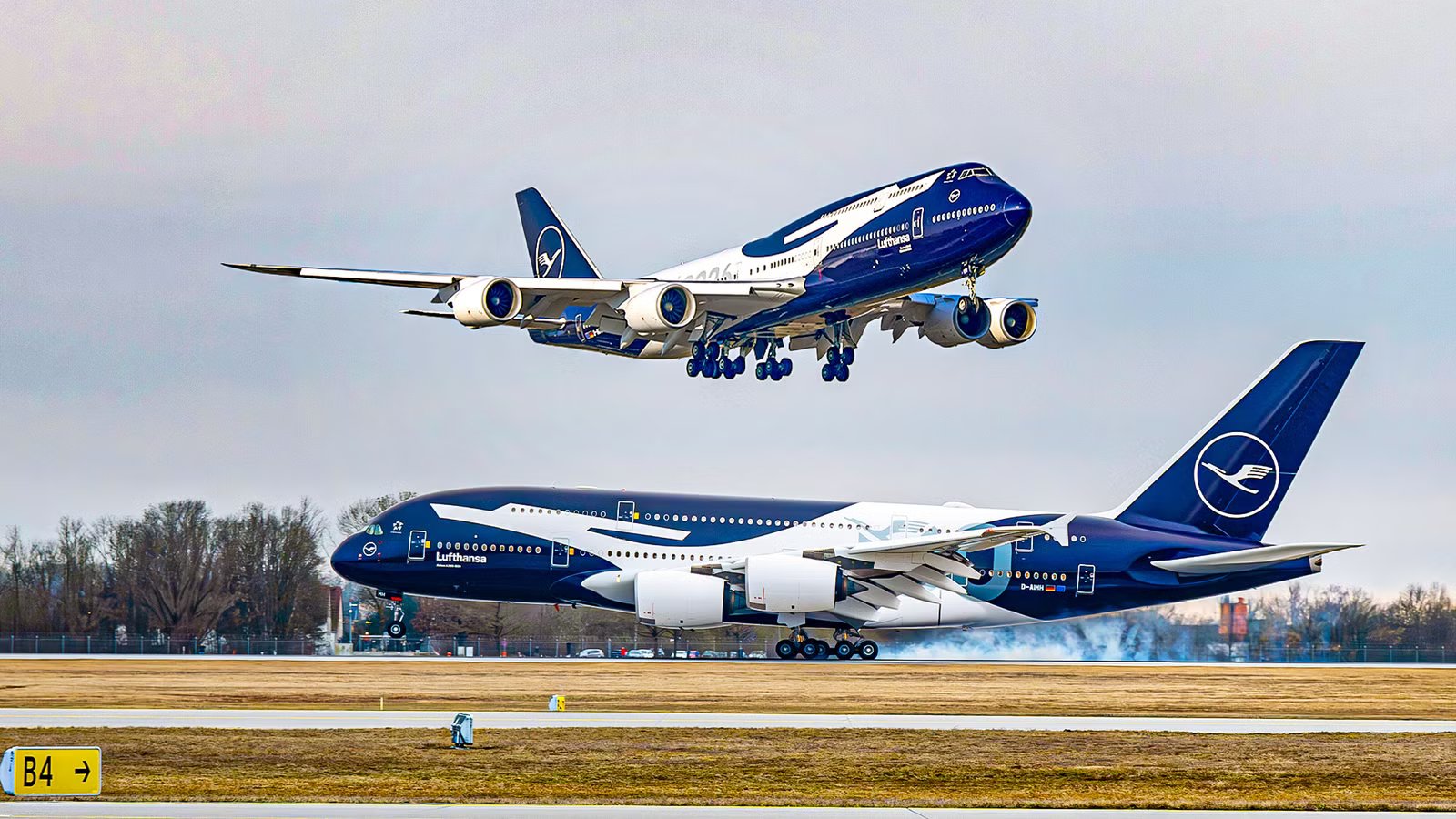

The Airbus A380 is a modern-day high-capacity commercial airliner that is commonly known to be the successor to the Boeing 747 (colloquially known as the Queen of the Skies). The Airbus A380 was founded based on expanding basic principles of the Boeing 747. Both aircraft are large-sized, “super jumbo” jets designed to carry the maximum number of passengers or, in some cases, cargo. The Airbus A380, however, is larger than the Boeing 747-400 in terms of measurements.
As the Boeing 747 production ended in 2023, many airlines worldwide needed a replacement aircraft that would fill the unique niche served by the Boeing 747 with high capacity, long-haul flying. With developments in engine and airframe engineering, Airbus was able to collaborate with both Rolls-Royce and Engine Alliance to produce the A380.
A Brief History Of Each Model

Wikimedia Commons | Shutterstock | Simple Flying
Physical measurements referenced in each respective Aircraft Flight Manual (AFM) suggest the A380 outsizes the Boeing 747 in nearly every metric. As the Boeing 747 was first introduced in September 1968, Airbus’s answer to the high-capacity superjumbo market came in the early 2000s, with its first test flight taking off from Toulouse on April 27, 2005.
The A380’s physical footprint reflects a generational leap in what a superjumbo could be. Measurements published in each aircraft’s AFM show the Airbus giant surpassing the Boeing 747 in nearly every dimension—wingspan, tail height, maximum takeoff weight, and internal cabin volume. This wasn’t accidental; Airbus designed the A380 as a purpose‑built, double‑deck, high‑capacity flagship optimized for dense trunk routes and slot‑restricted megahubs. Where the 747 evolved through incremental stretches and engine upgrades, the A380 was conceived from day one as a clean‑sheet response to the long‑haul capacity problem, pushing the physical limits of what airports and airframes could accommodate.
The historical gap between the two aircraft underscores how dramatically the industry changed. Boeing launched the 747 program in 1968, at a time when long‑haul travel was exploding, and deregulation had not yet reshaped airline economics. Airbus entered the high‑capacity market more than three decades later, in the early 2000s, when global hubs like London-Heathrow, New York-JFK, and Tokyo-Narita were straining under demand. The A380’s first test flight from Toulouse symbolized Airbus’s ambition to redefine the upper end of commercial aviation with a modern, ultra‑large aircraft built around 21st‑century materials, avionics, and passenger expectations. In many ways, the A380 wasn’t just larger than the 747—it represented a different era’s answer to the same question: how do you move the world at scale?
Size Comparison, By The Numbers

The A380 surpasses the Boeing 747 in nearly every major physical metric, reinforcing its status as the largest commercial airliner ever built. In terms of height, wingspan, overall mass, and even maximum range, the A380 pushes beyond the limits established by the 747, which itself was considered enormous for its time. This size advantage translates into greater cabin volume, allowing the A380 to accommodate more passengers, larger galleys, and expanded premium cabin layouts. Even structurally, the aircraft’s full‑length double-deck and massive wing design highlight Airbus’s intention to redefine what a superjumbo could be. Taken together, these measurements show that the A380 didn’t just edge out the 747—it reset the upper boundary of commercial aircraft scale.
The Boeing 747, with its proven track record in the market, already provided massive dimensions. The A380 took each measurement one step further, rapidly approaching the threshold of how big a commercial aircraft can really get. The AFM for each aircraft provides the dimensional breakdown below:
|
Dimensions |
Airbus A380-800 |
Boeing 747-400 |
|---|---|---|
|
Length (meters) |
72.7 |
70.7 |
|
Wingspan (meters) |
79.8 |
64.9 |
|
Height (meters) |
8.5 |
7.8 |
|
Number of Passengers |
555 |
416 |
|
Range (kilometers) |
14,800 |
13,450 |

The Striking Differences Between The Boeing 747-8 & Airbus A380
Both quadjets are massive and serve several high-capacity routes.
The Pan Am vs Emirates Example

Pan American World Airways (Pan Am) was a global operator of the 747 having ceased operations in 1991 due to economic uncertainty in the era of deregulation. The Boeing 747 was the hallmark of their operation, specializing in transoceanic travel to and from the United States. Emirates, founded in 1985, has become a global airline connecting Dubai to the world, supported by its fleet of A380s.
Pan Am was the launch customer for the Boeing 747, having placed a landmark order worth $4 billion in today’s money. This was the first step in creating a global operation equipped with high capacity aircraft, serving destinations primarily overseas. The 747 was a replacement for the original Pan Am flagship, the Boeing 707. Emirates, on the other hand, placed an order for the A380 in 2008, with a similar strategy: to connect its global hub in Dubai to destinations around the world with high-capacity, long-range heavy jets.
They’re similar in the big picture; both aircraft were the flagship of an airline aiming to bend global traffic patterns around a single dominant hub. Pan Am used the 747 to make New York the center of the world; Emirates uses the A380 to make Dubai the center of the world. They are both famous examples of an all-super jumbo quad-jet fleet that other airlines, such as Qatar or even Northwest Orient, have also adopted.
Which One Is “Better”?

The Boeing 747 was created to make long‑haul travel accessible at scale, giving airlines a versatile, high‑capacity aircraft that could serve passengers, cargo, and even military missions. Its partial upper deck and adaptable airframe allowed it to evolve over decades of variants, becoming the backbone of global aviation and earning its role as the aircraft that connected the world. The 747’s purpose was broad and flexible: move people and goods farther, faster, and more affordably than ever before.
The Airbus A380, by contrast, was designed for a narrow but powerful mission: maximize passenger volume on the world’s busiest hub‑to‑hub routes. Its full‑length double-deck and enormous cabin were optimized for airlines that could reliably fill 500+ seats, especially in slot‑restricted airports like Heathrow or Dubai. Unlike the 747’s multipurpose identity, the A380’s purpose was singular — deliver unmatched capacity and comfort on dense long‑haul corridors.

Airbus A380 Vs. Boeing 747: How Do They Compare On Ultra-Long-Haul Flights?
Does it make a significant difference to to choose one aircraft or another for a long flight? If so, that’s the thing, which is the best airliner?
The Economics Of Operating Jumbo Jets

With the data in hand, which of the two widebodies is the better choice for operators? Unfortunately, operators looking to strategize their fleet with either airframe must buy used; production for the 747 ended in 2023, whereas production for the A380 ended in 2021. Airbus and Boeing have shifted to a high efficiency, lower-capacity airframe strategy, such as with the Boeing 787 and the Airbus A350. These aircraft are longer range, and can fill both high-capacity trunk routes as well as “long and thin” routes alike, depending on the specific variant.
It should be noted, however, that Boeing designed and produced the 747-8 variant, launched in 2005. This specific variant competes more closely with the A380 and outperforms it in terms of fuel efficiency, having a lower fuel burn (measured below in liters per passenger-mile).
|
Aircraft |
Raw Fuel Burn (kg/hr) |
Typical Seats |
Per‑Passenger Fuel Efficiency (L/100 km) |
|---|---|---|---|
|
A380-800 |
~10,000–12,000 |
~525–615 |
3.16 |
|
747-400 |
~10,000–11,000 |
~416–487 |
3.16 |
|
747‑8 Intercontinental |
~10,000–12,000 |
~410–467 |
2.82 |
The Future Of The A380

The A380 has been out of production since 2021, with a massive slowdown in demand in the post-COVID-19 era. However, the production of a successor to the A380 is not off the table for Airbus. With operators such as Emirates, Qatar, and Etihad proving that the A380 fits their business model, Airbus has a business case to continue development into the high-capacity widebody market. However, the idea that Airbus is “continuing active development” of a high‑capacity successor has not been confirmed by the operator.
Practically speaking, the customer base for an A380 successor is small. The aircraft never sold to a US operator, with neither United, Delta, nor American opting to order the type. All three of the major legacy US carriers have operated the 747 historically, however. The 747 was a popular choice, being manufactured by an American company, and was routinely used on flights from the continental US to overseas destinations worldwide.
Emirates’ Tim Clark has floated the idea that an A380-powered by next‑generation engines such as the Rolls‑Royce UltraFan could deliver a 20–25% efficiency boost. From an engineering perspective, such an upgrade would require a full aerodynamic and structural redesign rather than a simple re‑engine. No manufacturer is developing an engine sized for a very large aircraft, and the global customer base is far too small to justify the multi‑billion‑dollar investment. In short, a next‑gen A380 is technically possible but commercially implausible.