dailynewsnblog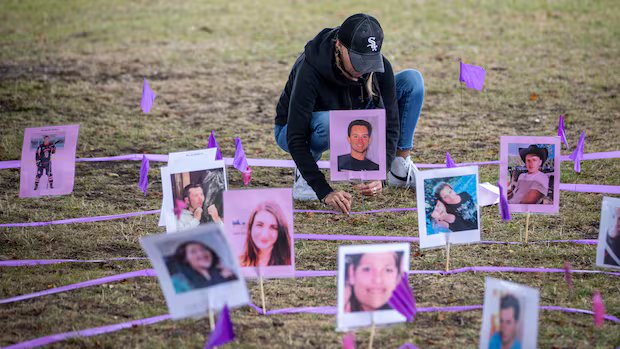
Cousins Patricia Caddy and Jordane Lopez spent their summers like a lot of kids in the mid-90s did — watching sitcom reruns, recording their favourite songs on the radio onto mixtapes and playing games outside.
“We’d take cardboard flats and pretend we were sledding in the middle of summer and go down the hill and tumble off at the bottom,” Caddy recalled, with a smile. “It was the perfect 90s childhood.”
Lopez was a constant in Caddy’s life, someone she travelled, laughed and grew up with. In many ways, Caddy said, she was closer to her cousin than her own siblings, who were much older than she.
It’s tough to pinpoint stories about her cousin, though, Caddy said, because they were simply living, not consciously committing to memory those moments they might want to return to one day.
Lopez died on Feb. 28, 2023, at age 35, with his beloved dog Arnold by his side.

He is one of the thousands of British Columbians who lost their lives to unregulated toxic drugs over the past decade, after the provincial government brought in emergency measures in an effort to save lives. Experts say they worry the province hasn’t used all the available powers that come with a public health emergency, and is leaning on public opinion rather than science to inform policy decisions.
Declaring an emergency
On April 14, 2016, then-provincial health officer Dr. Perry Kendall made B.C. the first province in Canada to declare a public health emergency in response to a sharp increase in illicit drug-related deaths.
The year prior, the Ministry of Health said 474 people had died from using illicit drugs, 30 per cent higher than in 2014.
That number has increased drastically through the years since. Though the number of deaths was down compared to the four years prior, a staggering 1,833 people died due to toxic drugs in 2025, according to B.C.’s coroners service. That brought the total number of people killed by unregulated toxic drugs since the beginning of April 2016 to more than 18,000.
Who is dying from unregulated supply?
Former chief coroner Lisa Lapointe said in 2024 that an estimated 225,000 people in B.C. use unregulated drugs. Of those, about 100,000 have opioid use disorder (addiction to opioids).
Modelling from the B.C. Centre for Disease Control (BCCDC) suggests that from June 2020 and 2023, about 191,000 people were at risk of experiencing harms, including overdose, brain injury, dependency and death, from using unregulated opioids.
The BCCDC says most people who are harmed by toxic drugs are people who have not been diagnosed with an opioid use disorder.

Most of the people dying from unregulated toxic drugs are aged 30 to 59. About half die in private residences. The majority are men. About one-fifth work in trades. And a disproportionate number are First Nations.
The unregulated drug supply is the leading cause of unnatural death in B.C., according to the B.C. Coroners Service.
Changing drug supply
Experts say one of the biggest problems B.C. faces when it comes to drug deaths is the ever-changing make up of the unregulated drug supply.
In the early days of the crisis, fentanyl — a pain reliever frequently used legally in hospital settings — was considered the big threat. Later on, a more potent opioid called carfentanil entered the drug supply. And then, benzodiazepines — which made the street drug supply particularly complex, according to Provincial Health Officer Dr. Bonnie Henry.
“What is on the street is a synthetic opioid that had some resemblance at one point to fentanyl, but now is a whole bunch of different compounds that are mixed in with different things,” she said.
“We call it fentanyl, but it’s not fentanyl.”
Now, drug poisonings are becoming even more common, as a substance called medetomidine — used primarily by veterinarians to sedate animals — is being mixed into illicit drugs.
“We’re seeing much more complex overdose responses,” Henry said. “It’s more and more challenging.”
Dual public health emergencies
In the midst of one emergency, another began: the COVID-19 pandemic.
A second public health emergency was enacted on March 17, 2020, giving the provincial health officer the power to issue verbal orders “with immediate effect,” amend regulations without the approval of the cabinet and make changes to the Public Health Act without the consent of the legislature.

Health Minister Adrian Dix says a public health emergency gives expanded powers to the provincial health officer
These two emergencies played out differently; the toxic drug emergency has persisted for a decade, while the COVID-19 emergency ended after about three years.
Henry, who was deputy provincial health officer when the toxic drug crisis emergency was declared, sees the two as similar — officials were able to collect data they couldn’t previously, in both cases, and take actions they may not have been able to without an emergency declared.
“But, of course, things happened very, very rapidly with COVID,” she said. “It’s much more of a slow moving epidemic with the toxic drug crisis, in that it didn’t affect people in the same way, it wasn’t a respiratory virus, but it was connected to people.”

Dr. Bonnie Henry says B.C. will continue to provide support to those who use drugs, four years after the province declared an opioid public health emergency.
Caddy, Lopez’s cousin, also happens to be an addiction physician based in Nanaimo, B.C.
Having started in the field in 2016, she watched on as the province reacted to the two emergencies, and from her perspective, the response was quite different.
“The response just made the overdose crisis response look, in some ways, it’s pitiful,” she said, acknowledging that the COVID-19 pandemic was complicated.
“It was alarming to see the two different responses to the crises.”
In particular, Caddy said, the provincial health officer and minister of health made sweeping changes to keep people safe — they ordered businesses to close, mandated masks and required vaccines for certain activities.
“So many things changed so rapidly with COVID, and we’re still at a point where I can’t get a detailed readout of what drugs are in a patient’s urine sample,” Caddy said.
“It feels that patients who struggle with addiction are still relegated to the sidelines.”
Preventing deaths
Dr. Ryan Herriot, an addiction physician in Victoria and member of the advocacy group Doctors for Safer Drug Policy, said over the past decade, there’s been a “failure” to bring the number of toxic drug deaths down, particularly in more recent years.
“Governments like to talk about other things. They like to talk about dollars spent … they like to talk about beds opened, they don’t like to talk about outcomes for human beings very much,” he said.
“Are they doing anything to curb the deaths? That’s the metric that matters.”
The year the emergency was declared, in 2016, 997 people died from toxic drugs.
That number of deaths peaked in 2023 at 2,590 — seven people per day. The number was down slightly in 2025, at 1,833, but still well above where the province was at the beginning of the crisis.
In the early years, Herriot said the province launched some initiatives he believes helped, including an expansion of overdose prevention sites and expanding naloxone availability and distribution.
But, he added, that momentum has stalled out.

The province implemented new restrictions on the provincial safe supply program on Jan. 1, 2026, forcing most patients who take prescription opioids such as hydromorphone or fentanyl patches to do so under the supervision of a pharmacist or health professional.
On Jan. 31, B.C. ended its three-year drug decriminalization pilot project.
According to B.C.’s Centre for Disease Control, the initial purpose of the project was to reduce the stigma people seeking care for substance use faced, and to treat substance use as a health matter and not a criminal one.
Health Minister Josie Osborne said in January it was “not even possible” to attribute changes in the number of people accessing care to decriminalization.
The move to end the project was criticized by some, including by the Canadian Drug Policy Coalition.
“Criminalization makes the unregulated supply more dangerous,” the organization said in a blog post. “Decades of data show that policing, arresting, charging, and jailing people for their substance use increases harm, while doing nothing to reduce drug use or increase safety.”
Public opinion versus science
Henry, who provides advice based on scientific data to politicians, remains supportive of decriminalizing people who use unregulated drugs. She said that as a physician, watching provincial leaders make decisions based on public opinion rather than scientific evidence can be difficult.
“I was disappointed by some of the rhetoric that came out from people who were leaders in communities, political people who took advantage of the complexity of the issue to target specific people and to regress back into blaming and shaming people.”
Herriot said the choices the province has made around rolling back decriminalization and limiting safe supply are “maddening.”
“[Governments] tend to hide behind notions of public opinion while totally ignoring their own ability to shape public opinion,” he said.
“They have at various points introduced some evidence-based policies and then completely failed to defend them, completely failed to educate the public … and they throw their hands up and say, ‘Well, the public doesn’t want this,’ as if they have no power.
“Stop blaming public opinion, start doing your job and inform the public of the evidence.”

Osborne said politicians have a responsibility to both listen to scientific advice and take society’s reactions into account, noting that people respond poorly to “people using drugs openly on the street.”
“The world we live in is one where we have to balance all of these factors in the decisions that we make of how to support people.”
Moving forward
Ten years on, Kendall stands by the decision to declare a public health emergency, and believes the government has, overall, done a good job of using the tools that come with it.
Although, he does point out some shortcomings, from his perspective, including recently imposed restrictions on safe supply.
“B.C. has, for decades, been at the forefront of evidence-based interventions,” he said. “I would just suggest that it might be time to act with perhaps a little more political courage and move forward.”

Osborne said the last decade has seen successes in government response, and there have been things “that didn’t work the way we thought they would.”
“It’s important for all of us to learn and to try new tools, to listen to the experts and take their advice and recommendations, make public policy decisions too, in the context of the society that we’re living in,” she said. “Sometimes that means difficult decisions get taken.”
When asked when the emergency might end, Osborne simply said “I don’t know.”
Declaring the public health emergency over doesn’t come down to a specific number or statistic, according to the provincial health officer, but to a societal shift in our approach to supporting people who use drugs.
“To think that we would never have anybody who has an addiction to drugs, to alcohol, is just not human nature. We have been using these substances since they were first discovered,” Henry said.
“What we need to do is have open conversations … and have understandings of where people can go when they need that help or are at the place when recovery is something they are able to get on that journey.”
Despite the pain of losing not only a family member, but several patients through the years, and the frustration of politics informing health-care options, Caddy remains hopeful.
“I work with amazing doctors and nurses and social workers and recovery workers and peers who care so deeply about the work that they do and the people that they work with, and they care regardless of where the tides take us in politics,” she said.
“People who I meet in the hospital, who are honest with me about these still intensely stigmatized behaviours, people who tell me about their substance use and trust me enough with that information knowing that I’m going to try to help care for them with that information — that’s hope.”