dailynewsnblog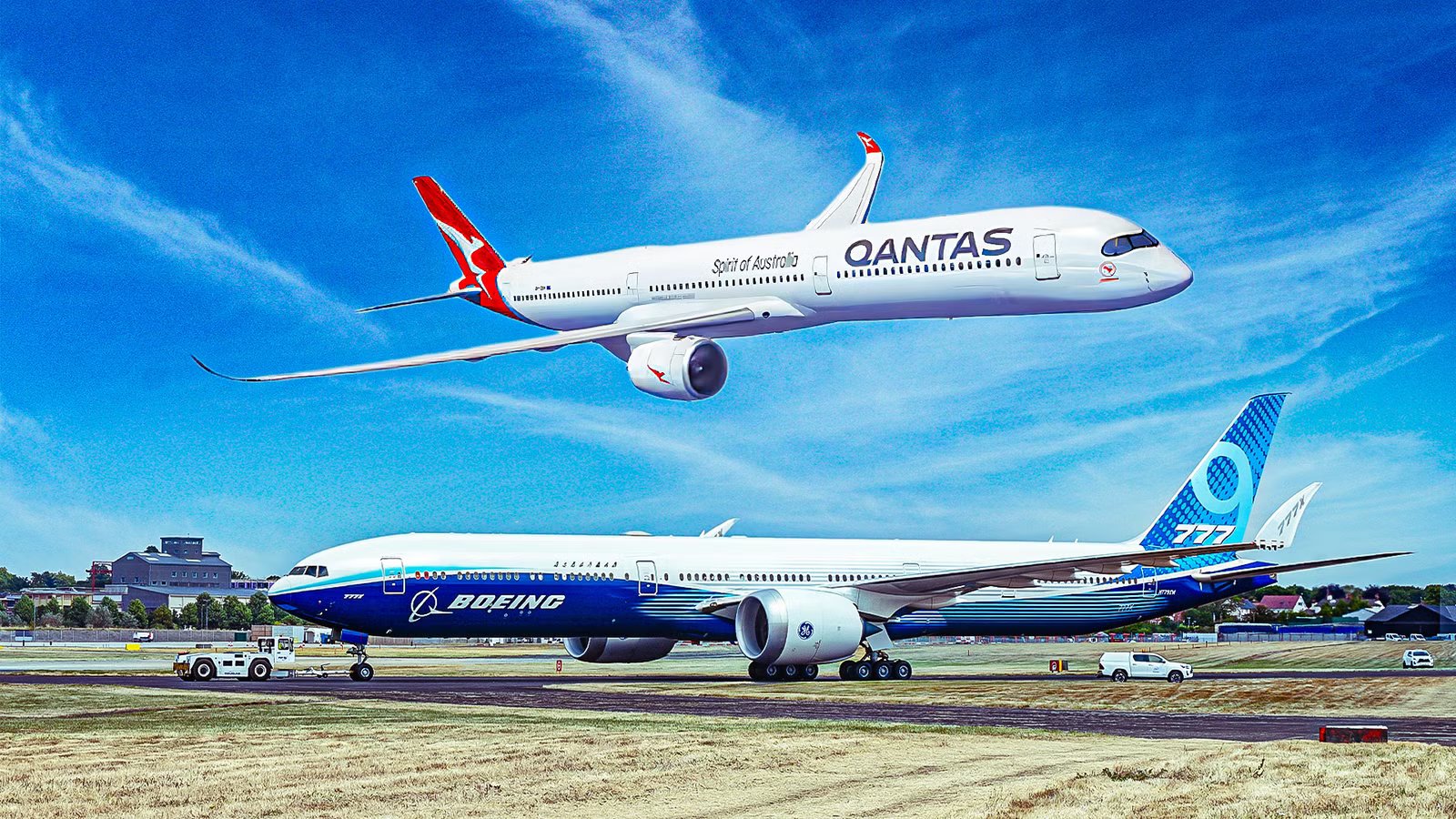
The Boeing 777X and Airbus A350-1000 are expected to play a significant role in shaping the commercial aviation industry over the next decade. However, while the Airbus A350-1000 made its first commercial flight back in 2018, the first Boeing 777X is still to be delivered, following a series of delays. And while the A350 family has already proven itself as a reliable workhorse for airlines around the world, it is still to be seen whether the 777X family can deliver on its promises.
Certain, however, is that both aircraft are competing in the same market. The 777X is said to have a capacity of 426 seats in a two-class configuration over a range of 7,285 nautical miles (13,500 km), according to  Boeing. On the other hand, the Airbus A350-1000 seats 375 to 400 passengers in a 3-class configuration, according to Airbus, across a maximum range of 8,700 nautical miles (16,112 kilometers). So let’s have a look at how these aircraft differ from each other and how they compete in one of the most competitive industries out there.
The Characteristics Of The 777X

Since the Boeing 777X is a re-developed version of the regular Boeing 777 family, it appears very similar to its predecessor in terms of flight deck and fuselage design. Although characteristics vary across 777 variants, the 777X will generally offer increased capacity and a longer range compared to older B777 aircraft. The new Boeing 777X family is currently being developed in two variants: the smaller 777-8, with a two-class seating capacity of 395 seats, and the larger 777-9, with a capacity of 426 seats. Additionally, Boeing is developing a 777-8 Freighter version, which will have a revenue payload capacity of 112 tons.
|
Specification |
777‑8 |
777‑9 |
|---|---|---|
|
Typical two‑class passengers |
395 |
426 |
|
Range |
8,745 nautical miles (16,190 km) |
7,285 nautical miles (13,500 km) |
|
Length |
232 feet, 6 inches (70.86 meters) |
251 feet, 9 inches (76.72 meters) |
|
Wingspan (extended – in flight) |
235 feet, 5 inches (71.75 meters) |
235 feet, 5 inches (71.75 meters) |
|
Wingspan (ground / folded) |
212 feet, 9 inches (64.85 meters) |
212 feet, 9 inches (64.85 meters) |
|
Height |
64 feet (19 meters) |
64 feet (19 meters) |
|
Engines |
2 × GE9X |
2 × GE9X |
The most notable differentiating characteristic of the 777X is, of course, its massive wingspan of 235 feet, 5 inches (71.75 meters) when extended and 212 feet, 9 inches (64.85 meters) on the ground, when the winglet is folded. This wingspan is similar across all variants of the 777X family. Furthermore, the 777-8 has a length of 232 feet, 6 inches (70.86 meters) compared to 251 feet, 9 inches (76.72 meters) for the 777-9. In addition, both variants have a similar height of 64 feet (19 meters). In terms of technical range, the 777-8 can cover distances up to 8,745 nautical miles (16,190 km), allowing this variant to compete with Airbus’ A350 family. However, its larger brother, the 777-9, only has a range of 7,285 nautical miles (13,500 km).
Although the Boeing 787 family allows airlines to choose between two engine types, the 777X family will be similar to its predecessor and will offer only one engine type: the GE9X, produced by General Electric. The original Boeing 777 series still allowed airlines to choose between different engines from a number of manufacturers. However, the second generation (-200LR and -300ER) was already limited to a single engine type, the GE90, as aircraft manufacturers have increasingly adopted this approach in their product offerings for commercial airlines over the years.
How Does The A350-1000 Compare?

According to Airbus, the A350-1000 seats up to 400 people in a three-class configuration, which is slightly less than the capacity of the 777-9. This allows the aircraft to comfortably compete with the 777X in capacity. Besides this, the A350 has an edge over the 777-9 in terms of range, offering airlines a range of 9,000 nautical miles (~ 16,700 kilometers), which is 1,715 nautical miles (~ 3,200 kilometers) more compared to the 777-9.
This increased technical range might allow some airlines to commence routes not possible with the 777-9, such as between Europe and Australia, for example. The A350-1000 is also available in a special “ultra-long range” (ULR) variant, which has an even longer range. The A350-1000ULR can fly upwards of 9,700 nautical miles (~ 18,000 kilometers), and is currently in development for Qantas’ “Project Sunrise”.
In terms of size, the A350-1000 has a length of 242 feet (73.78 meters) and a wingspan of 212 feet, 5.2 inches (64.75 meters), slightly less compared to the 777-9, and, of course, without foldable wingtips. Similar to the 777X, the A350 is exclusively powered by one engine type: Rolls-Royce Trent XWB-97 turbofan engines. These engines are the most powerful ever installed on an Airbus aircraft, delivering up to 97,000 lbs of thrust each.
|
Boeing 777-9 |
A350-1000 |
|
|---|---|---|
|
Range |
8,318 miles (13,500 kilometers) |
10,376 miles (16,700 kilometers) |
|
Capacity |
426 (2-class) |
375–400 (3-class) |
|
Wingspan |
235 feet, 5 inches (71.75 meters) / 212 feet, 9 inches (64.85 meters) |
212 feet, 5.2 inches (64.75 meters) |
|
Length |
251 feet, 9 inches (76.7 meters) |
242 feet, 0.7 inches (73.78 meters) |
Besides the A350-1000 and -1000ULR, the A350 family also consists of the smaller A350-900 and its ULR variant, as well as the A350F. This latter is currently still under development and the first deliveries are expected to take place in 2027, carrying up to 111 metric tons over a maximum range of 4,550 nautical miles (8,430 kilometers).

The Airbus A350 Freighter: Everything We Know So Far
The A350F freighter is poised to enter service in 2027.
The Unique Feature Of The 777X

The Boeing 777X has one very special and innovative feature setting it apart from the A350 and other aircraft: its foldable wingtips. This innovative technology allows the aircraft to access existing airport infrastructure without expensive infrastructure changes by folding the wingtip upward on the ground. Without folding wingtips, the aircraft’s wingspan would exceed the limits of many airports’ infrastructure, such as parking positions and taxiways. This one-of-a-kind wingtip, built from advanced composite materials, is an engineering milestone for the commercial aviation industry.
From the flight crew’s perspective, the wingtips are part of their pre-departure configuration checks, similar to setting the flaps. Obviously, pilots must extend the wingtips, and to ensure this, the aircraft’s system provides escalating levels of alert. Once the aircraft’s wingtip is extended, the wingtips are electronically isolated and mechanically locked using a large physical locking bolt to provide fail-safe protection, ensuring the wingtips cannot be folded in-flight. After landing, the wingtips automatically fold at 50 knots ground speed, removing additional workload from the flight crew while clearing the runway.

The Airline Set To Fly One Of The Boeing 777X’s Longest Routes
This Star Alliance carrier will be one of the world’s largest operators of the Boeing 777X.
The Endless Delays Of The Boeing 777X

Perhaps a more important reason for airlines to choose the A350-1000 over the 777-9, rather than technical characteristics, is availability. The 777x program is heavily delayed, and there are no guarantees that the aircraft won’t be delayed further. This has forced airlines that have ordered the aircraft to adapt their fleet strategy and reduce growth prospects. As a result, airlines are postponing the retirement of older, less-efficient aircraft, such as the 747 and the A380.
In particular, Emirates, the largest customer of the 777-9, is extremely dissatisfied with the 777X’s delays, and it has forced the airline to retrofit and redesign older A380 aircraft. Considering the size of Emirates’ order for the aircraft, it is no surprise that the airline is extremely dissatisfied with the delays Boeing is facing with the 777X program. The program was originally announced in 2013 with the expectation that deliveries would start in 2020. Today, however, the first 777X is not expected to be delivered before the beginning of 2027 due to certification and production delays. A delay has been costing Boeing billions in charges totaling $15 billion at the end of October 2025, according to Reuters. For Emirates, the delay has meant re-adapting its fleet strategy by renewing its aging Airbus A380s and Boeing 777-300ERs.
Other airlines with outstanding orders for the 777X include Cathay Pacific, Singapore Airlines, and Lufthansa. Also, these airlines have been forced to adapt their fleet strategies due to the delays surrounding the 777X. For German flag carrier Lufthansa, the delays mean keeping its 747 fleet flying for longer, as the airline will replace its relatively large and aging Boeing 747 fleet with the aircraft. While Cathay Pacific, the current third-largest customer of the 777X, also had its patience tested by Boeing as the airline placed its first order for the aircraft back in 2013, and it was set to play a crucial role in its future growth.

How Many 777Xs Has Boeing Already Started Building?
Boeing’s 777X program faces delays and challenges, but how many aircraft have they built so far?
The Most Popular By Number Of Orders

Since the first Boeing 777X is still to be delivered, and the Airbus A350 has been in commercial service since 2015, comparing which aircraft is the more popular one is difficult. As of November 2025, there are 619 outstanding orders for the 777X family. With 521 orders, the 777-9 is by far the most popular version of the family, followed at a considerable distance by the -8F and -8. These latter two aircraft currently only have 63 and 35 orders, respectively. The two largest customers for the type are, as mentioned earlier, Emirates with 270 aircraft on order, as well as Qatar Airways with 124 aircraft.
The A350-1000, on the other hand, has only 257 outstanding orders as of February 2026. In total, 367 aircraft of the type were ordered, and 110 have already been delivered, considerably less than the 777X. However, when looking at the A350 family as a whole, the total number of orders far exceeds the 777X’s 1,529 orders since the aircraft was first announced. 1,081 of these orders are for the smaller A350-900, of which 592 have already been delivered. Another 101 outstanding orders are for the freighter variant, the A350F, of which none have been delivered as the aircraft is still under development.