dailynewsnblog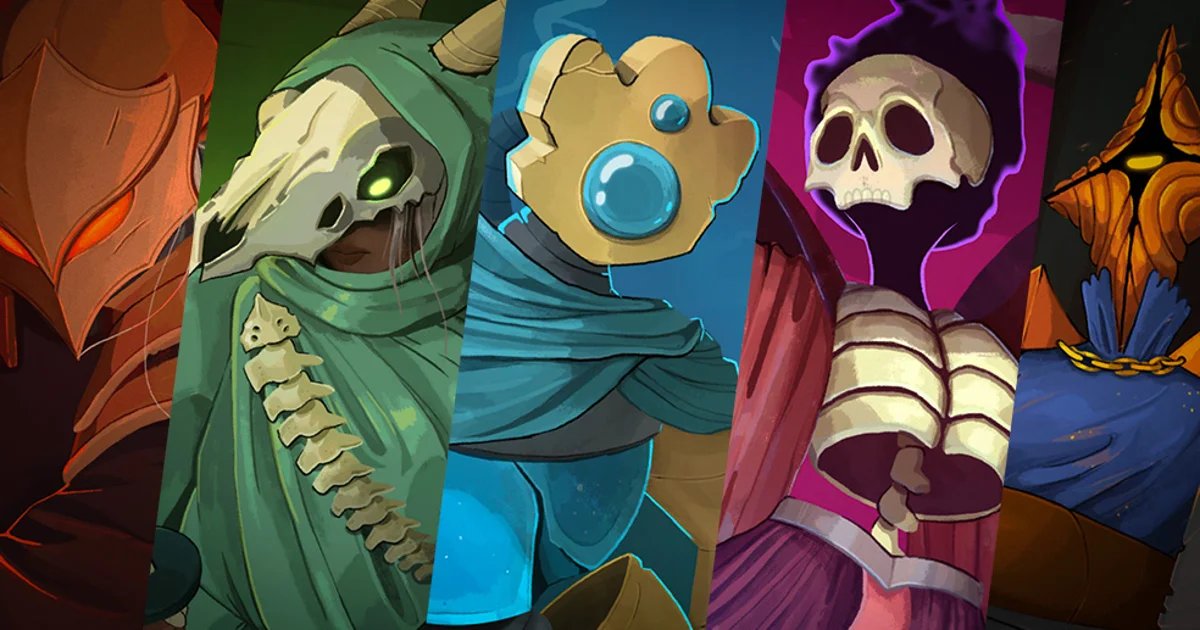
It seems like such a simple change – and one I’m aware people modded into Slay the Spire 1 – but co-op multiplayer transforms Slay the Spire 2. This is, superficially, a sequel of very familiar parts, an evolution rather than a revolution. But played with a friend – or friends – the formula is renewed.
The potential problems here were many. Slay the Spire sung so clearly because it was balanced so precisely. It was a deck-building game honed for one player to tackle a spire full of enemies and see how far they could get; introduce another player to that and you wobble the entire foundation. All sorts of disruptive questions start to appear. Isn’t it unfair to have more than one player fighting an enemy? Do players share a resource pool? Which player do enemies attack – does positioning suddenly matter? And how do you handle relic and card rewards? The whole formula is jeopardised. But Slay the Spire 2 answers these questions with such elegance and confidence it makes you wonder why there was ever any doubt.
You can play Slay the Spire 2 with up to three other people; I played it with one other and hosting and joining a game worked immediately – not a remarkable feature but a welcome one nonetheless. The question of ‘who does an enemy target?’ has been answered easily by ‘all of you’; every time an enemy strikes, all of you take the damage. The question of it being unfair to have more than one player fight an enemy has been answered by enemies having larger health pools, and every battle here felt balanced in terms of the challenge it presented. You don’t share an energy pool, you don’t share card or relic rewards, and you don’t squabble over who buys what in the shop. It’s all individualised as if you were playing alone.
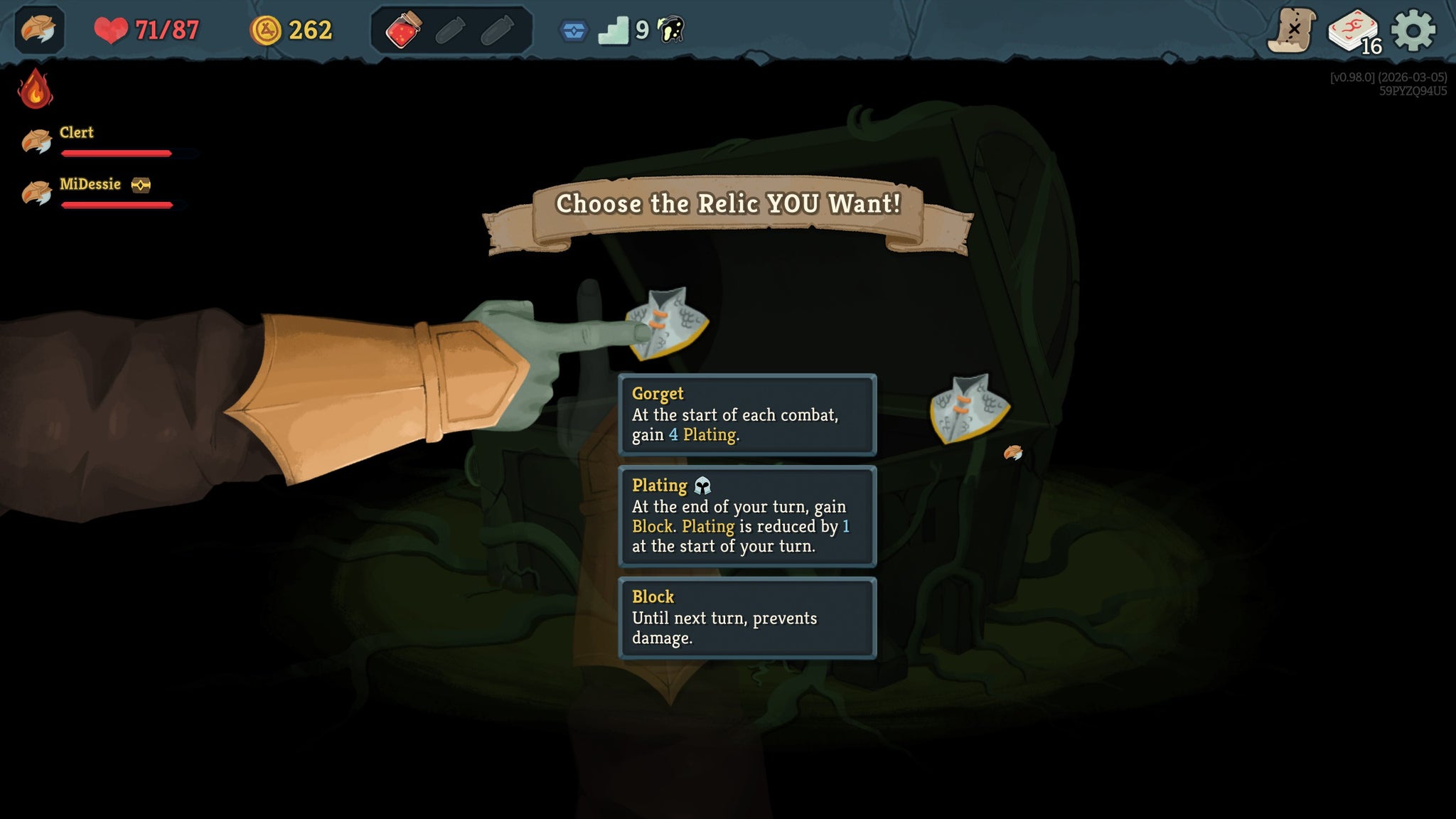
Except, you’re not playing alone, and this is an important point, because Slay the Spire 2 hasn’t just tried to make multiplayer playable, it’s embraced the idea. And this is where it gets exciting. Let’s start with the little touches. When you open a chest containing a relic reward, each player gets a pointy-fingered arm to waggle to show which relic they’re interested in, which is fun. If you can’t agree and more than one person wants a relic, you play a game of rock, paper, scissors to see who gets it.
You can draw on the map. You can, using a little quill, leave notes or pictures for your friends while you collectively work out which route to take. You can draw a penis if you want; I’m sure many will. You don’t have to use this to decide where you’re going because you have a little player symbol that appears on whichever destination you opt for, but like the waggly finger, it’s a concession to help playing together seem thought about and, again, it’s fun.
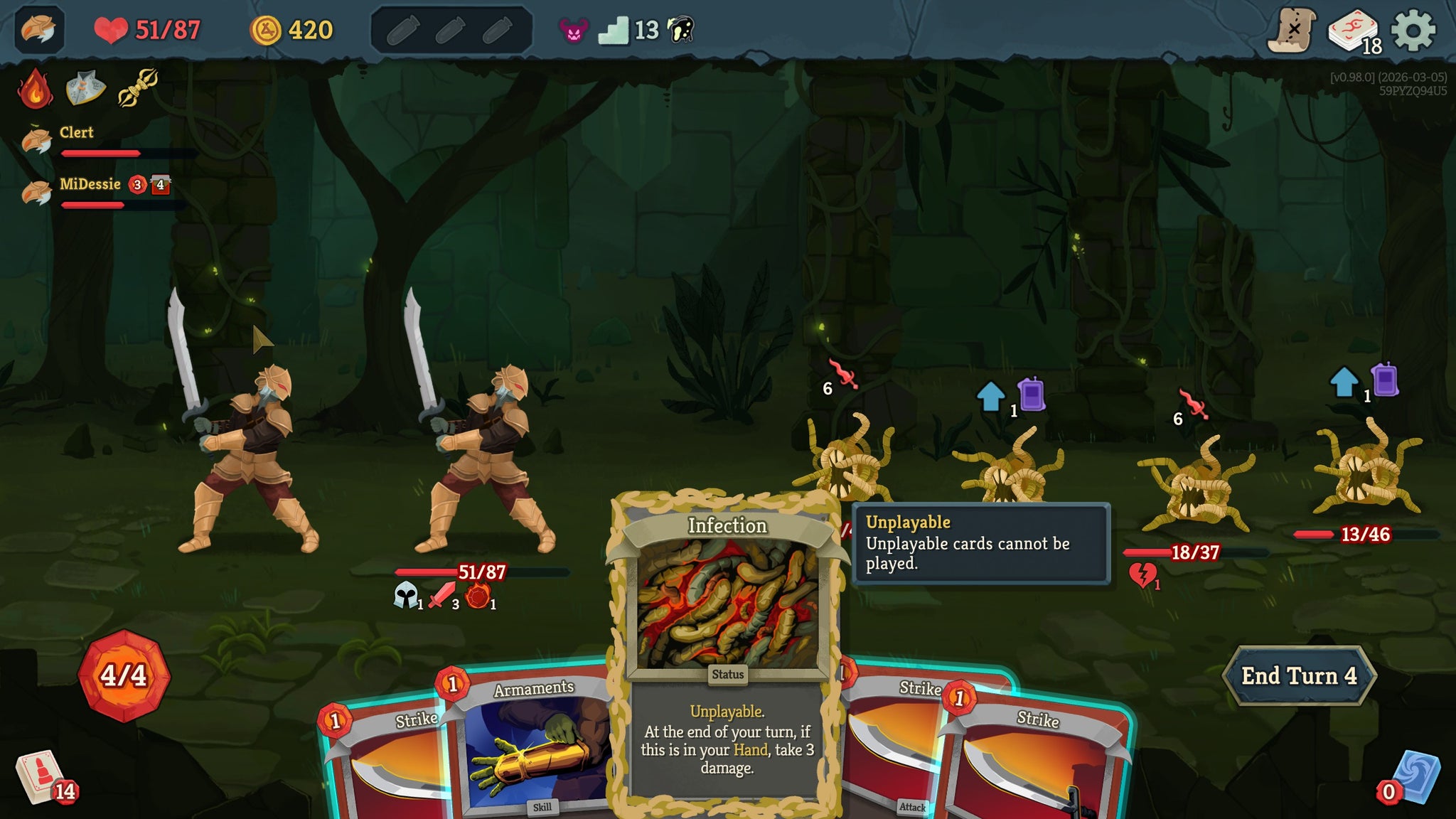
But playing together also changes the game of cards itself, in the sense it opens a new world of tactical possibilities. Consider debuffs: if one player makes an enemy vulnerable, the other player can exploit that, potentially leading to someone becoming the debuffer and setting enemies up, so the glory hunter can knock them down. Potions can be played on your friend, helping them in a pinch. There are even cards that directly affect someone you’re playing with, such as one I had that duplicated my Block at the cost of some health. That’s hard-coded party play. You can choose to heal you friends at rest sites as well. I’m sure I’ve barely discovered a fraction of what’s on offer but everywhere, Slay the Spire 2 seems to encourage collaborative thinking, and the ripples spread such that you’ll begin building decks in complementary ways. It’s a totally new way of thinking about the game – and I like it.
There’s a broader and more philosophical aspect here, too, in that it’s simply nice not to play alone. Slay the Spire, unless you were streaming it to an audience (or modded it), or forced a friend to watch you play, was a solitary pursuit. There was no one there to discuss strategies or work out card-playing order with, so there was no one there to celebrate with when things went well. Or to agonise with when things – inevitably – went bad. Now, there is. The silence is filled. And it’s such a striking experience it makes you wonder why it was never there, properly, before.
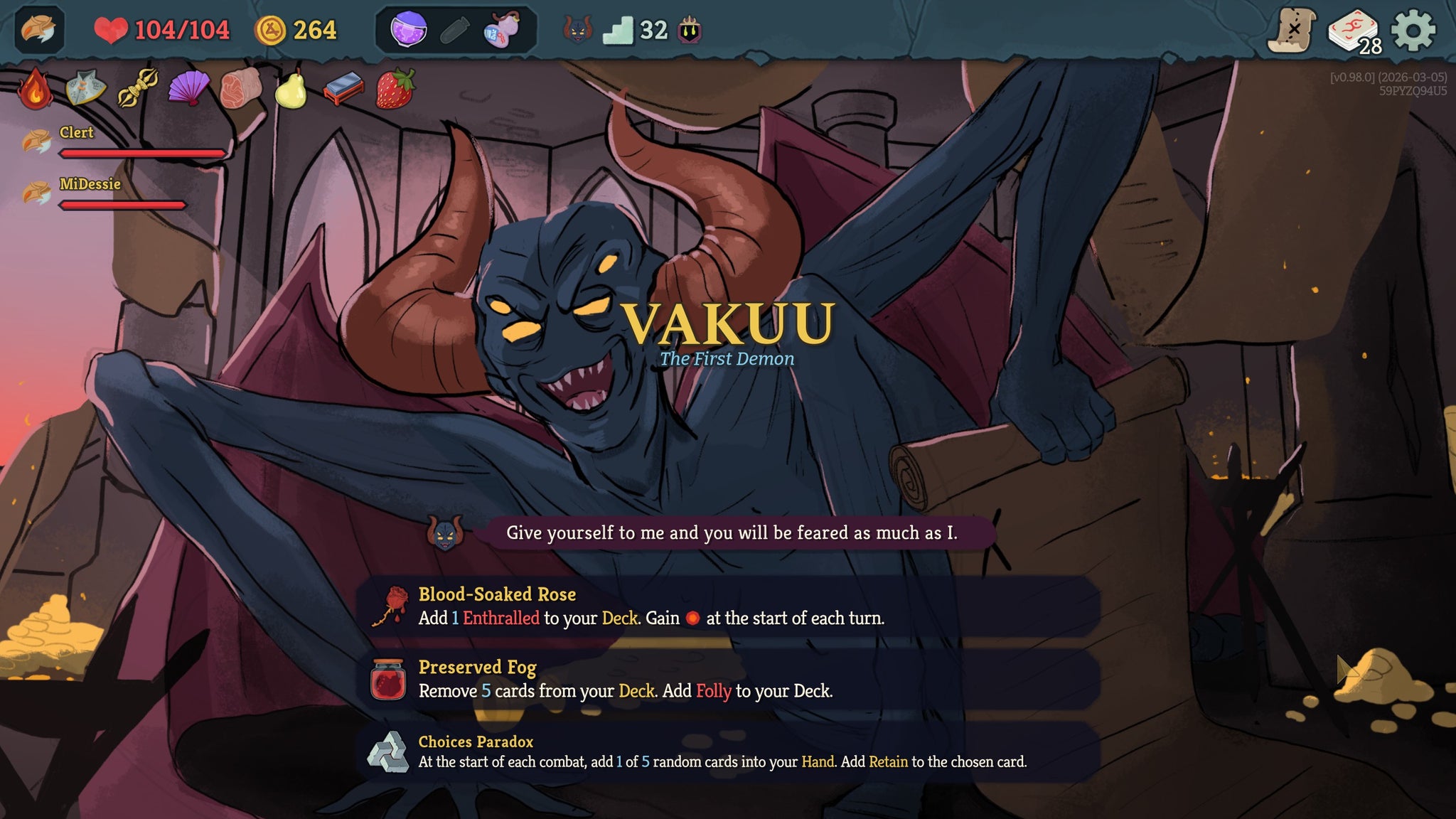
Co-op has tremendous impact, then, and it’s my focus here, but Slay the Spire 2 is by no means dependent upon it. I’m still in the early hours of the game so there’s lots for me still to see, but already I’m impressed with how polished Slay the Spire 2 is and how – to use the word again – elegantly it plays. The whole presentation feels more alive and sophisticated, though still with that familiar homemade vibe. There are also – for all the many cards and characters that have returned – plenty of new things here. Many new interactions to discover, risky new deals with demons to make – Mega Crit is in sublimely wicked form – and of course entire new characters and card sets to explore. I had wondered how new this would feel; I wonder no more. A new era for Slay the Spire has begun.