dailynewsnblog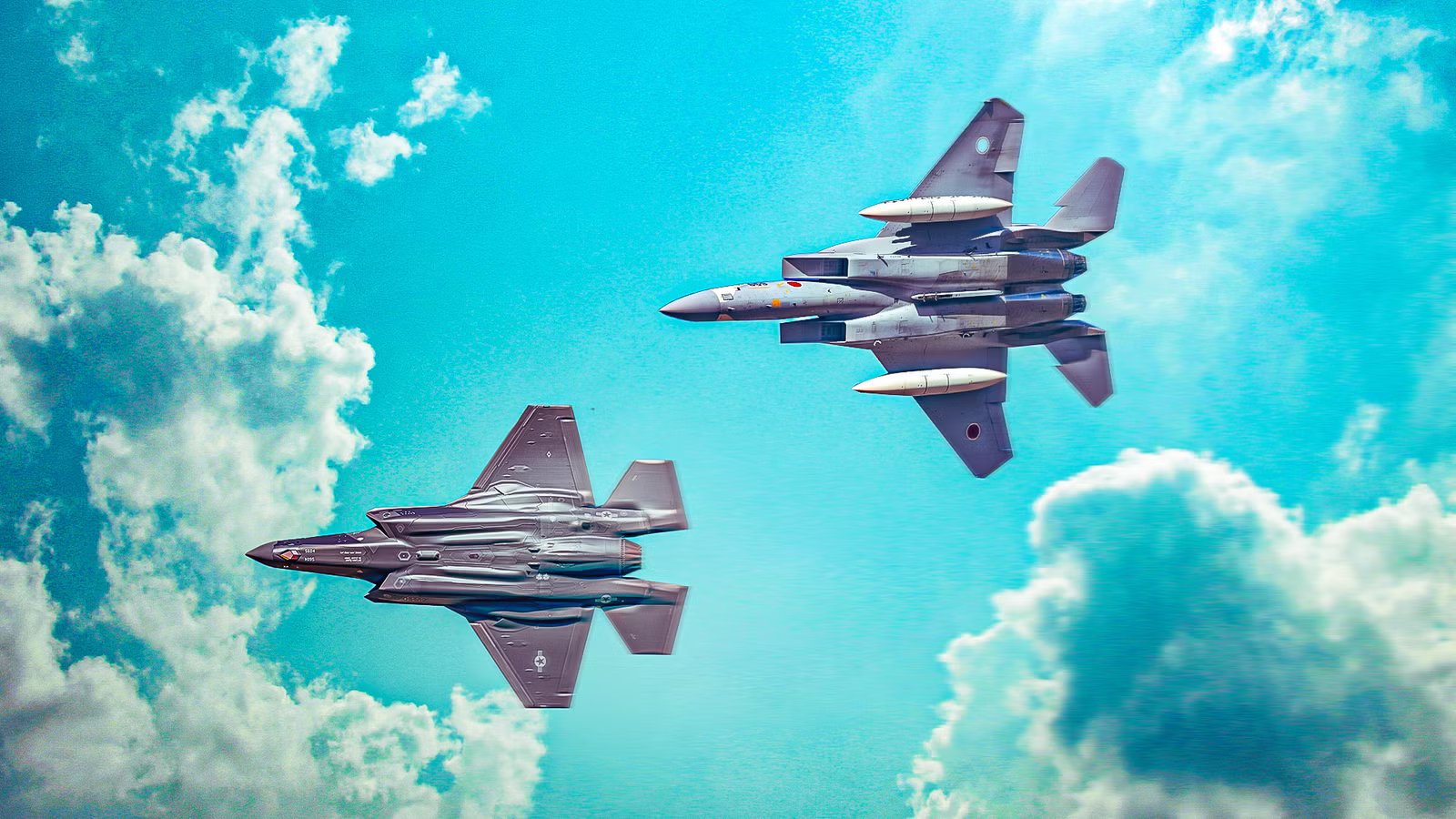
Today,  Boeing and Lockheed Martin are the two major pillars in the American defense industrial base of aerospace. But each manufacturer has divergent design philosophies. The aircraft that each produces for the US armed forces are distinctly different from each other in both engineering qualities and tactical missions. Boeing has a more diverse defense portfolio, but its share of fighter contracts is dwarfed by Lockheed Martin’s Joint Strike Fighter output.
Lockheed Martin is the primary contractor of the largest defense contract in history, thanks to its F-35 Lightning II program, worth an estimated two trillion dollars over the full lifetime of the program. Instead, Boeing is focused on maximizing conventional fighter performance, which in the modern United States Air Force doctrine has evolved into a kind of ‘missile truck’ philosophy. As such, its Super Hornet and Eagle II designs are focused on raw power and payload capacity.
Made In America Versus Multinational

The F-35 program is the most complex defense industrial project in history, partly due to the fact that many countries that purchase the jet also contribute to its production. The LM-USAF Fort Worth ‘Bomber’ plant runs like an auto assembly line, with aircraft passing through stations every few days. Unlike Boeing, Lockheed Martin has Final Assembly and Check-Out facilities in Cameri, Italy, and Nagoya, Japan, allowing for more localized production and maintenance.
Boeing’s fighter production is concentrated in St. Louis, where it has been since McDonnell Douglas was using the plants to roll out F-4 Phantoms. Because Boeing’s order volume is significantly lower, at about 2 fighters per month versus Lockheed’s 15 or more. These facilities function more like a specialized workshop, but Boeing is currently investing in a massive new facility for sixth-generation F-47 Next Generation Air Dominance, aiming to take the lead in stealth technology.
One vulnerability to the F-35 model is that a strike or disruption at a key site anywhere in the global supply chain can halt the entire program for Lockheed Martin. By keeping production largely domestic, Boeing avoids the vulnerability of the JSF program but lacks the scale and scope that Lockheed’s multinational partnership model has created.
The USAF’s High-Low Fleet

Today, the F-35A Lightning II and F-15EX Eagle II are the two primary land-based fighters for the United States Air Force. While they cost roughly the same to purchase at round $90 million each, they are designed for fundamentally different mission sets. The F-35A is a stealthy ‘quarterback’ designed to penetrate deep into enemy territory undetected, while the F-15EX is a massive ‘missile truck’ intended to haul heavy ordnance and dominate the air from a safer distance.
The F-15EX is much higher maximum speed and can fly to 60,000 feet, which far surpasses the F-35. The F-35A is slower as it is optimized to be more efficient and loiter over the battlefield. The Air Force plans to use them as a team where F-35As will go in first to ‘kick down the door’ by destroying enemy radars. Once the threat is reduced, F-15EXs arrive to provide ‘massed effects,’ raining down heavy bombs and missiles on remaining targets selected by F-35s.
Specifications | Boeing F-15EX Eagle II | Lockheed Martin F-35A |
|---|---|---|
Generation | 4.5+ Generation | 5th Generation |
Stealth | None (Large radar signature) | Very High (Internal bays) |
Max Speed | Mach 2.5 | Mach 1.6 |
Max Payload | ~29,500 lbs | ~18,000 lbs (Total) |
Air-to-Air Load | Up to 12+ missiles | 4–6 missiles (internal) |
The F-35A uses advanced stealth to survive against modern air defenses like the S-400. The F-15EX lacks stealth but features a world-class electronic warfare suite that jams enemy sensors, known as the Eagle Passive Active Warning Survivability System. While the F-35A can carry external weapons in ‘Beast Mode,’ the F-15EX is always in beast mode, capable of carrying outsized weapons like future hypersonic missiles.

How Lockheed Martin Fighters Stack Up Against Each Other In 2026
Lockheed Martin’s fighters continue to define the shape of Western airpower, but how do the F-22, F-35, and F-16 compare in evolving scenarios?
Naval Aviation Enters The Stealth Era

Currently transitioning into its most advanced Block III configuration to serve alongside fifth-generation fighters like the F-35, the Boeing F/A-18E/F Super Hornet is the legacy cornerstone of the US Navy’s carrier air wings. The F-35C, identifiable as having the largest wingspan of all F-35 variants, is still in the early stages of integration with the USN. It is designed to be a sensor hub to identify targets and pass that data to a Super Hornet flying miles behind it.
A Super Hornet can then fire its missiles at a target it can’t even see yet, when paired with the F-35C on the battlefield. In addition to being stealthy, the F-35C has a significantly better combat radius than the Super Hornet, partially due to how it remains clean while carrying weapons internally. This makes it the better platform for the crucial mission of combat air patrol, where loiter time allows fighters to protect the carrier longer before relief by another flight.
This same battlefield synergy applies to the penetrating strike mission frequently carried out by naval aviators. The Super Hornet relies on Electronic Warfare assets and ‘buddy’ support from EA-18G Growlers to survive in contested airspace. The F-35C can leverage its stealth to operate inside the range of enemy Surface-to-Air missiles and find targets where a Hornet would be vulnerable.
The F-35 also features Magic Carpet software, which is a more advanced version of the type found in Super Hornets. It makes landing on a moving deck significantly easier and safer for the pilot compared to the more manual inputs often required in the first-gen Hornet. When stealth is not required, the F-35C can also enter ‘Beast Mode,’ carrying weapons on external pylons just like the Super Hornet. In this configuration, both aircraft carry roughly the same amount of firepower.

Lockheed Martin Vs. Airbus: Which Manufacturer Produces More Military Aircraft?
Lockheed produces more fighter jets than Airbus, but Airbus wins on the number of military helicopters shipped.
F-35B: Jump Jet Evolved

The US Marines are in the final stages of the transition from the Boeing AV-8B Harrier II to the Lockheed Martin F-35B Lightning II. The introduction of the JSF is a generational leap in technology for the Marines, moving from a specialized subsonic ground-attack jet to a multirole, supersonic stealth fighter. While both share the unique ability to operate from amphibious assault ships and austere forward bases, they achieve this through vastly different technologies.
The Harrier is a subsonic aircraft primarily built for close air support, but flying a Harrier in a hover is notoriously difficult, requiring high pilot skill to manage. On the other hand, the F-35B uses advanced flight control laws and AI to automate much of the hovering process, allowing the pilot to focus on the mission rather than just keeping the aircraft in the air.
Specifications | Boeing AV-8B Harrier II | Lockheed Martin F-35B Lightning II |
|---|---|---|
Generation | 4th Generation | 5th Generation |
Primary Role | Close Air Support | Multirole (Stealth, Strike, ISR) |
VTOL Technology | Direct thrust (four swiveling nozzles) | Shaft-driven lift fan + swivel nozzle |
Armament | External pylons only | Internal & External carriage |
Unit Cost | ~$25–30 million | ~$100+ million |
The AV-8B Harrier II uses a Rolls-Royce Pegasus engine that directs all exhaust through four rotating nozzles for vertical lift. In contrast, the Lockheed Martin F-35B utilizes a more efficient shaft-driven lift fan located behind the cockpit, which provides ‘cool’ lift and greater stability during hover.
The US Marine Corps is phasing out its remaining Harriers, with a planned final retirement date of June 2026. Meanwhile, the F-35B is now the primary short takeoff and vertical landing platform for the Marines, the UK’s Royal Air Force, and the Italian Navy.

The Real Reason Why Boeing Is Building The F-47 Stealth Fighter And Not Lockheed
Stealth, Speed, and Strategy: Inside the F-47 Revolution.
The Dominance Of Skunk Works

The manufacturing of Lockheed Martin’s F-35 and Boeing’s fighters represents two completely different industrial philosophies and vastly different scales in production. Lockheed Martin’s manufacturing is currently focused on the F-35 program, which was developed under the Skunk Works division. It is now a high-rate manufacturer delivering hundreds of aircraft annually, while Boeing has shifted toward low-rate output of specialized fighter jets.
Lockheed Martin produces fighters roughly five times faster than any other Western manufacturer. Its assembly line in Fort Worth, Texas, is supplemented by Final Assembly and Check-Out facilities in Italy and Japan. In 2025, Lockheed Martin set a new delivery record of 191 F-35s after resolving a year-long delivery hold caused by software issues with the Technology Refresh 3.
Boeing’s fighter production has been in a state of transition and recovery, even with the award of the F-47 contract last year. Delivery of the F-15EX has been delayed by nearly a year due to a 15-week labor strike in St Louis that ended in late 2025, as well as critical material shortages. While F/A-18 Super Hornet production is scheduled to end next year, Boeing is attempting to double F-15EX production from one to two jets per month by early 2027.