dailynewsnblog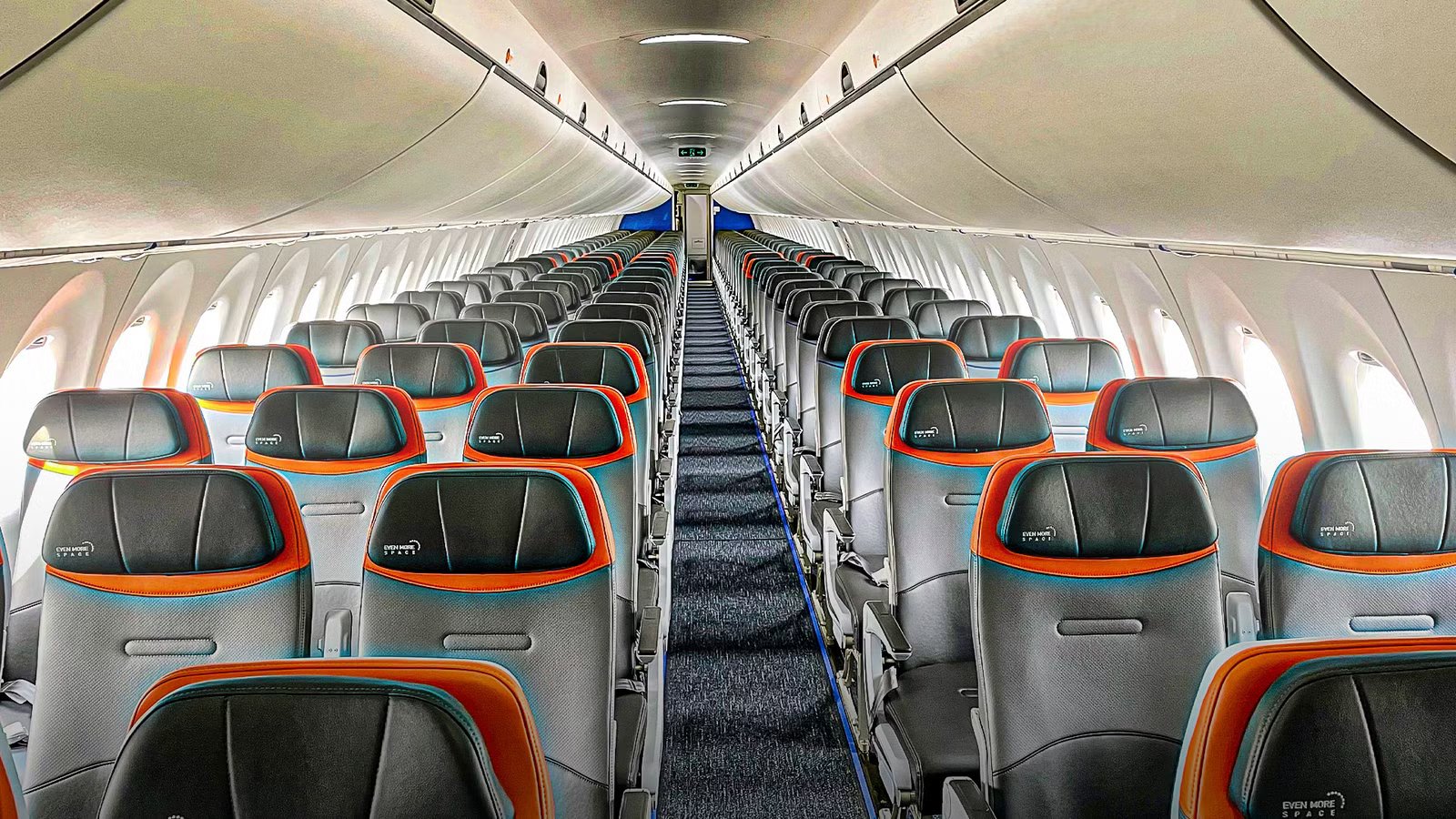
For many passengers, the difference between a pleasant flight and an uncomfortable one often comes down to legroom. While inflight entertainment, Wi-Fi connectivity, and onboard service all play their roles, the amount of space between rows remains one of the most important factors in overall comfort. In economy class, that space is measured in seat pitch, the distance from a fixed point on one seat to the same point on the seat in front.
Across the US, airlines vary considerably in how much legroom they offer in economy class. Ultra-low-cost carriers typically prioritize higher density and lower fares, while full-service and hybrid airlines often allow for slightly more generous legroom. In this article, we will examine how eight major US airlines compare, starting with the tightest configurations and moving toward the most spacious.
Frontier Airlines & Spirit Airlines – 28 Inches (71.1cm)

It should come as no surprise that at the lower end of the legroom range are Frontier Airlines and Spirit Airlines – two airlines built around the ultra-low-cost model. Both carriers are known for offering some of the lowest base fares in the US, and their cabin layouts reflect a strategy focused on maximizing seat count. Frontier Airlines operates an all-Airbus fleet, consisting of Airbus A320 family aircraft, including the A319, A320, and A321.
The airline’s standard economy class seat pitch is just 28 inches (71.1 cm). The Airbus A320, a core aircraft type in Frontier Airlines’ fleet, is configured in a single-class layout with tightly packed rows to accommodate as many passengers as possible. Meanwhile, the larger A321 follows the same approach, stretching the fuselage to add even more seats while maintaining similar spacing between rows. Even on the smaller A319, passengers can expect the same compact arrangement.
Spirit Airlines follows a nearly identical formula in that its fleet also consists entirely of Airbus narrowbody aircraft – the A319, A320, and A321. On these aircraft, standard economy class seat pitch is generally 28 inches. Spirit Airlines’ A320s, which form the backbone of its operations, are configured in high-density layouts designed to keep operating costs low.
Both Frontier Airlines and Spirit Airlines offer optional extra-legroom products for an additional fee. Frontier Airlines offers Stretch seating in the front rows of its aircraft, while Spirit Airlines has its well-known Big Front Seat, which provides substantially more space. However, in standard economy class, 28 inches (71.1 cm) remains the norm, placing these carriers at the bottom of the pile for legroom among major US airlines.
United Airlines – 30.1 Inches (76.5cm)

Moving up slightly in seat pitch is  United Airlines, one of the three major US legacy carriers. With a vast domestic and international network, United Airlines operates a mixed fleet of
  Boeing and Airbus aircraft, and its standard economy pitch averages around 30.1 inches (76.5cm). United Airlines’s narrowbody fleet includes the Boeing 737 family, from the 737-700 through the 737-900 and newer 737 MAX variants.
On aircraft such as the 737-800 and 737 MAX 8, economy class seating is typically arranged in a 3-3 configuration, with pitch hovering around 30 inches in standard rows. The airline also operates Airbus A319 and A320 aircraft, which similarly feature economy class cabins in a 3-3 layout with comparable spacing. For longer domestic routes and high-demand markets, United Airlines deploys aircraft such as the Boeing 757-200 and 757-300.
These aircraft offer a similar pitch in economy class, although the longer cabin can sometimes feel more spacious. On widebody aircraft like the Boeing 777 and Boeing 787, generally used on long-haul routes, economy class seat pitch sits around 30-31 inches (76.2-78.7cm), although seating configurations can vary depending on the specific subfleet.
While 30.1 inches (76.5cm) does not represent a dramatic increase over ultra-low-cost competitors, the additional space is noticeable, particularly on flights exceeding two hours. Combined with a more traditional full-service offering, United Airlines’ main cabin product reflects a balance between density and passenger comfort.

The Airlines With The World’s Widest Economy Seats In 2026
Beyond some Asian airlines, the best way to get extra space between other economy class passengers is to focus on the aircraft type.
American Airlines – 30.2 Inches (76.7cm)

Closely aligned with United Airlines is  American Airlines, which offers an average economy class seat pitch of approximately 30.2 inches (76.7cm) across much of its fleet. As the world’s largest airline by several metrics, the
  oneworld carrier operates an extensive mix of narrowbody and widebody aircraft. Within its narrowbody fleet, Airbus Airbus A319, A320, and A321 aircraft play a central role.
These aircraft are typically configured with a standard 3-3 seating arrangement in economy class. On many Airbus A321 aircraft, which are commonly used on high-traffic domestic routes, economy class seat pitch measures around 30 inches (76.2cm). American Airlines’ Boeing 737-800 fleet follows a similar pattern, with tightly optimized cabins designed to remain competitive in both cost and comfort.
On widebody aircraft such as the Boeing 777-200, 777-300ER, and 787, American Airlines maintains its economy class seat pitch in the range of 30-31 inches. Although these aircraft are often deployed on long-haul routes, they occasionally appear on premium domestic routes, and the slightly wider fuselage enhances the sense of space even if seat pitch remains similar.
American Airlines has undertaken various cabin retrofits in recent years, sometimes increasing seat counts while maintaining comparable pitch figures. As a result, while the official measurement may only slightly exceed that of United Airlines, passenger perception of comfort can vary depending on aircraft type and interior generation.
Alaska Airlines & Delta Air Lines – 31 Inches (78.7cm)

A more noticeable improvement in legroom appears with  Alaska Airlines and Delta Air Lines, both of which typically offer around 31 inches (78.7cm) of pitch in standard economy seating on many domestic aircraft. Alaska Airlines operates a fleet primarily composed of Boeing 737 aircraft, including the 737-800 and the newer 737 MAX 8 and 737 MAX 9.
In economy class, these aircraft are generally configured with a seat pitch of approximately 31 inches. The airline’s cabins are arranged in a 3-3 layout, and Alaska Airlines has managed to maintain a slightly more generous baseline than several competitors. The consistency of its short-haul fleet simplifies the onboard experience, as most aircraft offer similar seat spacing.
 Delta Air Lines, with one of the most diverse commercial aircraft fleets in the world, operates a wide range of narrowbody aircraft, including the Airbus A319, A320, A321, and A220 aircraft, along with Boeing 737-800s and 737-900ERs. Across much of this narrowbody fleet, economy pitch measures around 31 inches (78.7cm). Delta Air Lines’ Airbus A220 fleet, in particular, is often praised for passenger comfort, combining 2-3 seating with large windows and a generous seat pitch.
On larger aircraft such as the Boeing 757 and select widebodies used domestically, pitch can be similar or slightly greater depending on configuration. The additional inch compared to United Airlines and American Airlines may not sound substantial on paper, but over longer journeys, even small differences can improve comfort. Both Alaska Airlines and Delta Air Lines have built reputations for offering a passenger experience that blends competitive pricing with relatively generous cabin layouts.

5 World Airlines With Economy Class Seats That Don’t Recline
While many might disagree, the use of fixed-back seats offers advantages for both airlines and passengers.
Southwest Airlines – 31.8 Inches (80.8cm)

Among major US carriers,  Southwest Airlines stands out for offering approximately 31.8 inches (80.8cm) of seat pitch in standard economy. Southwest Airlines operates a single aircraft type, the Boeing 737, allowing for consistent cabin design and passenger expectations.
Southwest Airlines’ Boeing fleet of 737-700, 737-800, and 737 MAX 8 aircraft all feature all-economy class layouts, as the airline does not operate a traditional business class or first class cabin. Seats are arranged in a 3-3 configuration, and the nearly 32-inch (81.3cm) pitch provides more space than most US carriers offer in their standard economy class rows.
Southwest Airlines’ decision to maintain a relatively generous pitch reflects its long-standing emphasis on customer-friendly policies. Even without a premium cabin, the low-cost carrier provides a level of comfort that places it ahead of many competitors in terms of standard economy class legroom.

The Most Spacious Premium Economy Seats In The US Today
All three major airlines in the US offer competitive premium economy products.
JetBlue – 32.3 Inches (82.0cm)

At the top of the list is JetBlue, which offers approximately 32.3 inches (82.0cm) of seat pitch in standard economy class. Since its launch, JetBlue has marketed itself as a comfort-focused alternative within the US market, and its cabin layouts reflect that strategy. JetBlue’s fleet includes Airbus A320 and A321 aircraft, as well as the newer A220.
On the A320, which long served as the backbone of the airline’s operations, standard economy class pitch typically exceeds 32 inches, and the A321, which is used on both domestic transcontinental and transatlantic routes, maintains similar spacing in its core economy cabin. The Airbus A220, with its 2-3 seating configuration, combines competitive pitch with wider seats and larger windows, further enhancing the perception of space.
In addition to its standard economy class product, JetBlue offers Even More Space seating in designated rows, providing additional pitch beyond the already generous baseline. However, even in its regular economy class cabin, the airline’s 32.3-inch (82.0cm) pitch places it at the forefront among major US carriers for legroom.