dailynewsnblog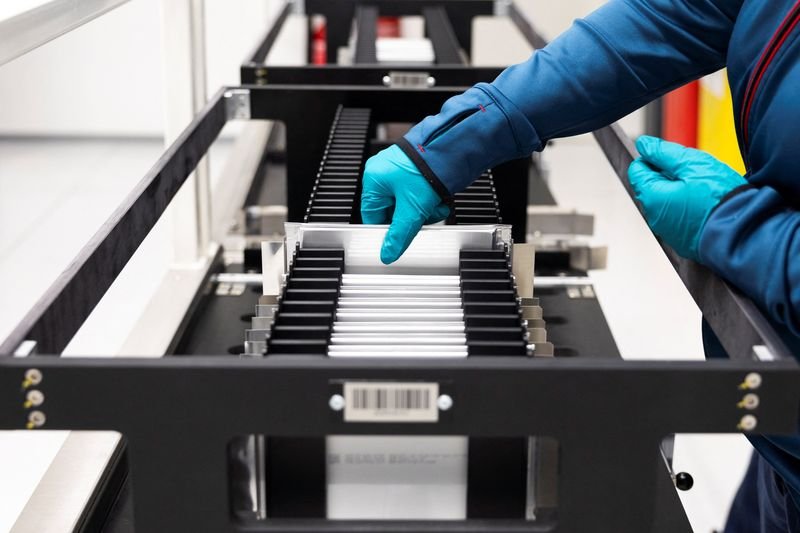
By Philip Blenkinsop
BRUSSELS, March 2 (Reuters) – Scaling up production in Europe could cut the cost gap between EU-made batteries and those coming from China to around 30% from a current 90%, transport and environment campaign group T&E said in a report on Monday, and it urged the EU to support the sector with its “Made in Europe” plans.
The EU executive is set to propose its “Industrial Accelerator Act” on Wednesday, with requirements to prioritise locally manufactured products when public money is used. It is designed to cover “key strategic sectors” including batteries, solar and wind energy, hydrogen manufacturing, nuclear power and electric vehicles.
Some automakers have said local content requirements would make batteries prohibitively expensive and undermine their models’ competitiveness.
T&E’s report said that improved manufacturing efficiency, notably through lower scrap rates as well as labour know-how and automation could reduce the cost gap to $14 per kilowatt-hour in 2030 from a potential $41.
This would equate to a gap for an average electric vehicle of 500 euros ($590), which could be even less with public incentives or be treated as an insurance premium against the sort of export restrictions China has already placed on critical minerals and rare earths.
“Europe needs a domestic battery industry as an insurance policy against its supply chains being weaponised. Local content requirements are the only policy on the table to avoid another Northvolt. The cost of Made-in-EU rules is a sovereignty premium worth paying,” said Julia Poliscanova, T&E’s senior director for vehicles & e-mobility supply chains.
The cost gap would only narrow if EU local content requirements allowed companies such as ACC, Powerco, Verkor to scale up production.
The Made in Europe plan should spell out that public support schemes explicitly include EV tax rebates for EV owners as well as for employers and employees in corporate car schemes, T&E said.
($1 = 0.8464 euros)
(Reporting by Philip Blenkinsop; Editing by Hugh Lawson)