dailynewsnblog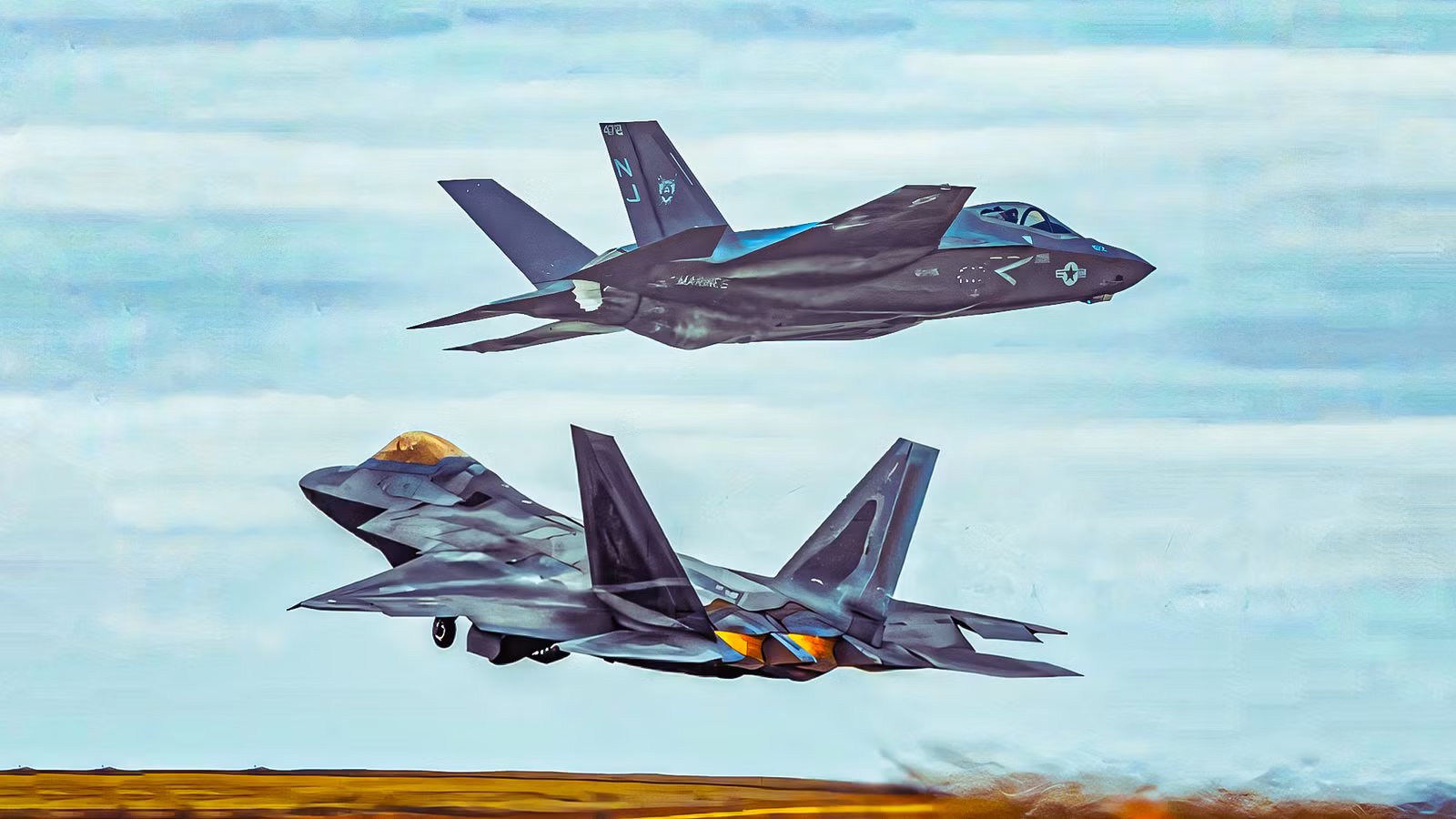
At the beginning of the 21st century, these are among the most advanced fighter jets ever built: the F-22 Raptor and the F-35 Lightning II, both created by Lockheed Martin. On paper, they share a lot: stealth, supersonic performance, and cutting-edge avionics, but once you jump into the cockpit, you quickly discover that they inhabit very different worlds. For pilots, the difference is what they see, feel, and control in the heat of flight.
In our article, we’ll explore those differences in depth, focusing on cockpit designs, control philosophies, advanced helmet systems, and the F-35B’s unique vertical landing capability, which mainly differentiates it from the F-22. Whether you’re an aviation geek, a fellow pilot, or just curious about what it takes to operate these modern warbirds, we will take you inside the jet seats and into the minds of those who fly them.
Two Fifth-Generation Fighters, Two Distinct Philosophies

At first glance, line-ups of the F-22 and F-35 look more like siblings than competitors: both are sleek, stealthy, fifth-generation fighters designed by Lockheed Martin. Both incorporate advanced avionics, sensor fusion, and high-performance engines. Yet scratch below the surface and it becomes clear this comparison is more like cousins than twins — they were built for very different missions, and that difference extends straight to the pilot’s experience inside the cockpit.
The F-22 Raptor was designed primarily as a pure air superiority fighter. Born out of the United States Air Force’s Advanced Tactical Fighter program in the 1980s, the Raptor prioritized high speed, agility, and stealth to dominate enemy combat airspace. Its twin engines, thrust-vectoring nozzles, and high-G capability support rapid engagements and tactical dogfights at extreme performance envelopes. Its sensor architecture and avionics package were built to provide pilots with razor-sharp information for threat engagement and energy management.
By contrast, the F-35 Lightning II came from the Joint Strike Fighter program, conceived as a global, multi-service solution that could do it all: strike ground targets, perform air-to-air combat, gather intelligence, and operate from land bases and aircraft carriers, and even allow vertical landings in its B variant. It is flown by the US Air Force, the Marine Corps, the Navy, and the air forces of dozens of other countries. With a central philosophy around sensor fusion that integrates data from radar, cameras, and network links into a single tactical picture, the Lightning II functions as a networked combat node in addition to being a fighter jet.
These philosophical differences, such as pure air dominance versus multirole networked combat, lead directly to diverging cockpit layouts and control experiences, shaping how pilots think and operate from the moment they strap in.
Cockpit Designs: Tradition Meets Next-Gen Integration

The first step for any pilot to understand a fighter is to inspect its instrument panel — and the difference between the F-22 and F-35 cockpits is immediately noticeable.
In the F-22 cockpit, pilots are greeted with a conventional glass cockpit that was extremely advanced at its introduction in the 1990s. Six-color multifunction displays show airspeed, altitude, tactical maps, weapon status, navigation, and radar information. A broad head-up display (HUD) projects critical flight and targeting information in front of the pilot, allowing eyes-forward flying at high speed. The Raptor also uses a Hands-On Throttle And Stick (HOTAS) layout — meaning the controls for weapons and radar are integrated directly into the throttle and stick to reduce the need to look away.
Importantly, the F-22 was originally planned to use a helmet-mounted display, but its fielding was delayed due to development risks and costs, meaning many Raptors fly without the helmet system widely used on later fighters.
The F-35 cockpit is a much bolder departure. At its center is a massive 20-by-8-inch panoramic touchscreen display called the panoramic cockpit display (PCD). Instead of spreading data across multiple small screens, the F-35 consolidates it into a single, reconfigurable panel that pilots can customize via touch. Traditional HUDs are completely absent: all flight, sensor, and targeting information is projected directly to the pilot’s helmet through its Helmet Mounted Display System (HMDS).
This helmet replaces the physical HUD, overlaying symbology such as altitude, heading, weapon cues, and targeting reticles onto the pilot’s visor — essentially letting the pilot “see through” the aircraft using imagery from the Distributed Aperture System’s infrared cameras. This fusion of sensor data with helmet-based visuals is a leap beyond what previous fighters offered.
Cockpit Control Comparison
|
Feature |
F-22 Raptor |
F-35 Lightning II |
|
Primary Display |
Multiple LCD panels & Analog HUD |
20” panoramic touchscreen + HMDS |
|
Heads-Up Display |
Yes |
None; replaced by helmet |
|
Sensor Fusion |
Moderate |
Highly integrated |
|
HOTAS Controls |
Yes |
Yes |
|
Helmet System Integration |
Optional |
Standard and fundamental |
|
Voice Recognition |
No |
Supported (DVI) |
Sources: Lockheed Martin, US Air Force, JSF.mil
Pilots often describe the F-22 cockpit as a refined evolution of traditional design: displays and switches in their classic places, intuitive but physical. The F-35 cockpit, on the other hand, feels closer to a highly advanced tech workstation — information-rich, customizable, and fundamentally oriented around automation and decision support rather than purely manual control.
This fundamental divergence shapes everything a pilot does — from scanning the horizon to tracking threats and managing weapons.

Seven Fighter Jets That Might Rival The F-22 Raptor’s Air Superiority
The F-35 is the closest rival to the F-22 while sixth-generation fighters are underdevelopment that could supersede it.
The F-22: Pilot Authority Through Precise Controls

For pilots who grew up flying classic fighters, the F-22 cockpit feels more familiar — except that everything it presents is amplified by modern computation and stealth integration. The Raptor’s design puts a premium on control consistency and tactile feedback. Pilots sit with HOTAS throttles and stick controls, allowing them to manage radar modes, targeting cues, and weapon assignments without leaving the throttle or stick. While the displays provide necessary information, the pilot is required to actively mesh it together — a conscious tactical process that rewards experience and situational awareness.
The HUD remains a central anchor for flight and combat data. Critical flight cues such as altitude, airspeed, and angle of attack live in the pilot’s forward view, with tactical symbology layered on top during engagements. The navigation and weapons systems are accessible through multifunction displays below, but pilots must shift their gaze and cognitive focus — a balance between precision and mental workload.
As reported by the Fly A Jet Fighter, pilots highlight the Raptor’s responsive handling, owed in large part to its thrust-vectoring nozzles and carefully tuned fly-by-wire flight control laws. Combined with the intuitive placement of switches and displays, the F-22 gives pilots confidence in the aircraft’s responsiveness in highly dynamic air-to-air engagements. Unlike the F-35, the Raptor doesn’t attempt to automate as much decision logic; instead, it presents raw data and lets the pilot act on it.
This means the Raptor cockpit feels like a pilot’s instrument panel — a cockpit designed around a human at the center of tactical decision loops. For pilots trained in older jets like the F-15 or F-16, the transition to the Raptor often feels like an intuitive enhancement rather than a complete re-education.
The F-35: Data Fusion And Situational Awareness Redefined

The F-35 cockpit represents a form of system-assisted decision-making closer to classic pilot control than to pure automation. Here, the aircraft doesn’t just show data — it interprets and pre-packages it for the pilot, integrating sensor tracks, threat information, navigation data, and weapons status into a unified tactical picture.
Central to this experience is the Helmet Mounted Display System (HMDS). Built by Collins Aerospace (formerly Rockwell Collins) and Elbit Systems, the HMDS replaces the need for a physical HUD and projects all critical information onto the pilot’s visor. The system also incorporates imagery from the aircraft’s six infrared sensors — known as the Distributed Aperture System (DAS) — allowing pilots to see 360° around the jet.
What this means in practical terms is profound: instead of scanning multiple screens and mental maps, the pilot can look at a target and have the aircraft’s systems respond. As reported by Military Aerospace, targets can be designated by looking at them: the helmet tracks gaze direction and links it to weapon cueing, enabling high-off-boresight missile engagements that would be impossible with a traditional HUD alone.
This sensory fusion drastically reduces cognitive load and expands situational awareness. In high-intensity environments where threats can appear from any direction, the ability to “see through” the airframe and get an integrated threat picture fundamentally changes how pilots engage.
Critically, these systems are software-centric. Pilots interact through touchscreens, voice recognition, and dynamic symbology that can be configured for mission types, such as ground attack, air-to-air, or ISR roles, making the F-35 truly a mission-adaptable cockpit.

Why The F-35 Is The US Air Force’s Most Important Fighter Jet
Discover why the F-35 is the US Air Force’s most critical fighter — from stealth and sensors to strategy, readiness, and future upgrades
VTOL: The F-35B’s Unique Game-Changer

One of the most visible operational differences between the F-35 and the F-22 is not only the F-35’s cockpit layout but also its vertical capability. But only one member of the Lightning II family possesses STOVL (short takeoff and vertical landing) ability: the F-35B. This capability allows the aircraft to operate from very short runways, expeditionary bases, and amphibious assault ships. This flexibility is unmatched by the F-22 or most other modern fighters.
The concept of vertical or near-vertical flight isn’t new. In fact, the iconic Hawker Siddeley Harrier Jump Jet pioneered operational VTOL flight decades earlier, enabling aircraft to hover, land, and take off from unprepared fields or small ship decks. The Harrier used vectored thrust from swiveling exhaust nozzles to achieve this capability — but it lacked the stealth and supersonic performance of modern jets.
The F-35B’s approach is more sophisticated. Behind the cockpit sits the shaft-driven lift fan — a small vertical fan driven by the jet’s main engine via a clutch and shaft system. When switching to vertical mode, doors open to expose the lift fan, and a swiveling rear nozzle directs thrust downward. Together with roll posts in the wings for balance, these components allow the aircraft to hover and land vertically with precision, as described by the Engineer Live.
From the pilot’s perspective, STOVL operations aren’t simply “hovering.” They involve real-time control of lift systems, careful throttle modulation, and intense situational awareness due to proximity to ships, terrain, or other obstacles. The aircraft’s software assists piloting inputs, but the pilot must manage energy, position, and mission priorities — a blend of helicopter-like finesse and jet-fighter precision.
This capability traces a direct lineage back to the Harrier’s pioneering work — but integrated into a fighter with stealth, modern avionics, and supersonic performance. It’s a testament to how far aviation technology has come: an aircraft that can hover like a rotorcraft one minute and dive-bomb a target at Mach 1.6 the next, all while projecting a battlefield network picture.
Two Fighter Cockpits, Two Combat Mindsets

Despite similar fifth-generation bones, each aircraft’s core is different. The F-22 embodies pilot authority. It’s about mastery of flight dynamics, precision in maneuvering, and conscious tactical decision-making. It rewards pilots who have honed their instinctive scanning and control skills over years of training.
The F-35 represents the next wave: decision support and integrated awareness. It reduces workload through sensor fusion and an advanced, futuristic helmet system, allowing pilots to focus on what they need to do rather than on where to find the data. This shift reflects the increasing complexity of modern combat environments and the need to act quickly on fused sensor intelligence.
Neither approach is better since they are designed for different missions. The Raptor’s cockpit emphasizes traditional pilot control and sharp tactical awareness. The Lightning II’s cockpit uses computing power to make complex information easier to understand and act on. Both focus on keeping the pilot at the center of a more complicated battlespace, whether through tactile control or immersive, data-rich visualization.