dailynewsnblog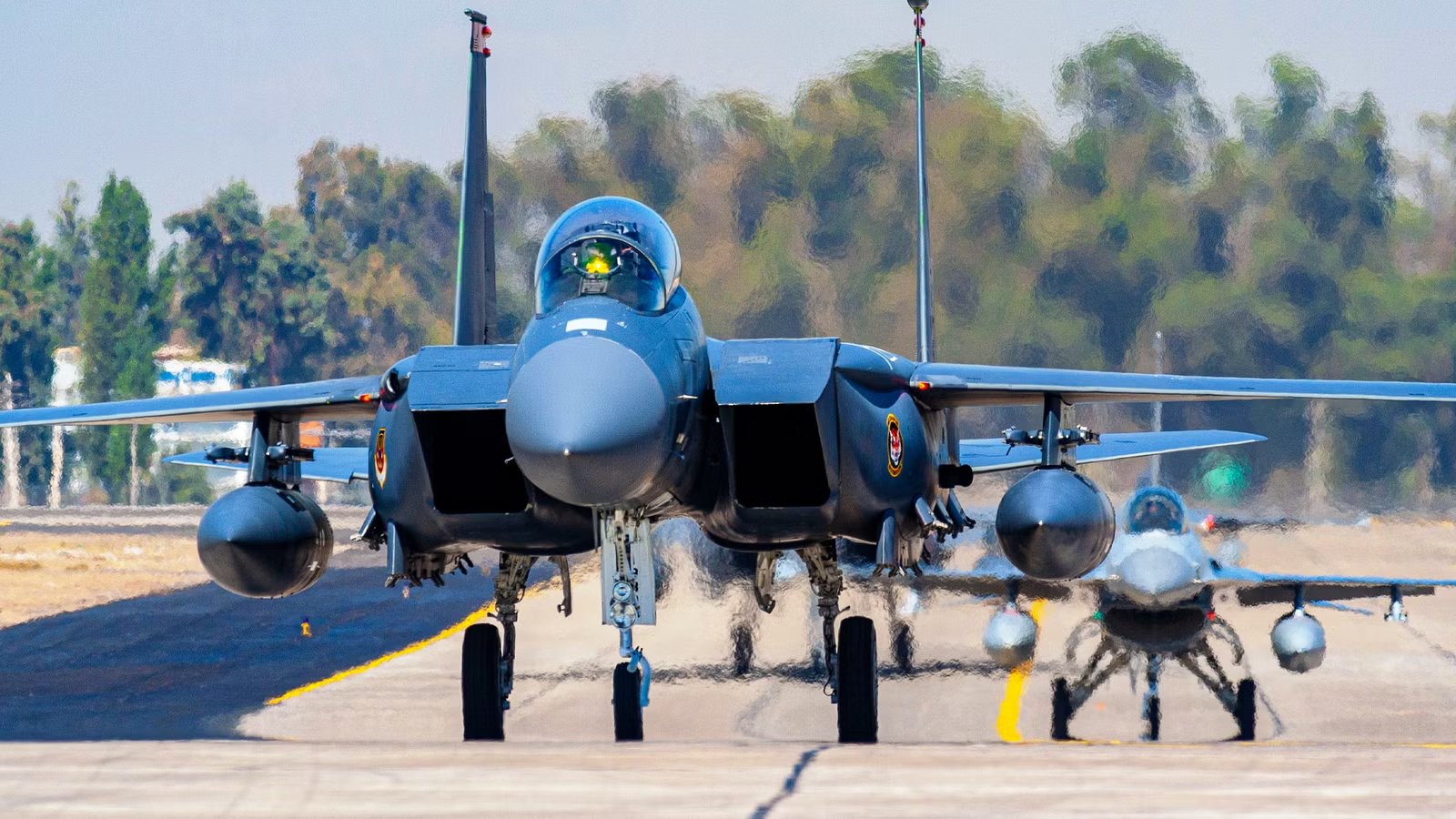
The McDonnell Douglas F-15 Eagle was born in the heat of the Cold War, designed for a single overriding purpose: to win air superiority at any cost. More than 50 years after its first flight in 1972, the F-15 is still flying and is still being built. As we live in an era of stealth fighters and unmanned systems, that fact alone raises an important question: how has a 1970s fighter remained so relevant in the modern era?
We will explore the full story of the F-15, from its origins dating back to the Vietnam War and the Cold War arms race to its first operational variants, global exports, combat record, and the sweeping upgrades that have kept it at the cutting edge. Along the way, we will examine how the Eagle evolved into a multirole strike platform, how international operators customized it for their own needs, and why the newest variant, the  Boeing F-15EX, may extend its service life well into the 2040s.
The Origins Of The Eagle: Lessons From Vietnam And The FX Program

The F-15’s story begins with a concern. During the early years of the Vietnam War, American air planners were forced to confront uncomfortable realities. Aircraft like the McDonnell Douglas F-4 Phantom II were fast and powerful, but they had been designed under the assumption that beyond-visual-range missiles would make dogfighting obsolete. Reality proved otherwise: encounters with agile Soviet-designed MiG fighters revealed weaknesses in training, tactics, and aircraft design.
The concerns of the United States Air Force (USAF) deepened in the late 1960s, after unsettling intelligence assessments about the Soviet Union’s new Mikoyan Gurevich MiG-25 Foxbat. Early estimates suggested a fast, high-flying interceptor that could outmatch existing Western fighters, adding urgency to the demand for a purpose-built air superiority platform.
The USAF’s Fighter Experimental (FX) program sought something radically different from the multirole compromise of the F-4 Phantom II. The new aircraft would prioritize climb rate, acceleration, radar power, and maneuverability above all else. When McDonnell Douglas won the contract in 1969, the blueprint for the modern air superiority fighter was drawn: twin engines for redundancy and thrust, a large wing for lift, and a powerful pulse-Doppler radar to detect and engage targets beyond visual range.
From the beginning, the design philosophy was clear: give the pilot the advantage in every measurable way. Twin Pratt & Whitney F100 engines delivered a thrust-to-weight ratio greater than 1:1 in certain configurations, meaning the aircraft could accelerate while climbing vertically, and reach a top speed around Mach 2.5. A large wing area provided lift and agility, and a powerful radar enabled long-range detection and engagement. The Eagle was built to out-climb, out-accelerate, and out-turn most contemporaries. That “overbuilt” philosophy is the reason modern F-15EX aircraft can integrate AESA radars, digital fly-by-wire systems, and hypersonic weapons half a century later.
First Variants: The F-15A/B Air Superiority Proven In Europe And The Middle East

The initial production variants, the F-15A (single-seat) and F-15B (two-seat trainer), entered US Air Force service in 1976. These early Eagles were pure air superiority fighters. Their mission was simple: intercept and destroy enemy aircraft before they could threaten friendly forces. The aircraft’s AN/APG-63 radar was revolutionary for its time and introduced true look-down/shoot-down capability, allowing engagement of low-flying targets against ground clutter. Combined with AIM-7 Sparrow and AIM-9 Sidewinder missiles, the F-15 gave pilots an extraordinary combination of detection range and maneuverability. Its large canopy offered exceptional visibility, a crucial factor in close-in combat.
In exercises such as Red Flag, the Eagle quickly proved its worth. Pilots reported extraordinary acceleration and climb performance. Perhaps most impressively, the aircraft’s design allowed it to sustain high-G maneuvering without significant energy loss, something that had plagued earlier fighters. The aircraft’s real-world combat debut came not with the US Air Force, but with Israel. Exported F-15As delivered to the Israeli Air Force in 1976 quickly saw real combat, primarily against Syrian aircraft operating over Lebanon and the Bekaa Valley. During the late 1970s and especially in the 1982 Lebanon War (Operation Mole Cricket 19), Israeli Eagles engaged and shot down Syrian-operated Soviet-built fighters, including the MiG-21 Fishbed and the newer MiG-23 Flogger.
In the air battles of June 1982 alone, Israeli F-15s and F-16s collectively downed more than 80 Syrian aircraft over several days without suffering air-to-air losses. The F-15 was responsible for a significant portion of those kills, with engagements involving both AIM-7 Sparrow beyond-visual-range missiles and AIM-9 Sidewinders in close combat. Syrian pilots flying MiG-21MFs and MiG-23MS/ML variants faced opponents with superior radar, situational awareness, and missile integration, advantages that proved decisive. The F-15A also has a curious first moment. It is the only aircraft to ever shoot down a satellite: on September 13, 1985, an F-15A received the task of destroying an inactive US satellite, the Solwind P78-1. Equipped with a dedicated ASM-135 ASAT missile, the aircraft reached 38,000 feet, and after reaching supersonic speed, it successfully launched the missile, intercepting the satellite at 345 miles altitude.

Why Is The US Air Force So Reliant On Stealth Technology?
The US Air Force relies on stealth to survive modern defenses, evolving from Cold War lessons as speed, altitude, and numbers became insufficient.
Evolution Into Multirole: The F-15C/D And The Game-Changing F-15E Strike Eagle

Even though the original Eagle was purpose-built for air superiority, evolving strategic demands in the late 1970s drove substantial upgrades that produced the F-15C and F-15D. Introduced in 1979, these variants featured increased internal fuel capacity, improved radar processing, upgraded electronic warfare systems, and provisions for conformal fuel tanks. For the US Air Force units based in Europe, including the 36th Tactical Fighter Wing at Bitburg and the 48th Tactical Fighter Wing at RAF Lakenheath, the F-15C became the backbone of NATO air defense during the Cold War’s most tense years. They scrambled regularly, intercepting and escorting Soviet Tupolev Tu-95 Bear bombers approaching NATO airspace. Thanks to the high-level training, the pilots were constantly ready for high-speed intercept and beyond-visual-range engagements, contributing to building the Eagle’s reputation for dominance long before its first shots were fired in combat.
The structural strength built into the Eagle also became legendary. In 1983, an Israeli F-15C airframe derivative survived a midair collision with an A-4 Skyhawk that tore away nearly its entire right wing. By maintaining high speed and applying full power, the pilot generated sufficient lift from the fuselage and remaining wing to land safely, a dramatic illustration of just how much aerodynamic and structural margin the design possessed.
The F-15C would go on to become the backbone of US air superiority for decades. During Operation Desert Storm in 1991, F-15Cs were credited with more than 30 of the 36 USAF air-to-air victories scored in the conflict, engaging Iraqi MiG-29s, MiG-25s, MiG-23s, and Dassault Mirage F1s. Their AN/APG-63 radar, AIM-7 Sparrow, and AIM-9 Sidewinder integration, later augmented by the AIM-120 AMRAAM, were combined with rigorous pilot training to deliver overwhelming dominance. Across all operators, the F-15 family has accumulated more than 100 confirmed air-to-air victories with no confirmed losses in aerial combat, a record unmatched by any contemporary Western fighter.
However, the most consequential transformation of the Eagle came with the F-15E Strike Eagle. Developed in the 1980s and entering service in 1989, the F-15E was designed as a dual-role fighter capable of deep interdiction missions while retaining full air-to-air capability. Equipped with conformal fuel tanks, a strengthened airframe, advanced navigation and targeting pods such as LANTIRN, and a dedicated weapons systems officer in the rear cockpit, the Strike Eagle could carry more than 23,000 pounds of ordnance over long distances at high speed. It proved decisive during the Gulf War, conducting precision strikes against Scud missile sites, airfields, and strategic infrastructure. In one notable engagement during Desert Storm, an F-15E scored an unusual air-to-air kill by dropping a laser-guided GBU-10 bomb on an Iraqi Mil Mi-24 Hind helicopter; the crew initially designated the Hind as a ground target, but as it began to lift off, the laser designation was maintained and the bomb tracked it in flight, destroying the helicopter, a rare demonstration of precision munition flexibility.
Unlike stealth aircraft optimized primarily for penetrating heavily defended airspace on the first night of war, the Strike Eagle excels at sustained operations, heavy payload delivery, and persistent strike missions, a role that remains vital in modern air campaigns, and each redeployment of them still makes headlines.
Global Reach: Export Variants And International Customization

One of the most remarkable aspects of the F-15’s longevity is its global adaptability. Over time, the Eagle has been exported to multiple nations, each adapting it to specific strategic needs. The Eagle evolved into distinct branches tailored to national doctrine and regional threats. Broadly, international operators fall into three categories: air-superiority derivatives of the original F-15A/C design, strike-optimized variants derived from the F-15E, and the newest “Advanced Eagle” generation incorporating digital flight controls and next-generation avionics.
The first category includes early air-defense operators such as Japan and Israel. Japan’s F-15J, license-built by Mitsubishi, is closely aligned with the original F-15C configuration and remains focused on homeland air defense and intercept missions. As we already saw, Israel’s F-15A/B/C/D “Baz” aircraft earned significant combat credibility in Middle Eastern conflicts, while later upgrades kept them viable decades beyond their initial delivery. These aircraft reflect the Eagle’s original purpose: long-range interception and air superiority.
The second and third categories stem from the Strike Eagle lineage. Israel’s F-15I “Ra’am,” South Korea’s F-15K, and Singapore’s F-15SG are deep-strike variants derived from the F-15E, optimized for long-range precision attack while retaining air-to-air capability. Saudi Arabia’s F-15SA and Qatar’s F-15QA represent a further evolution, the so-called “Advanced Eagle.” These aircraft incorporate digital fly-by-wire controls, active electronically scanned array (AESA) radars, modern electronic warfare suites, and large-area cockpit displays. In many respects, these export versions introduced technologies that later informed the US F-15EX, illustrating how international customization helped drive the platform’s continued modernization.

How Many Lockheed F-104 Starfighters Were Built?
Discover the verified production total and how NATO exports shaped this Cold War fighter’s legacy.
Modernization And The F-15EX: A 1970s Airframe For A 21st-Century Fight

When the Lockheed MartinF-22 Raptor and Lockheed Martin F-35 Lightning II began redefining air combat with stealth and sensor fusion, the F-15 faced an obvious question: what role remains for a fourth-generation heavyweight? The answer emerged from a simple reality. The Eagle’s large airframe, powerful engines, and structural margins still offered something uniquely valuable — range, payload, and upgrade capacity. Instead of retiring, the platform evolved once again.
The result is the F-15EX Eagle II. Produced by Boeing following its 1997 merger with McDonnell Douglas, the EX blends proven aerodynamics with contemporary systems: digital fly-by-wire controls, an open mission systems backbone, the APG-82 AESA radar, and the Eagle Passive/Active Warning and Survivability System (EPAWSS). Its redesigned structure is rated for 20,000 flight hours, roughly double that of many legacy F-15C airframes. Payload remains its calling card: up to 29,500 pounds of ordnance and configurations carrying as many as 12 air-to-air missiles, giving commanders the quantity that stealth fighters cannot provide.
In operational terms, the F-15EX slots directly into modern air combat concepts. Stealth aircraft push forward, detect and classify threats, and transmit targeting data through secure networks. The EX carries the weight: up to a dozen AIM-120-class missiles, future AIM-260s, or large standoff weapons such as the AGM-158 JASSM. With its range and 20,000-hour service life, it can remain on station longer than aging F-15Cs while bringing significantly greater missile capacity to the fight. That combination of sensors from one platform and weapons from another reflects how contemporary air forces plan to fight high-end wars. The modern Eagle is a high-capacity weapons carrier needed for the 21st century wars.
Why The F-15 Still Matters: Design Philosophy, Flexibility, And The Future

So why does a design born in the early 1970s remain relevant today? The answer lies in fundamentals. The F-15 was built with performance margins, such as power, payload, and structural strength, that eventually allowed room for growth. Its twin-engine configuration offers redundancy and reliability. Its large airframe accommodates new sensors and systems that smaller fighters cannot easily integrate. In 2026, considering just the USAF, there are still 42 combat-coded F-15C/Ds, 133 F-15Es, and 27 F-15EXs in service.
Operationally, the Eagle has accumulated an extraordinary combat record. Across multiple operators, it is often cited as having more than 100 air-to-air victories with no confirmed losses in aerial combat. That reputation carries weight, both in history books and in 21st century deterrence planning.
The F-15’s story is far from over. With production lines still active and new export customers emerging, the Eagle demonstrates that relevance is not solely defined by stealth or novelty. Sometimes, enduring excellence comes from a design so fundamentally sound that it can evolve with the times.