dailynewsnblog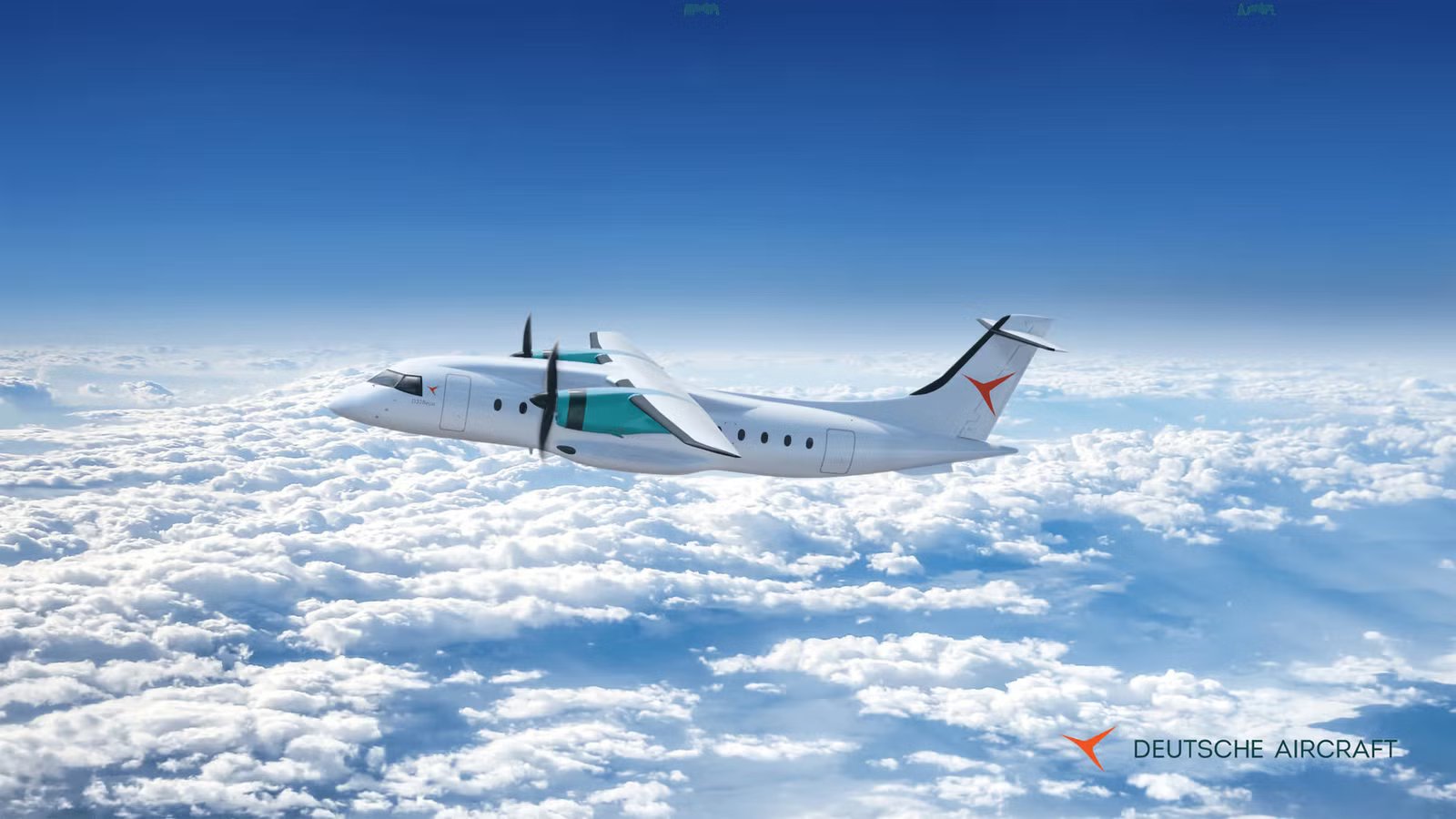
First conceived by the legendary Claude Dornier, the original Dornier 328 entered service in 1993. Even three decades later, approximately 150 of these aircraft remain in service globally. Today, under the leadership of Chief Engineer Thomas Ahn, himself once part of the original 328 team, Deutsche Aircraft is reclaiming that legacy with a bold vision to blend heritage, innovation, and efficiency into a new regional workhorse.
Built in Oberpfaffenhofen, just outside Munich, the D328eco is being designed not only for performance but with sustainability at its core. It will be capable of operating on 100% SAF and engineered using the newest tools in digital design and systems integration. The programme isn’t just about building an aircraft: rather, it’s about reestablishing a full Germany aircraft-manufacturing capability, where craftsmanship, modern technology, and environmental responsibility come together.
Build On Solid Roots: The Original Dornier D328

The original Dornier 328 was a twin-turboprop regional aircraft developed by Dornier Luftfahrt GmbH in the late 1980s and first flew in 1991. Designed to compete in the 30-seat regional market, it stood out for its sleek, jet-like fuselage, high cruising speed, and short takeoff and landing performance. At a time when many regional aircraft were slow and utilitarian, the Dornier 328 offered a higher level of passenger comfort, pressurization, and speed, which allowed it to operate more efficiently on short-haul routes.
Its advanced aerodynamics and systems, including a digital glass cockpit, were ahead of their time for a turboprop in this category. The D328’s design focused heavily on operating from shorter runways and under challenging conditions, making it popular among regional carriers serving remote or less-developed airfields. It was also praised for its reliability and versatility, with configurations available for passenger, cargo, and even military roles. Despite these strengths, the aircraft entered a highly competitive market.
As such, economic challenges and limited production capacity at Dornier led to only around 220 units being produced before the program was sold and later absorbed into Fairchild Dornier. About 110 of these were examples of the D328JET variant, based on the same airframe but utilizing an alternate power source to the original turboprop. Though its production run was relatively short, the Dornier 328 left a lasting mark.
Indeed, its combination of performance, efficiency, and comfort earned it a loyal following, and many are still in service today, particularly in Europe and North America. Over the years, its unique capabilities kept it relevant even as newer regional jets entered the market. The aircraft’s robust engineering and potential for modernization laid the groundwork for its current revival as the D328eco, a next-generation evolution being developed by Deutsche Aircraft.
Who Is Deutsche Aircraft?

Deutsche Aircraft is a German aircraft manufacturer building on over a century of aviation heritage, especially that of Dornier Flugzeugwerke. The company has taken over the type certificate rights for the Dornier 328 and is developing the D328eco.
It highlights through its website that the original D328 is certified in 85 countries and more than 150 aircraft remain in service globally, across passenger, special mission, cargo, search & rescue, and emergency roles.
|
Deutsche Aircraft’s Metrics |
Details (Per Deutsche Aircraft) |
|---|---|
|
Purpose / Mission |
Developing the most advanced, energy-efficient, and cost‑effective 40‑seater regional turboprop: the D328eco. |
|
Heritage |
Built on the legacy of Dornier Flugzeugwerke, Deutsche Aircraft took over the Type Certificate rights for the Dornier 328 platform. |
|
Current Product |
The D328eco is being developed. |
|
Existing Fleet / Platform |
The Dornier 328 was manufactured in the 1990s/early 2000s, and certified in 85 countries, with over 150 in service globally. |
|
Applications & Roles |
The D328 platform is used in commercial service and for special missions, including air ambulance, SAR, cargo, and firefighting. |
|
Values / Culture |
Sustainability, Collaboration, Openness, Respect, Excellence (rooted in German engineering/design quality). |
|
Scale / Team Composition |
Over 550 aviation experts, from 40 nationalities. |
Deutsche Aircraft also maintains global support for existing D328 operators. The firm’s organizational values include sustainability, collaboration, openness, respect, and excellence, reflecting both a modern mindset and the quality craftsmanship associated with German aviation. It aims to help push the aviation industry toward near-zero emissions by collaborating with other industry players, utilizing the latest technologies, and ensuring the D328eco meets high standards of reliability, versatility, and comfort.
The New Kid On The Block

The D328eco is a next‑generation 40‑seat regional turboprop under development by Deutsche Aircraft, designed to offer modern efficiency, sustainability, and versatility. It retains the high‑wing, rugged design heritage of the original Dornier 328, but is stretched by about 2m (to a fuselage length of 23.3 m) to accommodate more passengers and improve payload. It will be powered by Pratt & Whitney Canada PW127XT‑S engines and promises various improvements.
These include lower fuel consumption per passenger, extended maintenance intervals, and superior climb, cruise, and service ceiling performance. A key feature of the D328eco is its strong environmental credentials and operational flexibility, as it is Sustainable Aviation Fuel compatible, with claims of up to 95% CO₂ emissions reduction when using SAF‑PtL compared to conventional fuel.
The aircraft is also engineered for short takeoff and landing capabilities, unpaved runway operations, and steep approaches, which expand the number of airports it can serve, including those in remote or constrained environments. In terms of performance and passenger experience, the D328eco aims to combine comfort with efficiency. It has a nominal cruise speed of about 324 knots.
The aircraft also boasts a service ceiling of 30,000 feet, and range figures that cover over 98% of current turboprop flight missions and around 95% of regional jet missions in terms of distance. Its cabin is designed to offer a “mainline passenger experience” with a modern, quiet interior, generous overhead luggage space, stand‑up aisle, ergonomic seats, and faster turnarounds thanks to simplified boarding and servicing features.
Old Versus New

The Dornier 328 turboprop and the newer D328eco share the same design lineage, but they differ significantly in performance, capacity, and sustainability. The original D328, introduced in the early 1990s, was renowned for its exceptional short-field performance, high cruising altitude (up to 31,000 feet), and reliable Pratt and Whitney PW119 engines. It typically carried around 30 to 33 passengers and was praised for its rugged airfield capability.
However, it lacked modern avionics, had higher fuel consumption, and was not optimized for today’s sustainability standards. In contrast, the D328eco is a thoroughly modernized version, developed with current and future regional aviation needs in mind. It features a stretched fuselage to accommodate 40 passengers, more powerful and fuel-efficient Pratt and Whitney PW127XT-S engines, and a state-of-the-art Garmin G5000 cockpit.
|
Specifications |
Original Dornier 328 Turboprop |
D328eco |
|---|---|---|
|
Passenger capacity |
30–33 seats |
40 seats |
|
Length |
69 feet and three inches (21.11m) |
76 feet and five inches (23.31m) |
|
Wingspan / Height |
68 feet and ten inches (20.98m) |
68 feet and ten inches (20.98m) |
|
MTOW |
30,842 lbs (13,990 kg) |
34,524 lbs (15,660 kg) |
|
Take‑off field length |
3,000 feet+ (1,000m+) depending on load |
3,550 feet (1,082m) at MTOW, 2600ft (800m) at 70% load |
|
Landing field length |
3,600-4,000 feet (1,100–1,200m) |
3,200 feet (965m) at MLW |
|
Cruise speed |
310 KTAS |
324 KTAS max, 293 KTAS long‑range cruise |
|
Service ceiling |
31,000 feet |
30,000 feet |
While its service ceiling is slightly lower, at 30,000 feet, it offers superior short takeoff and landing capabilities, able to operate from 2600-foot (800-meter) runways under partial load, making it ideal for underserved regional routes. The aircraft also improves on range, climb rate, and payload capacity, while reducing fuel burn to around 480 kg/h at cruise, which translates to significant operating cost savings. Perhaps the most critical difference lies in environmental performance.
The D328eco is designed to run on 100% SAF and Power-to-Liquid fuels, offering up to a 95% reduction in CO₂ emissions. Compared to its predecessor, it emits 22% less CO₂ when running on standard Jet-A1 and benefits from up to 20% lower maintenance costs. This makes the D328eco not just a technical upgrade, but a strategically future-proof aircraft tailored for modern regional air transport, combining efficiency, sustainability, and short-field versatility.
D328MR: The D328eco’s Sibling

The D328MR (Multi-Role) is a flexible variant of the D328eco, tailored for a wide range of missions beyond regional passenger transport. It can be configured for roles such as medical evacuation, search and rescue, surveillance, cargo transport, paratroop drops, or VIP shuttle. Designed for operational flexibility, it supports rapid cabin reconfiguration, unpaved runway operations, and features options like a large cargo door and mission-specific systems.
In performance terms, the D328MR offers impressive endurance and mission adaptability. It can fly nearly 2,200 nautical miles in a medevac setup with eight patients and a full medical team, or remain airborne for over eight hours in surveillance roles. In a typical regional transport mode, it seats 40 passengers with a range of around 620 NM. The aircraft also supports extended time-on-station even at long offsets, making it well-suited for demanding government or humanitarian operations.
Built on the modernized D328eco platform, the D328MR benefits from lower emissions, compatibility with 100% sustainable aviation fuels, and a high target dispatch reliability. Its fuel-efficient engines and digital flight deck reduce lifecycle costs, while short takeoff and landing performance allow access to remote or underdeveloped airstrips. This combination of versatility, endurance, and sustainability makes the D328MR a capable and cost-effective multi-mission platform.
Proven Design Meets Tomorrow’s Demands

The Dornier 328 turboprop built a strong reputation for short-field performance, versatility, and reliability, serving both regional airlines and government operators. With seating for around 30 passengers and rugged capabilities, it was well-suited for challenging environments, but its older technology and fuel efficiency now limit its competitiveness.
The D328eco modernizes this proven platform with a stretched fuselage, 40-seat capacity, and advanced Pratt & Whitney engines. It offers improved fuel efficiency, lower emissions, and a fully digital cockpit, while maintaining short takeoff and landing performance. It’s also built to run on 100% sustainable aviation fuels, aligning with modern environmental standards.
Overall, the D328eco retains the core strengths of the original Dornier 328 while introducing key upgrades to meet modern operational and environmental demands. It offers a balanced mix of performance, efficiency, and sustainability within a familiar, proven design. While no firm orders have been announced yet and entry into service has been pushed to late 2027, the aircraft remains positioned as a forward-looking solution for the regional aviation market.