dailynewsnblog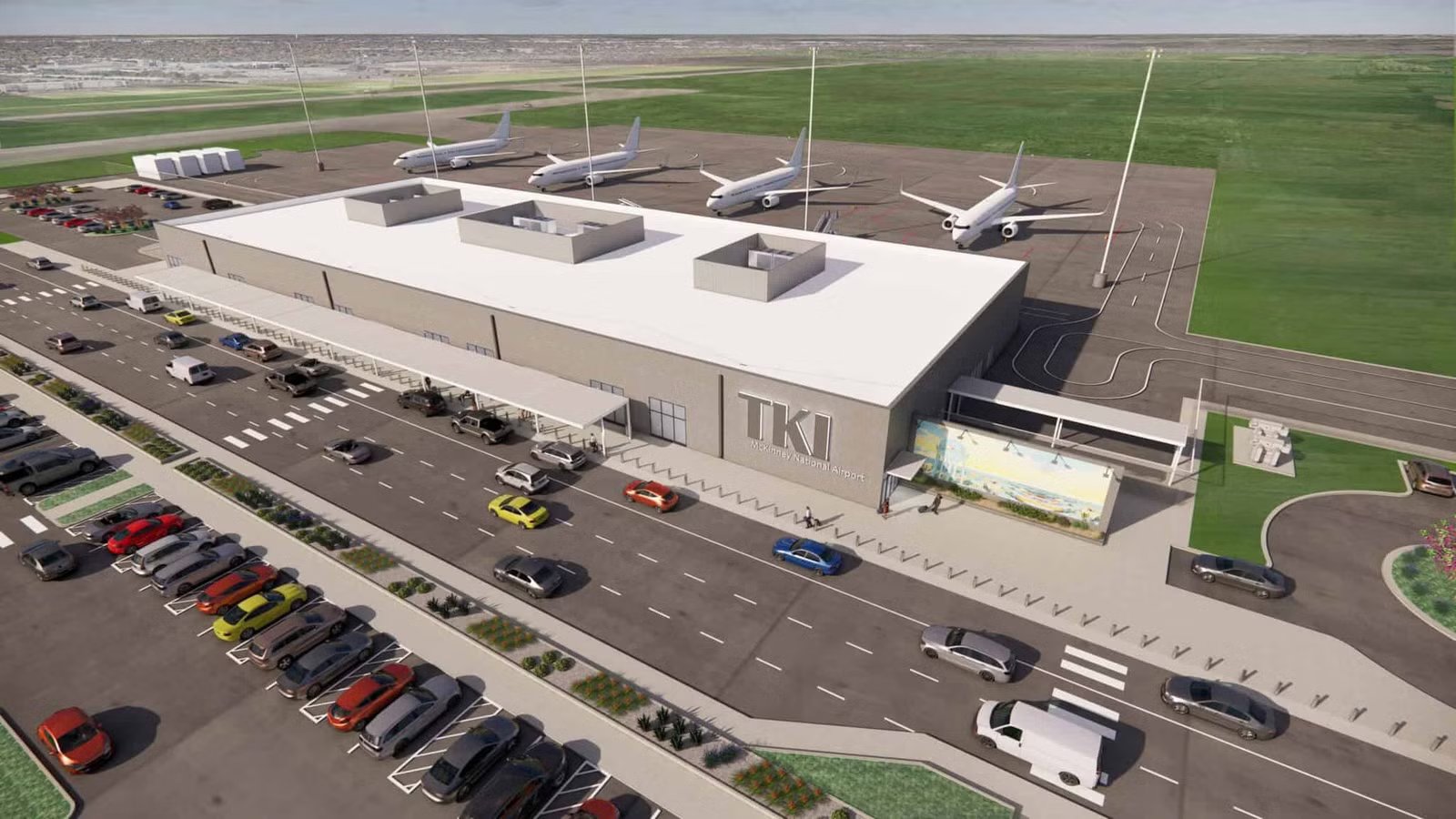
The Dallas-Fort Worth metroplex is one of the largest urban areas in the US, covering over 10,000 square miles and with nearly 10 million residents. And if you know anything about aviation, you know that it is served by two primary airports:  Dallas/Fort Worth International Airport (DFW), the megahub of
  American Airlines, and Dallas Love Field (DAL), where
  Southwest Airlines has a 98% market share. But not for much longer.
Dallas is about to get a third commercial airport in the form of McKinney National Airport (TKI). Sitting on the northern edge of the metroplex, in the heart of Collin County (amidst cities such as Richardson, Allen, Plano, and Frisco), TKI has been a general aviation facility for over 40 years. But it is currently undergoing a dramatic transformation to ready itself for commercial flights later this year.
Simple Flying sat down with Ken Carley, airport director at TKI, to discuss the latest developments and what to expect from the airport in the coming years. He confirmed that the development of the airfield remains on track for a commercial launch in November and is very buoyant about its prospects.
The Rationale For A Third Airport In Dallas

Carley says that the journey to become a commercial airport began in late 2018, when he “started getting calls from airlines wanting to explore what it might look like to operate out of here.” These airlines saw plenty of pent-up demand in North Texas, but had significant barriers to entry. Not only the high costs of established airports like DFW and DAL, but also the struggle to secure gates at facilities dominated by a single carrier.
So TKI began investigating whether the idea of commercial operations was even feasible, and if so, what was required to make it happen. It examined its primary and secondary catchment areas, defined by shorter driving distances compared to other airports, and discovered that it had an addressable market of over 2 million annual enplanements. And it found that while TKI already contributes over $300 million to the local community via general aviation, this would more than double with the signing of the first commercial airline.
Carley explains that these findings created a “perfect storm” to provide impetus for the establishment of commercial operations:
“We have a huge catchment area that is growing quickly and wants a convenient airport. The airlines know this, so we have strong demand from a good number of them that have been in constant contact with us throughout this journey. And then we had a city council that clearly understood the huge value to the community and the broader region, and was willing to make the investment to make this happen.”
The final piece of the puzzle was the creation of the commercial model. Carley explains that the costs of the new infrastructure are relatively low, and the airport was fortunate to be able to fund it with grants at the local level. So it doesn’t have the burden of a lot of capital debt to recover. This allows it to entice new airlines with a highly advantageous cost structure:
“It’s a performance-based model, so the more enplanements we have, the better the airlines and the airport do. Nothing complicated, like rents per square foot in the terminal building or exorbitant landing fees — we share the risks and the rewards. And that means operating costs are a fraction of what they are for an airline at DFW or Love.”
The Progress Made So Far

To facilitate commercial operations, TKI has embarked on the construction of a $72 million, 45,000 sq ft (4,200 m2) passenger terminal on the east side of the airport, as well as 1,500 parking spaces and rental car facilities. The terminal will start out with four gates, but inside, six passenger hold rooms are being constructed, so an additional two gates can be added with ease when demand dictates.
Carley says that construction is on track for a November opening, with all interior walls in place, all passenger parking lots constructed, and the aircraft apron nearly complete. The current focus is on mechanical, electrical, and plumbing installations inside the terminal, while simultaneously, construction has begun on the new parallel Taxiway C alongside the 7,000 ft (2,130 m) runway. And it’s important that TKI holds to that November deadline because it has already signed its first airline.
It was recently announced that Avelo Airlines will become the first tenant at the airport, signing a five-year agreement with plans to launch flights in November and ultimately make TKI its fifth base. While the airline’s routes have yet to be announced, Carley says he expects about three daily flights in the first year, growing to 7–8 daily flights and up to 450,000 annual enplanements by the third year. Which means that the airport needs to meet its goal of being ready by November:
“They [Avelo] want to have a couple of weeks of operations leading into the Thanksgiving holiday season to work the kinks out, and obviously we do too. So that’s what we’re pushing for, and honestly, from a construction standpoint I feel very good about it.”
However, Carley is very transparent about the factors outside his control, notably securing commitment from the TSA for personnel and equipment for checkpoints, as well as obtaining final FAA certification for scheduled passenger airline operations under 14 CFR Part 139. He says that TKI and Avelo will jointly decide over the summer whether the airport is still on track for its November timeline, and if not, it is likely the first flights would be pushed back to the Spring of 2027.

Avelo Airlines Cuts 29% Of Flights: Why Is The Budget Carrier Shrinking So Fast?
A combination of factors has led to the budget carrier cutting nearly a third of its network.
What Other Airlines Might Choose TKI?

While signing its first airline is a big achievement, adding more will be crucial to the success of TKI in its early years. Carley has said that an announcement of a second airline is expected within the next 90 days, and that talks are “advancing really well.” He added that the airport is in a “regular cadence” of discussions with three additional airlines that have also expressed interest in the airport. While he declined to disclose the name of the second airline due to confidentiality agreements, he described it as a nationally “well-known brand.”
So, which airlines might be a good fit for TKI? There are quite a few options:
-
Allegiant Air
: The leisure-focused budget carrier has no presence at either of the existing Dallas airports, so TKI would present a unique low-cost opportunity for it to connect North Texas with its base in Las Vegas and its six bases in Florida. -
Breeze Airways
: With only a single connection from DFW to Provo, TKI would likely be a far better fit for Breeze’s
Airbus A220
fleet, with possibilities for both eastward and westward expansion. -
JetBlue
: With only seasonal service from DFW to Boston and Fort Lauderdale, TKI would offer the New York-based carrier an opportunity to expand and increase frequency in the Dallas region. - Others: While Frontier Airlines and Spirit Airlines already have extensive operations at DFW, it is conceivable that they might be tempted to test the waters at TKI. Another potential candidate is Porter Airlines, which has been on a recent expansion drive.
Carley acknowledges that a lot will ride on the growth and success of the first few airlines and whether they can effectively tap into the pent-up demand in North Texas. But he is confident that when success comes, there is plenty of space for expansion:
“We have hundreds of acres on the east side of the airport for commercial expansion. So when the concept gets proven, and airlines show they can make a buck here, we can build the existing terminal out further. Or if an airline comes in and wants a whole new terminal, we have the space for that too.”
Which led this Atlanta-based writer to ponder whether his hometown airline, which once had a hub in Dallas but lacks a Texas hub today, and is not at all shy about building its own terminals, might be tempted to swoop in. It may be a pipe dream, given that concrete is still being poured on the first apron at TKI, but the fact that it is even conceivable shows how the sky is really the limit for the new third airport in Dallas.