dailynewsnblog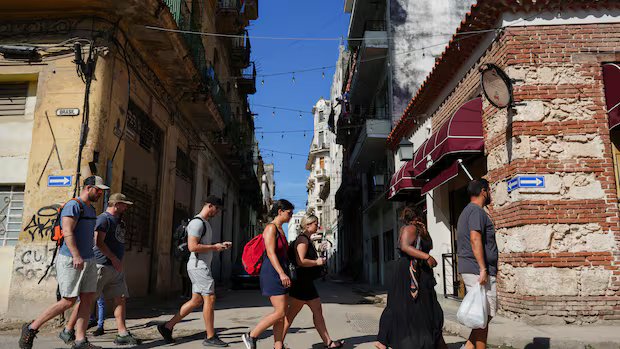
For decades, Cuba’s tourism sector has enjoyed a reputation as an “economic locomotive” — a term used by authorities who saw it as the lifeblood of the Caribbean island country’s economy.
But the industry has been in decline since its 2018 peak, and the U.S. government’s squeeze on Cuba’s oil supply has pushed the nation’s most crucial industry closer to its breaking point.
The Trump administration has threatened to impose tariffs on countries that supply fuel to Cuba — part of an effort to strangle the communist-run country after the fall of its close ally and main energy supplier, Venezuela, in January. As a result, Canadian, Russian and European airlines have suspended flights and resorts have shuttered, staunching the flow of international visitors.
Without them, Cuba might not be able to survive. In 2024, the country had 2.2 million visitors, down more than 50 per cent from the 4.7 million tourists it welcomed in 2018.
Some experts say Cuba now faces its worst economic crisis since the aftermath of the 1962 Missile Crisis, and the collapse of its tourism industry could be the economy’s death knell.
“It will be a major blow to the Cuban economy if the tourism industry dries up,” said John Kirk, a professor emeritus of Latin American studies at Dalhousie University in Halifax, in an interview with CBC News.

U.S. President Donald Trump is applying severe economic pressure to an already-strained Cuba mired in a food and power crisis. Andrew Chang explains why the U.S. is choosing now to cut off the country’s oil supply, and why, for Trump and U.S. Secretary of State Marco Rubio, it’s also personal.
How tourism reshaped the Cuban economy
Before the 1959 Cuban Revolution, Cuba’s tourism industry was largely privatized, much of it owned and exploited by the American mafia as a gangster’s paradise. Once the Castro-led revolution overthrew the Batista regime, the sector was put on a backburner, according to Kirk.
“No one wanted to deal with it because it smelled of the mafia and it smelled of fat cat Americans and the corruption and casinos,” he said.
When the Soviet Union imploded in the 1980s, “the Cuban government decided that sun and salsa made sense and as a result tourism should be dusted off,” he explained.
Cuba welcomed visitors from many countries, namely Canada, as well as Russia, Spain and Germany.
By the 2000s, Castro’s regime moved to centralize parts of the Cuban economy, a restructuring that included putting its tourism industry under the mandate of GAESA, a military-run conglomerate that generates more than a third of Cuba’s GDP.
“Most of those investments are real estate investments more than tourism investments, meaning the Cuban military has taken possession of prime locations in the best tourism areas of Cuba,” said Paolo Spadoni, an associate professor at Augusta University in Augusta, Ga., and co-author of the 2025 book The Cuban Tourism Industry: Evolution, Challenges and Prospects.
Sector generated $3.3B US in 2017
After former U.S. president Barack Obama normalized relations with the Castro government in 2015, an uptick in American visitors meant tourism skyrocketed.
At its pre-pandemic peak, the sector made up 10 per cent of the country’s overall GDP: it had its best year for overnight stays in 2017, generating $3.3 billion US for the country’s economy, according to Spadoni’s book.
Around that time there were roughly 100,000 to 120,000 direct jobs in Cuban tourism, and close to 500,000 workers were directly and indirectly linked to tourism, Spadoni noted.

But the thaw in U.S.-Cuba relations slowed when the first Trump administration imposed restrictions on travel to Cuba in 2019, just months before the COVID-19 pandemic ground global tourism to a halt. A few years later, the war in Ukraine slowed tourism from Russia.
Now, Cuba’s chance of surviving without a functioning tourism industry is “very unlikely,” according to Spadoni, largely because the sector, through the cash spent at its hotels, resorts and restaurants, is a major source of liquidity for a country already in financial dire straits.
“Unlike other sectors, tourism provides liquidity for necessary imports and investments, taking care of the most pressing problems within Cuba. So not having that kind of source of revenue definitely is going to have a huge impact,” he said.

Frustration over government mismanagement
The country’s economy is about 15 per cent smaller now than it was during the tourism sector’s 2018 peak, according to Ricardo Torres, a Cuban economist and research fellow at American University in Washington, D.C.
“It’s a disaster,” Torres told CBC News, noting that Cubans have become increasingly frustrated with what they view as the government’s mismanagement of the tourism industry.
The Cuban government invested heavily in the industry during Joe Biden’s administration, hoping that if the former U.S. president approached Cuba with the same warmth that Obama had, it would lead to a post-COVID recovery in tourism. That didn’t quite pan out.
Rather than invest in the country’s infrastructure, Torres says the government poured billions into a dying industry.
“I think that’s what Cubans resent,” he said. “They had enough [time] to change course, and they didn’t. And now we are paying the price — because tourism is not working, but neither is any other part of the economy.”

After U.S. President Donald Trump signed an executive order to place new sanctions on countries selling oil to Cuba, Mark Entwistle, a former Canadian ambassador to Cuba, says the Trump administration is trying to inflict pain and throttle the country’s economy.
The sector has also split the country’s economy in two: those working in Cuban tourism mostly earn in “hard” currencies that are largely stable, like U.S. or Canadian dollars and the Euro; while those outside of it earn in devalued Cuban pesos.
“Foreign exchange is really critical in economies like Cuba. If you don’t have foreign exchange, the economy paralyzes because you cannot buy fuel, you cannot buy food overseas, you cannot buy spare parts,” said Torres. “It doesn’t matter how many pesos you have.”
During protests that have flared up across the country since 2021, some of Havana’s most luxurious hotels have becoming gleaming symbols of inequality, as Cuba’s electrical grid has continuously flatlined and humanitarian conditions have deteriorated.
The country’s other strategic sectors, meanwhile, have been pushed to “the point of checkmate,” wrote Miami-based market expert Emilio Morales in a 2024 report. Those sectors include electrical energy generation, transportation, health, agriculture and supplying drinking water. In the same report, Morales estimated that 10,000 tourism workers have left the country.
“Any Cuban person who is short of medicine, who is cooking with wood or coal, must be very frustrated at seeing these empty hotels, at seeing the possibility of tourism decreasing and therefore the economic situation getting more dire,” said Kirk.
“The level of sub-social frustration — it is there in Cuba and will continue to grow.”