dailynewsnblog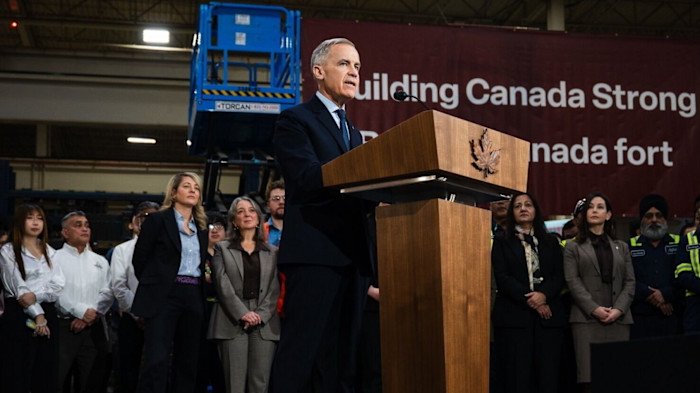
Stay informed with free updates
Simply sign up to the Energy sector myFT Digest — delivered directly to your inbox.
Canada is failing to meet its climate targets after “slackening” over the past year, an independent review found, as Prime Minister Mark Carney weakened environmental policies to boost the automotive and fossil fuel industries to counter a US trade war.
The report from the Canadian Climate Institute on Friday said the nation would not meet either the 2026 interim emissions reduction goal, the 2030 Paris Agreement commitment, or the long-term goal of achieving net zero emissions by 2050.
“The country is not on track for its targets — indeed, it has moved away from them,” it concluded.
Carney, once a champion of the green energy transition and climate finance, has been fiercely criticised by environmentalists for embracing the oil and gas sector in response to US President Donald Trump’s tariffs and rupture of relations.
Ottawa’s “slackening of policy effort over the past year, marked by the removal or weakening of climate policies across the country” is to blame, though the report does not specifically name Carney.
Since taking office in April last year, Carney has scrapped Canada’s consumer carbon tax, cut subsidies for electric vehicles and home retrofits while weakening industrial carbon pricing in a bid to woo Alberta’s oil sector.
In November, Carney signed a provisional deal to produce an extra million barrels of crude oil a day after pledging to double Canada’s liquefied natural gas production for new markets in Asia in a bid to make Canada an “energy superpower”.
The move prompted the resignation of former environment minister Steven Guilbeault from Carney’s cabinet, while two founding members of the federal government’s net zero advisory body also quit in protest.
Guilbeault told the FT on Friday that under the previous Trudeau government, in which he served, Canada was on track to reduce pollution by 36 per cent by 2030.
“This new report specifies that the ‘momentum is shifting in the wrong direction’; the government needs to pivot back to a plan that was working,” he said.
The latest data available from 2023 shows Canada ranked the worst in the G7. It made a 9 per cent reduction in emissions, while all its peers averaged a 30 per cent reduction.
The US, the second worst of the group after Canada, cut emissions by 17 per cent compared with 2005 — nearly double Canada’s rate of reduction.
Earlier this month, Carney announced a new automotive strategy aimed at defending Canada’s struggling auto industry against US tariffs. But the new policy softened emissions policy and outlines a target for 75 per cent electric vehicle adoption by 2035 rather than the previous 100 per cent mandate.
“The further Canada veers away from its climate targets, the steeper the path forward,” said Rick Smith, president of the Canadian Climate Institute. “Our assessment clearly shows that governments need to work together to put better policies in place for the country to reach its goals.”
Critical to the government’s climate policy is the yet-to-be-decided industrial carbon pricing scheme. If executed properly this “can roughly double the additional emissions reductions . . . compared to a scenario where systems largely continue as they stand today”, the report states.
Climate Capital

Where climate change meets business, markets and politics. Explore the FT’s coverage here.
Are you curious about the FT’s environmental sustainability commitments? Find out more about our science-based targets here